The 2026 Nissan Pathfinder has something that is becoming surprisingly difficult to find in a three-row SUV: a naturally aspirated V6 paired with a conventional automatic transmission. No turbocharger, no four-cylinder engine trying to do everything, and no CVT.
And folks, that combination makes a difference. This Pathfinder is smooth, predictable, and refreshingly straightforward to operate. It also has useful cargo space, an interior that does not make simple tasks complicated, and a few mechanical decisions that I really wish Nissan had handled differently.
The vehicle examined here is the Rock Creek edition, so some observations, particularly the tires, roof rack, seating configuration, and trim details, apply to this particular version. The biggest question is whether its excellent driving character outweighs the concerns hiding inside that otherwise very likable V6.
Key Takeaways
- The naturally aspirated V6 and nine-speed automatic deliver exceptionally smooth, linear power.
- The internal water pump and timing-chain history are the main mechanical concerns.
- Physical controls, comfortable second-row seating, and useful cargo space make the cabin practical.
- The Rock Creek’s aggressive tires produce noticeable road hum despite the smooth overall drive.
Table of Contents
- Under the Hood: A Lovely V6 With One Frustrating Design Choice
- The Nine-Speed Automatic Is a Major Strength
- Underneath: Mostly Sensible Hardware, With a Few Exposed Weak Points
- Rock Creek Exterior: Recognizably Nissan Without Going Too Far
- Cargo Space: Useful Room Even With the Third Row Raised
- Interior: Physical Controls and Very Little Nonsense
- How It Drives: The Powertrain Makes the Whole Vehicle
- Should You Buy the 2026 Nissan Pathfinder?
Under the Hood: A Lovely V6 With One Frustrating Design Choice
The Pathfinder uses Nissan’s 3.5-liter VQ35DD naturally aspirated V6. As manufacturers replace their six-cylinder engines with turbocharged four-cylinders, this engine feels like a little piece of the old school that is still hanging on.
That does not automatically make it better in every measurable way. Fuel economy is not its strongest selling point, and some turbocharged competitors produce more power. What I appreciate is how this engine delivers its power: smoothly, quietly, and progressively.
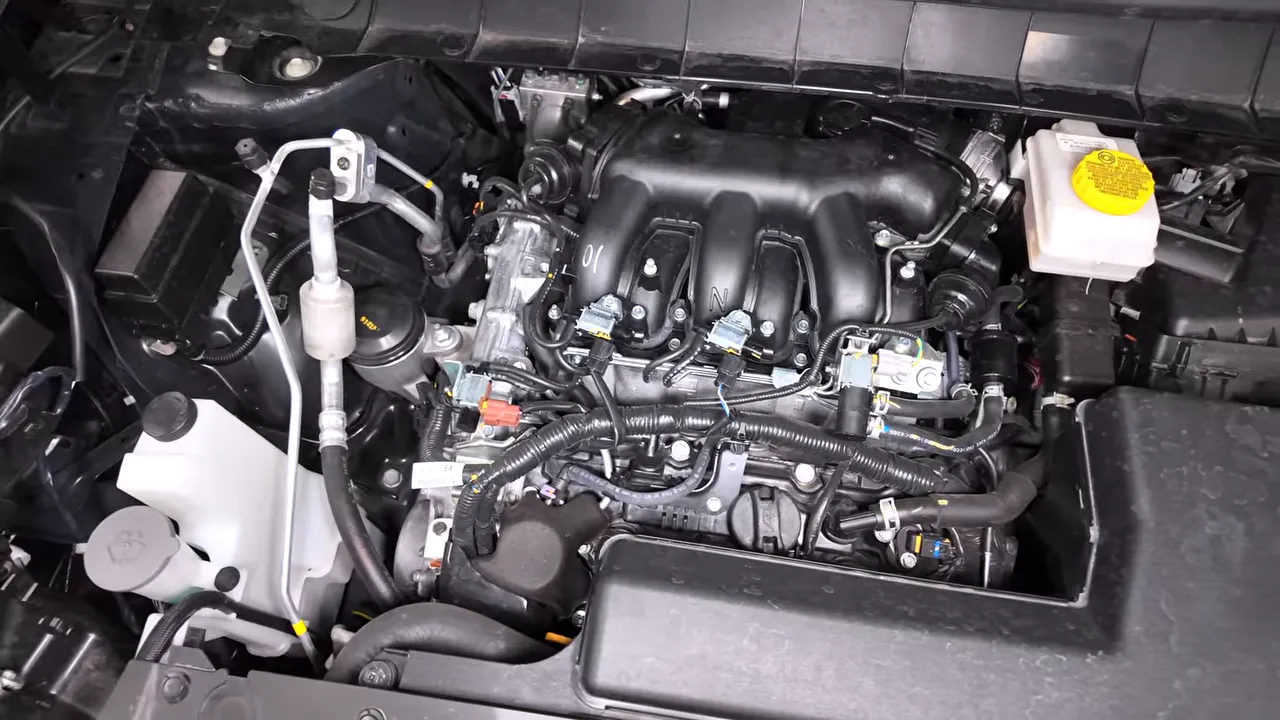
Cylinder Heads and Valve Adjustment
At the top are two plastic valve covers. Underneath, each bank has a conventional cylinder head with dual overhead camshafts, giving this engine four camshafts in total.
The valvetrain uses buckets rather than hydraulic lash adjusters. In other words, valve clearance is mechanically set instead of being automatically taken up by hydraulic lifters. The basic arrangement is straightforward, with conventional camshaft caps and relatively little complication in the heads themselves.
Two Different Types of Variable Valve Timing
The intake camshafts use electrically controlled variable valve timing. An electric motor acts through the cam timing gear:
- Running the motor faster relative to the camshaft advances the timing.
- Running it slower relative to the camshaft retards the timing.
- Matching the camshaft’s speed holds the selected timing position.
It is a clever system, and electric cam timing actuators are not something I generally see causing a great deal of trouble.
The exhaust side uses oil-controlled variable valve timing instead. Its oil control valves are not in my favorite location, but there is a useful service detail: the housings associated with the actuators and oil passages can be removed to inspect the gears when necessary.
Four Timing Chains, but a Familiar Layout
This is a timing-chain engine, not a timing-belt engine. It has four chains, which sounds more complicated than the layout really is:
- One chain drives the oil pump at the bottom.
- The main timing chain connects the crankshaft to one camshaft on each bank.
- Two smaller chains connect the paired camshafts within their respective banks.
There is nothing especially unusual about that arrangement. Other manufacturers use similar layouts.
Direct Injection Only
The fuel system is direct injection only. The injectors sit beneath the intake manifold, with a high-pressure fuel line and an accessible high-pressure fuel pump above.
Nissan fitted an insulating cover around the pump to reduce its characteristic ticking, which is a nice touch. Even so, I would prefer port injection here, or a combined port-and-direct-injection system. A naturally aspirated V6 can look traditional from the outside without being completely simple in its fuel system.
This particular vehicle also has mounting points that appear intended for an engine cover, but no cover is fitted. I cannot say whether that is specific to this example or how all of them come. Additional sound insulation would be welcome, although the engine is still much more pleasant to my ears than many four-cylinder alternatives.
The Internal Water Pump Is My Biggest Complaint
The water pump is driven by the timing chain, inside the engine’s front-cover assembly. That is the decision I struggle with most.
A water pump is a wear component. It may last a long time, but eventually it can need replacement, just like an alternator or starter. Burying it behind the timing cover turns what could have been a relatively straightforward external repair into a substantial operation.
There appears to be enough room around this engine that I would much rather see an externally mounted pump, whether mechanically or electrically driven. Instead, servicing the pump means opening the engine.
The front-cover arrangement has two layers: a rearward cover that forms part of the timing assembly’s structure, and an outer cover over the chains. Water-pump and chain access requires removal of the outer cover. More extensive work, such as cylinder-head removal, also involves the rearward cover.
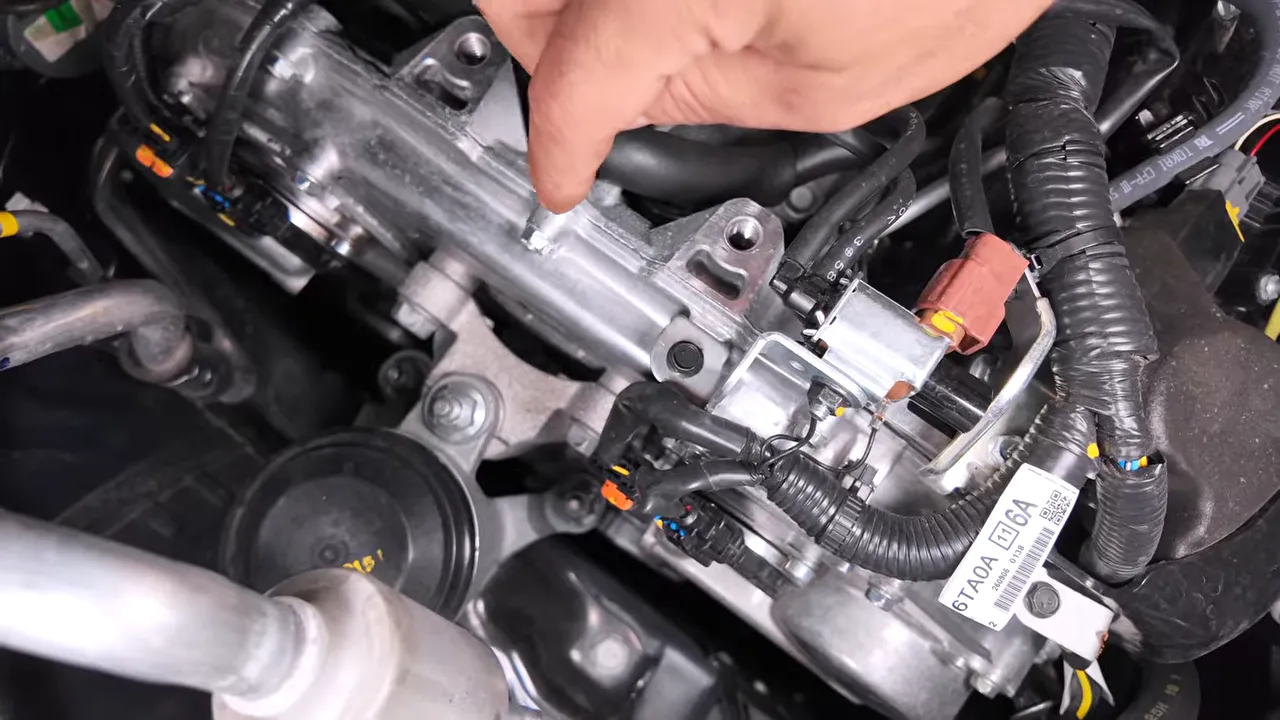
There is one important clarification: the water pump can be serviced with the engine still in the vehicle. This is not automatically an engine-out repair. But it is still a large job.
Then there is the timing-chain history. Earlier iterations of this engine family had chain problems, including stretching. Reports appear to have become less common, but I am not comfortable treating the concern as completely gone.
If the engine is already open for a water pump, the condition of the chains becomes part of the conversation. Replacing a timing-chain set while access is available can push the total bill much higher than an external water-pump replacement would have been.
That is the contradiction here. I really like this engine, but the component that makes the Pathfinder so appealing also contains its most important repair-cost concern.
General Build Quality and Routine Access
Much of what is visible under the hood is encouraging. The hoses use proper hose-and-clamp connections rather than an excessive collection of plastic-to-plastic fittings. The plastic valve covers feel substantial, and there is aluminum in the lower intake-manifold assembly beneath the upper plenum.
There is also more working room around the engine than the initial appearance suggests. Spark-plug replacement requires removal of the intake plenum, but that is familiar transverse-V6 work rather than something exceptionally difficult.
The Nine-Speed Automatic Is a Major Strength
The V6 is paired with a nine-speed automatic transmission. There is no CVT here, and that is very good news for how the Pathfinder feels on the road.
The transmission complements the engine beautifully. Power delivery is linear, shifts are smooth, and I do not get the constant sense that the transmission is stopping to think about which gear it wants.
This is not just about having six cylinders. It is about how the engine and transmission work together. Nissan has put together a powertrain that feels relaxed and well matched to a family SUV.
Underneath: Mostly Sensible Hardware, With a Few Exposed Weak Points
The Pathfinder’s underside is somewhat old school. There are smaller protective panels rather than a completely enclosed underbody, with an opening through the middle for the exhaust.
Oil-Service Access and Exhaust Construction
The engine has a steel oil pan, which I like. The oil filter is nearby, although the surrounding covers have to be dealt with for access.
The drain-plug position makes me wonder how neatly the oil clears the subframe during a service. A small clearance cutout might have helped. That is an observation about the layout, not a confirmed finding that every oil change makes a mess.
Exhaust construction is generally acceptable. The paired front flex sections are not my favorite arrangement, but the catalytic-converter construction looks good.
Front Suspension and Brakes
At the front, the Pathfinder uses:
- Dual-piston brake calipers.
- Aluminum lower control arms with integrated ball joints.
- Aluminum steering knuckles.
- MacPherson struts.
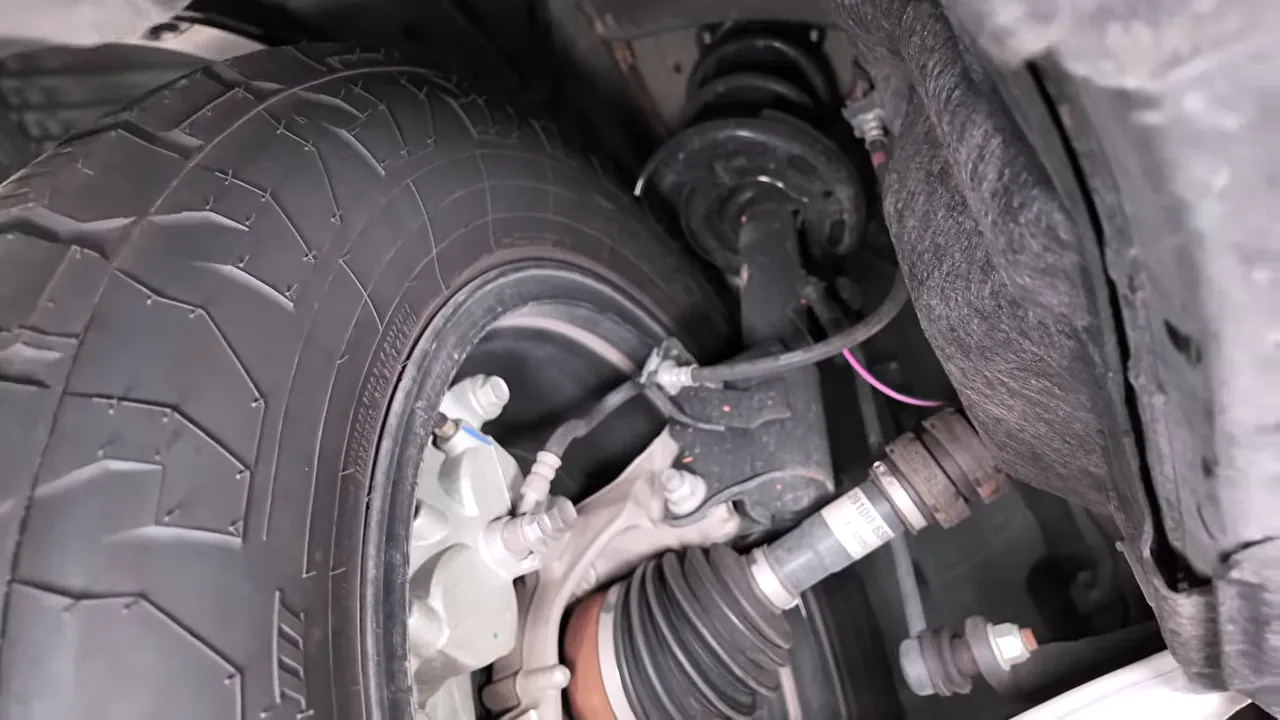
The sway-bar links appear metallic externally, although I would not make a firm claim about their internal construction based on appearance alone.
Driveline and Rear Suspension
This four-wheel-drive example has a transfer assembly and a propeller shaft running to a compact rear differential with a disconnect mechanism. There is also a shield near the front driveline that appears intended to protect it from catalytic-converter heat.
The fuel tank sits to one side rather than using a saddle-shaped arrangement around the shaft. The rear axle shafts are painted through their middle sections but not at the ends, a detail that has become fairly common.
At the rear, the suspension combines a large aluminum upper control arm with steel lower arms. The shock absorbers are separate from the coil springs, the knuckles are aluminum, and the single-piston rear brake calipers incorporate the parking brake.
There is also an actual spare tire mounted underneath. That is something I am always happy to find.
Why Are the Rear A/C Lines So Exposed?
The rear air-conditioning lines are routed close to an area where the tire can throw water, dirt, and road debris at them.
This is not a Nissan-only complaint. Many manufacturers do it, and I do not understand why a small protective cover is considered too much to ask. Debris can accumulate around these lines, and a leak later creates a much bigger repair problem.
The rear bodywork does close off some otherwise open areas, and there is shielding around part of the exhaust. I simply wish the same attention had been given to protecting those A/C lines.
Rock Creek Exterior: Recognizably Nissan Without Going Too Far
I like the way this Pathfinder looks. It is recognizably Nissan, and most of the styling is restrained enough to work well.
The grille and the three openings above it are a little busy for my taste, but the overall shape is attractive. The slim upper daytime running lights are separated visually from the main lighting elements below.
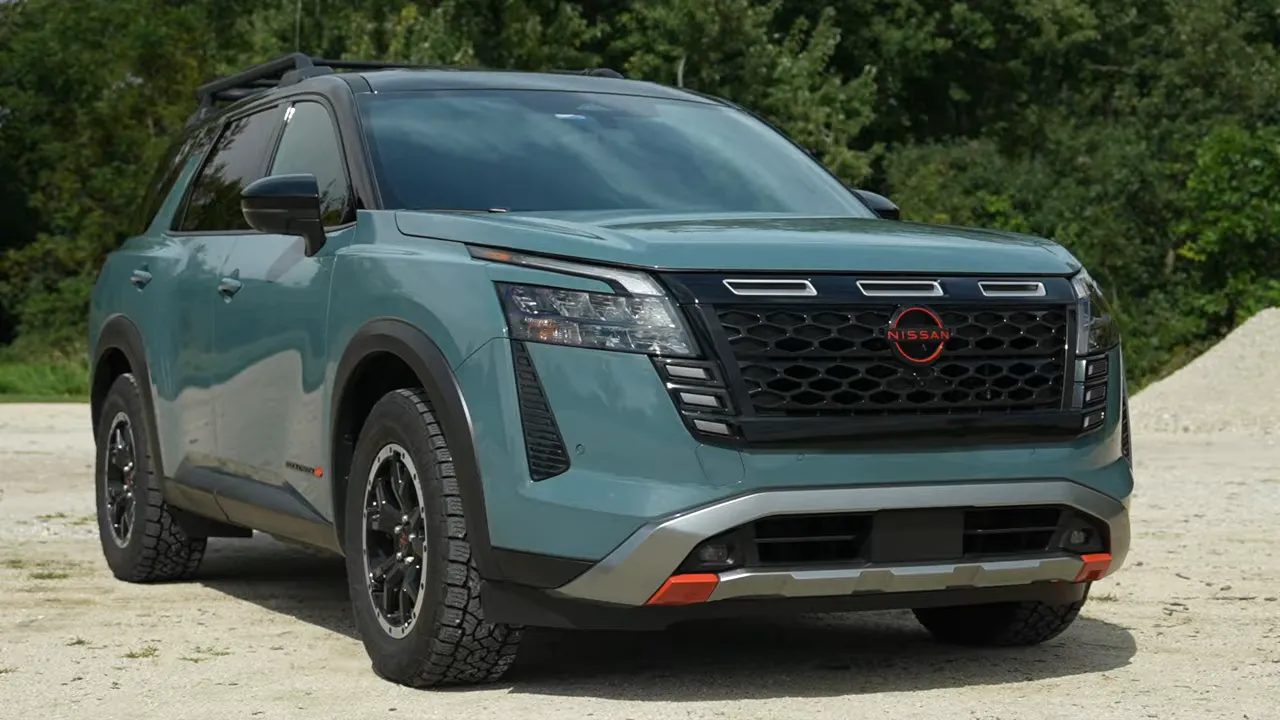
The Rock Creek adds its own wheels, aggressive tires, contrasting accents, and badges with an orange mountain detail. Unpainted wheel-arch cladding fits the intended character, even if it is not everyone’s preference.
Some of the exterior’s most useful details are less obvious:
- Front-door entry buttons: Locking and unlocking use physical buttons on the front handles. Simple, although the response feels a little old-fashioned.
- Wide-opening rear doors: The rear doors open to nearly 90 degrees, which is genuinely useful.
- A lower side-window line: The beltline dips below the hood line, although the rising door shape partly reduces that effect.
- A substantial Rock Creek roof rack: Its rear opening provides clearance around the shark-fin antenna.
The rear styling works well, too. I like the large Pathfinder lettering, the contrasting Nissan emblem, and the fact that the badge says “4WD.” That badge is a styling observation, however, not a reason to confuse this vehicle with the old body-on-frame Pathfinder.
Cargo Space: Useful Room Even With the Third Row Raised
From the outside, the Pathfinder does not look enormous. That makes the space behind the third row a pleasant surprise.
I own a 2023 Lexus GX 460, and the Pathfinder’s usable space behind its raised third row makes me a little jealous. For a family vehicle, keeping luggage room while all the seats are in use matters.
This example has a powered liftgate with two powered supports. Their wiring routes into the roof/headliner area rather than simply hanging exposed at the cargo opening.
Beneath the cargo floor is additional storage, with a removable panel providing access to the spare-tire tools.
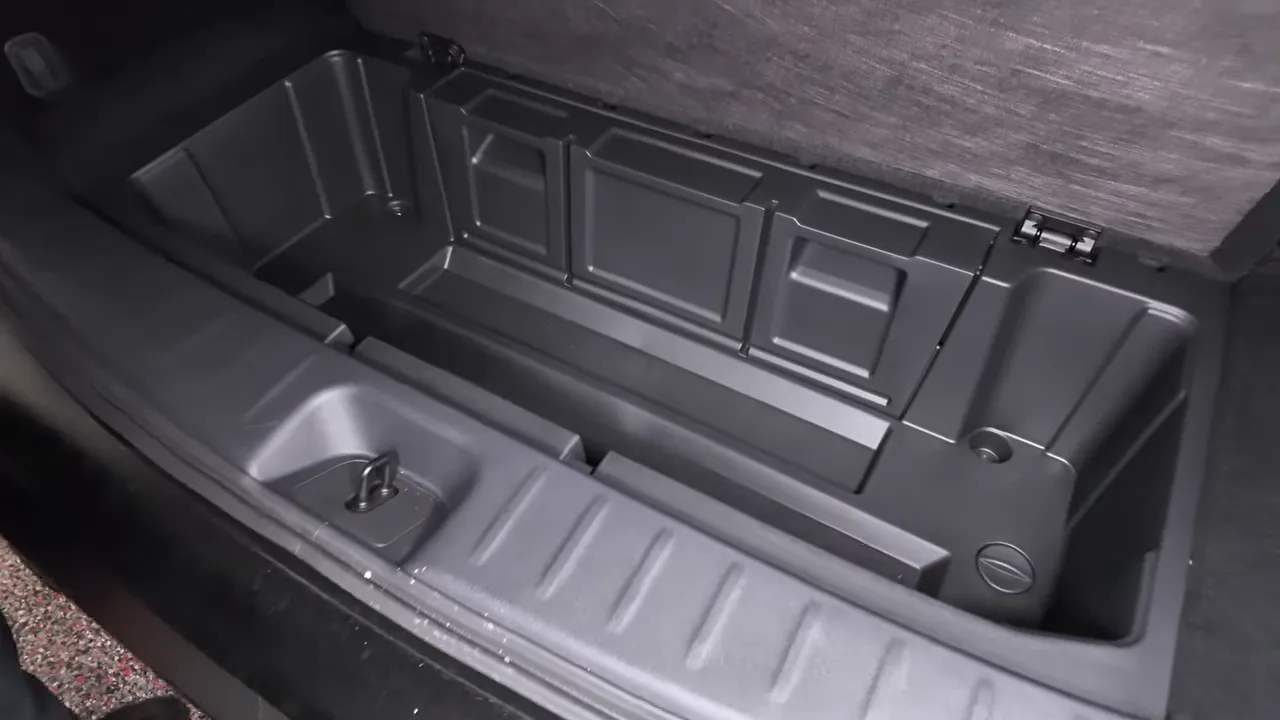
The third-row seats fold manually using handles on their backs. The small annoyance is that the head restraints do not fold automatically when you release the seatbacks. You fold them separately, then lower the seats.
It is not difficult. I just wish Nissan had linked those actions together. Raising the seats is straightforward: pull the straps and bring the seatbacks upright.
Interior: Physical Controls and Very Little Nonsense
The interior is basic in the best sense of the word. It has modern conveniences, but it does not turn every interaction into a demonstration of technology.
The steering-wheel controls are clearly laid out. The instrument cluster uses two conventional dials with a smaller display between them, and I think it looks elegant.
Most importantly, the climate controls are physical and have their own dedicated display. You do not have to interrupt the infotainment system to make a simple temperature adjustment.
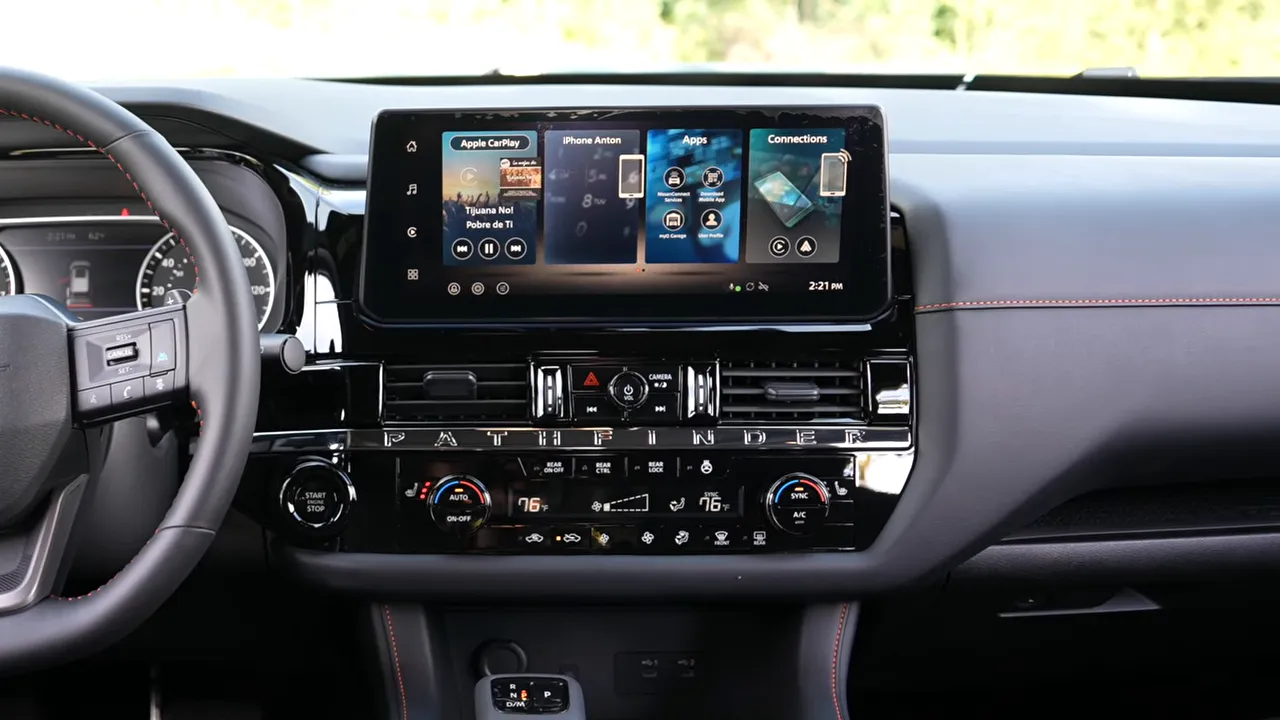
The infotainment screen is not enormous, but it is large enough and works well. Physical volume and track controls remain underneath it.
The electronic shifter is unusual. It is probably the most gimmicky part of the cabin, but it is not so strange that I would expect it to take long to learn.
Storage and Materials Are Well Judged
The center console offers several useful spaces: a place to stand a phone where its screen remains visible, a conveniently positioned wireless charger, a reasonably large console compartment, and open storage beneath the console. There is also a small passenger-side shelf.
Soft-touch materials remain across much of the upper cabin, and the harder plastics generally feel solid rather than flimsy.
Fit and finish is not flawless. The headliner, in particular, raises a few concerns when you look closely. Still, the overall impression is good.
My other complaint is the badging. From the driver’s seat, I can find Pathfinder branding in four places, including the trim, passenger storage area, and floor mats. The small chrome-style nameplate looks nice. The rest feels excessive. We have found our path, folks. We do not need another reminder every few seconds.
Second Row: Comfortable, With a Console I Could Do Without
At 5 feet 7 inches tall, sitting behind my own driving position, I find the second row comfortable.
This Rock Creek has captain’s chairs with a removable center console. I am not a fan of these little consoles because they occupy the very passage that makes captain’s chairs appealing. At least this one can be removed, and the floor is flat.
Equipment in this example includes rear climate controls, USB-C ports low on the console, and roof-mounted air vents. Built-in rear window shades would have been welcome, especially when some competitors offer them.
The rear door storage is an interesting detail. Its two round drink recesses project into the cabin a little, but that projection also creates a broad platform for a phone or other small items. There is a useful tradeoff there.
Third Row: Mainly for Children
The third row is much less comfortable for me. An adult can sit there, especially with some adjustment of the second-row seat, but I would primarily treat it as children’s seating.
There are storage areas and an air vent back there, which is good. More importantly, using the third row does not eliminate the cargo area behind it. That combination makes the Pathfinder practical even though the last row is not an adult lounge.
How It Drives: The Powertrain Makes the Whole Vehicle
The Rock Creek’s aggressive tires hum on the road. That is the compromise you hear with this particular off-road-oriented setup.
Yet even with the tire noise, the Pathfinder is a very smooth vehicle. It rolls down the road comfortably, does not feel excessively large to maneuver, and delivers power without fuss.
This is why the V6 matters so much to me. A turbocharged four-cylinder may have a stronger output figure, but that does not necessarily recreate the refinement or linear response of this engine.
In that respect, the Pathfinder can even feel more satisfying than the more expensive Infiniti alternatives I have driven without this V6. Premium materials are nice, but they cannot completely substitute for a powertrain that feels right.
Should You Buy the 2026 Nissan Pathfinder?
I still have a soft spot for the old body-on-frame Pathfinder. I would love to see that type of vehicle return as a rival to the 4Runner and Prado. But judging this Pathfinder for what it actually is, rather than what its name used to represent, there is a lot to like.
It deserves serious consideration if you want a smooth three-row family SUV with straightforward controls and useful cargo room. It does not feel massive, the second row is comfortable, and the cabin largely avoids unnecessary complication.
But do not buy it on the assumption that an old-school V6 automatically guarantees trouble-free ownership. My main reservations are concentrated in the engine:
- The direct-injection-only fuel system is not my preferred arrangement.
- The internal, chain-driven water pump makes replacement unnecessarily labor intensive.
- The engine family’s timing-chain history remains a point to consider, even though reports have diminished.
These are design and serviceability concerns, not proof that a particular 2026 Pathfinder will suffer a failure. For vehicle-specific safety information, check the VIN through the NHTSA recall lookup rather than treating a general review as an individual vehicle’s history.
For the Rock Creek specifically, make sure you are comfortable with the tire hum. It is a noticeable tradeoff, even though it does not spoil the excellent powertrain refinement.
My conclusion is simple: the 2026 Nissan Pathfinder is a strong contender, with a wonderful driving character and a few meaningful mechanical cautions. I wish Nissan had made the water pump easier to service. I wish the timing-chain concern were completely behind this engine. But every time that V6 and nine-speed automatic work together, it is easy to remember why I like this SUV so much.


