The 2026 Dodge Charger is one of the best-looking cars I have reviewed this year. Not just among sedans. Among cars, period. Dodge took the Charger’s heritage seriously, and the result looks mean, distinctive, and unmistakably Mopar.
Then you start it, drive it, and open the hood. That is where a very simple love affair becomes a much more complicated conversation.
The gasoline-powered Charger Scat Pack has a 550-horsepower twin-turbo inline-six, all-wheel drive, a beautiful interior, and genuinely useful hatchback practicality. But it also has a crowded engine compartment, a rough ride, some frustrating design decisions, and an exhaust note that does not deliver the character its appearance promises.
This is not a question of whether six cylinders can make enough power. They absolutely can. The question is whether this particular combination makes a convincing Charger, especially at the asking price.
Quick Summary
- The 550-horsepower Hurricane delivers serious output, but its exhaust lacks the traditional Charger character I want.
- Crowded engine packaging and extensive plastic plumbing raise concerns about future repair access and aging.
- Retro styling, a distinctive cabin, excellent Uconnect, and hatchback practicality are the Charger’s strongest qualities.
- A harsh ride and substantial asking price make the Scat Pack harder to recommend than admire.
Table of Contents
- Under the Hood: What the Charger Sixpack Actually Is
- Serviceability and Long-Term Reliability Concerns
- Underneath the Charger: Suspension, Brakes, and All-Wheel Drive
- Exterior Design: Dodge Got This Part Absolutely Right
- Hatchback Practicality Is a Major Strength
- Interior: Beautiful Design, Excellent Uconnect, and Some Odd Decisions
- Rear-Seat Space and Electronic Door-Release Concerns
- How It Drives: Big Power, Harsh Ride, Mixed Character
- The Charger’s Identity Problem Is Not About Horsepower
- Price and Verdict: Should You Buy the 2026 Dodge Charger?
Under the Hood: What the Charger Sixpack Actually Is
The new Charger lineup includes gasoline and electric configurations. The electric model carries the Daytona name, while the gasoline models use the Sixpack designation. This review focuses on the gasoline-powered, four-door Scat Pack we tested, not the electric Daytona.
Under the hood is the 3.0-liter Hurricane twin-turbocharged inline-six. There are standard-output and high-output versions, depending on the model. Our Scat Pack has the high-output engine producing 550 horsepower.
The basic architecture is shared between the two versions, but the fueling system and some internal details deserve a closer look.
Engine construction and the unusually busy cylinder head
At the top is a tall plastic valve cover. The direct-injection fuel rail and injector connections occupy the top of the engine, with the ignition coils positioned slightly off to the side. This is one of those layouts that immediately makes me think about how much must come apart for future repairs.
Below that is a single-piece aluminum cylinder head with roller rockers, hydraulic lifters, and two overhead camshafts. Both cams have oil-controlled variable valve timing.
Interestingly, the variable valve timing oil-control valves sit on the valve cover rather than in the more familiar front-cover location. The cover is tall enough to accommodate that arrangement. Removing it is a substantial process, but once it is off, the camshafts are exposed rather than remaining enclosed behind a tall front cover.
The engine uses an aluminum block and a steel crankshaft. The high-output version’s construction includes forged-steel connecting rods with fracture-split, matched caps, graphite-coated aluminum pistons, and ultra-low-friction piston rings.
That last description makes the mechanic in me raise an eyebrow. We already have enough conversations about low-friction rings. Now we have ultra-low-friction rings. That is a design choice I would keep in mind for long-term ownership, not evidence by itself that this engine will develop a particular problem.
Why this engine has a third camshaft
The Hurricane has two camshafts operating the valves, but there is also a third shaft lower in the engine that drives the high-pressure fuel pumps on the high-output version.
The timing arrangement works in stages:
- A chain connects the two overhead camshafts to the third shaft’s sprocket.
- Another chain connects that intermediate sprocket to the crankshaft.
- The oil pump sits at the bottom and is driven by the crankshaft.
The standard-output engine has one high-pressure fuel pump. The high-output engine has two. Both versions use direct injection only, with six injectors.
Those high-pressure pumps are buried in this installation. You can follow their fuel lines, but you cannot simply look down and find two conveniently accessible pumps sitting on top of the engine. It works, but I would have preferred a simpler, more service-friendly arrangement.
Twin turbos and liquid-to-air intercooling
The two turbochargers use oil and coolant cooling and have electronic wastegates. Access is tight. The same engine can look relatively approachable in a larger vehicle such as a Grand Wagoneer, but that is not the situation here.
The charge-air path is worth understanding because it explains much of the plumbing:
- Air enters through the air-filter housing.
- The intake splits to feed both turbochargers.
- The two compressed-air outlets merge.
- The compressed air passes through a liquid-to-air intercooler.
- The cooled charge then travels through the throttle body and intake into the engine.
Instead of sending compressed air through a conventional air-to-air intercooler at the front of the car, this system transfers heat into a separate coolant circuit. There are advantages to that arrangement, but it adds pumps, hoses, and connections to an already crowded engine bay.
Two cooling circuits, but a fairly conventional engine cooling system
The main engine cooling circuit is refreshingly ordinary. It has a belt-driven mechanical water pump and a thermostat, without an elaborate coolant-distribution valve arrangement.
The second circuit uses an electric water pump to circulate coolant through the intercooler and turbocharger cooling system. Electric circulation also allows cooling without depending on the engine’s belt-driven pump.
The reservoirs on our car contained visibly different-colored coolant, including a purple coolant. I would not assume from color alone that they require different chemistry, or that they are interchangeable. The visual difference is clear; the exact service specification is what matters.
Serviceability and Long-Term Reliability Concerns
Stand over this engine compartment and ask yourself one question: does this look enjoyable to work on?
Not particularly.
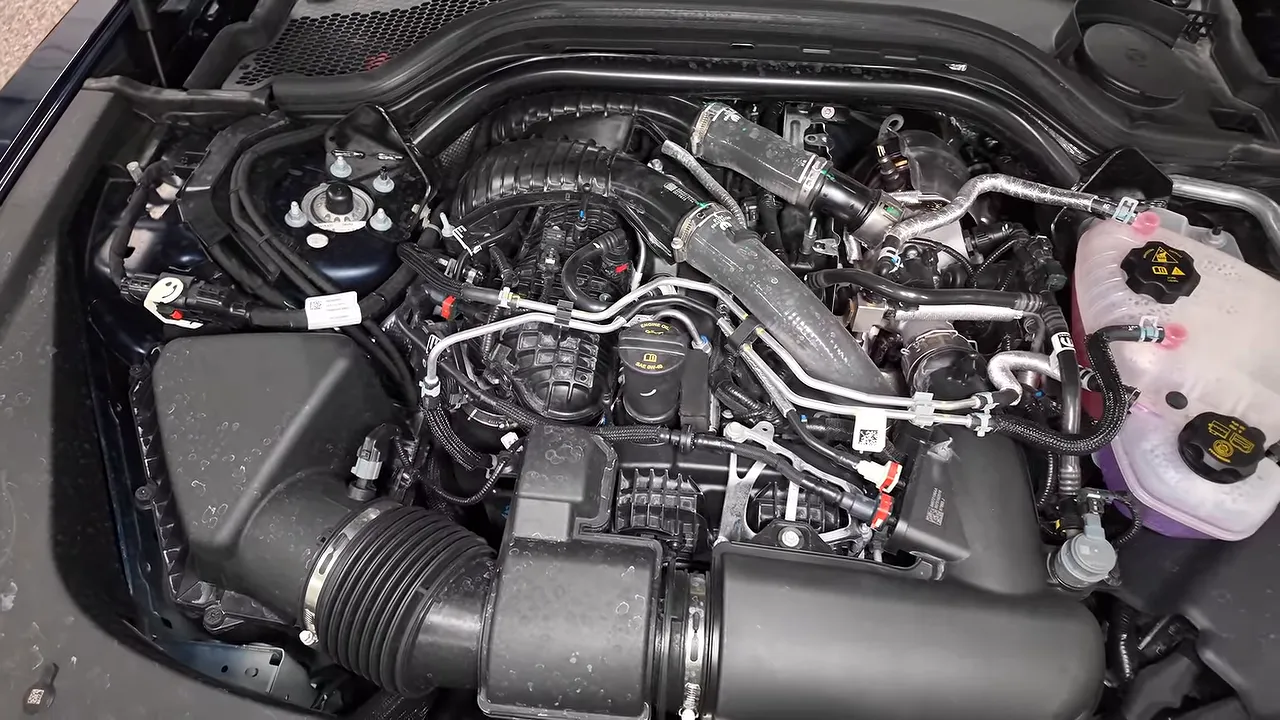
The engine sits far back, with part of it tucked beneath the cowl. Above it is a network of intake pipes, fuel lines, wiring, and plastic hoses. An inline-six sounds like it should simplify things compared with a V8, but cylinder count does not tell you how accessible an installed engine will be.
The amount of plastic plumbing is what concerns me most. Some components look nicely made, including portions of the metal pipework. There are also conventional rubber hoses secured with clamps to steel pipes, which I like very much.
A hose and clamp is straightforward. A plastic connector adds another component whose condition matters as the car ages. The plastic PCV hose is another example of something I would be paying attention to years down the road.
These are concerns about aging materials, repair access, and future ownership costs. They are not a demonstrated long-term failure record for this particular Charger.
There is some genuinely good maintenance access
To be fair, not everything under here is difficult.
- Front-mounted timing chains: The timing system is at the front of the engine, and the front cover can be removed with the engine still in the car.
- Space behind the intake ducting: The engine bay looks completely packed, but removing the large front intake components reveals useful working room.
- Accessible accessory belt: The belt arrangement is relatively simple and drives the alternator, air-conditioning compressor, and mechanical water pump, with a small tensioner.
- Oil-service openings: The front underbody panels include access for the oil filter and drain plug.
That matters. A complicated engine is easier to live with when at least some major service operations do not require removing it.
Underneath the Charger: Suspension, Brakes, and All-Wheel Drive
The Charger is built around a rear-wheel-drive layout with all-wheel drive added to it. That distinction becomes obvious once the car is on a lift.
Front suspension and brakes
The front suspension uses an upper wishbone and two lower links, with extensive aluminum construction, including the steering knuckle. The ball joints are incorporated into the control arms.
There is a substantial sway-bar link, and the lower damper mounting arrangement arches over the front axle. The dampers on our test car are conventional, non-adjustable units rather than adaptive shocks.
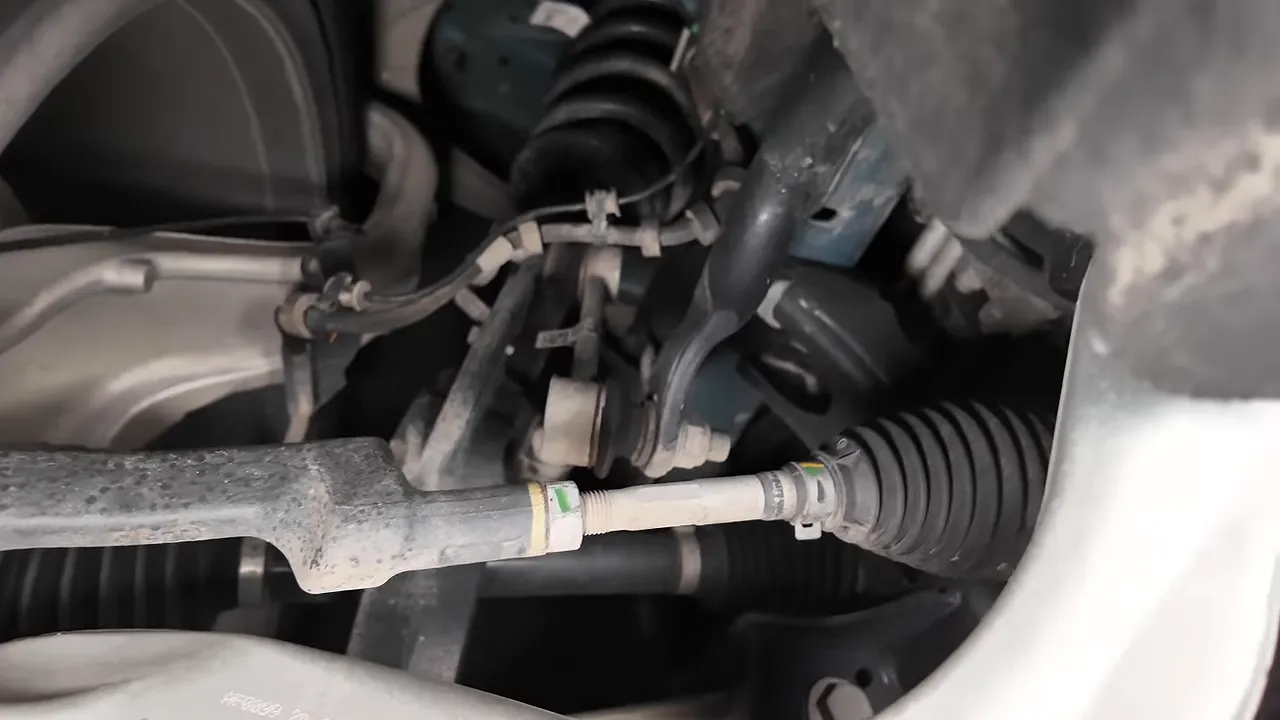
The front axle ends have a painted finish, which is a nice detail. The Scat Pack’s front brakes are substantial too, with six-piston Brembo calipers.
My cosmetic complaint is almost silly, but on a car with this much personality, details matter. The calipers simply say Brembo. A Dodge-specific marking would have made them feel more special. The hardware itself is not the issue.
How the all-wheel-drive system is packaged
The transfer case sits behind the eight-speed transmission. A forward-running driveshaft carries power to the front differential, and the passenger-side axle passes through the oil-pan area to reach the opposite wheel.
At the rear is a large differential. The car also offers a selectable rear-wheel-drive mode that leaves propulsion to the rear wheels. That is a welcome feature in something carrying the Charger name.
The ZF transmission has a plastic pan with an unusual protruding section and a plastic drain plug. Its one-time-use service components are another reminder that a transmission fluid service involves more than simply draining and refilling oil.
Some underbody details leave questions
The exhaust takes a pronounced detour around the transmission mount. It is an interesting packaging solution, although not an especially direct one.
The rear driveshaft also appears to change its lateral angle around an offset center mounting point. That caught my attention. I would want a better explanation of the intended joint geometry before calling it a defect, but it is not the arrangement I expected to see.
Another detail is a suspension attachment that uses a small integrated threaded section in a casting rather than a separate, conventional-looking nut. Again, it is an observation about the design, not proof that the attachment is inadequate.
Farther back, there is a saddle-style fuel tank and some surprisingly open spaces around the underbody packaging.
Rear suspension and exhaust construction
The rear suspension has a large lower control arm, a spring mounted separately from the shock absorber, and upper links using a mixture of steel and aluminum.
The rear brakes use large discs with single-piston calipers and integrated electronic parking brakes. The exhaust feeds two rear mufflers, each with a valve.
Here is the funny part: although I do not like the exhaust sound, I do like the apparent quality of the exhaust construction. The pipework and overall execution look nicely made. Good construction and good sound are two different things.
Exterior Design: Dodge Got This Part Absolutely Right
Modern cars are starting to look like a very large herd of sheep. This Charger is not interested in joining that herd.
It has a flat, recessed front treatment, a raised hood, classic Charger proportions, and a rear end that immediately tells you what it is. The styling follows the car’s heritage rather than whatever the rest of the industry happens to be doing.
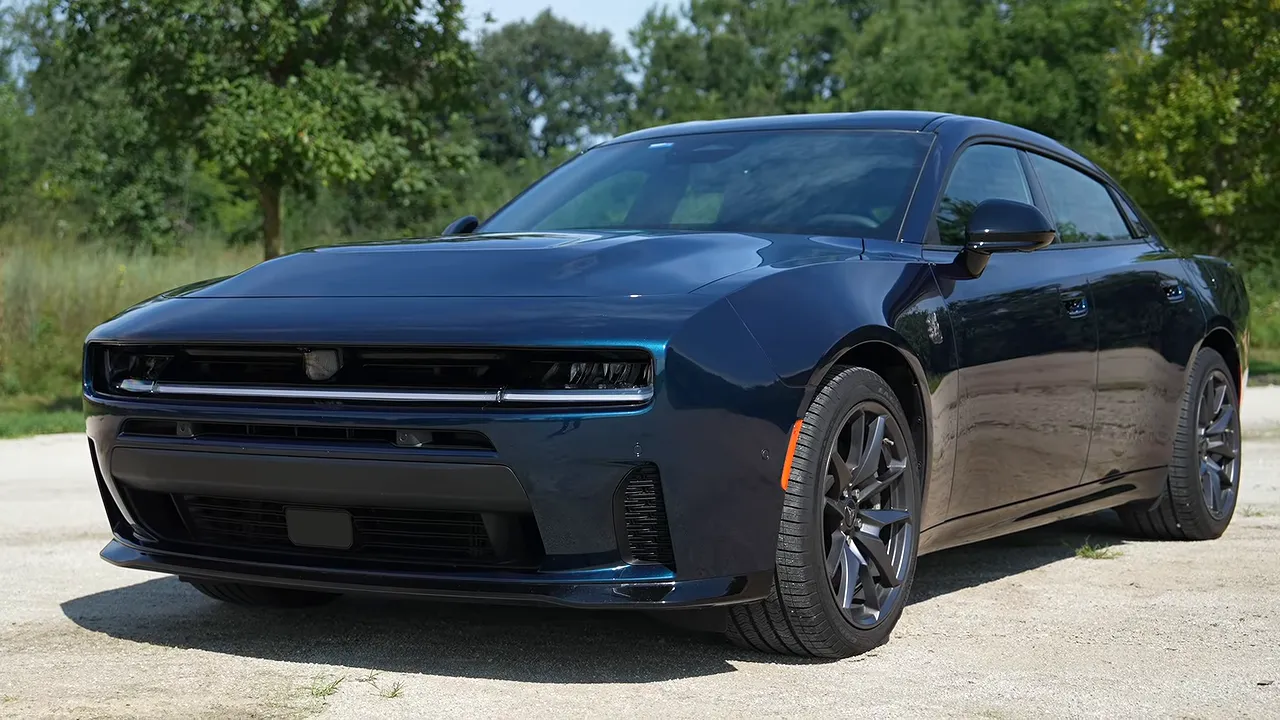
The front fascia has the depth and framing that make the old-school Mopar references work. The radar sensor sits low, keeping it from dominating the face. The hood’s raised center and Sixpack identification add character without making the whole thing look cluttered.
From the side, the connection to classic Chargers is just as strong. And leave it to Dodge to make a Scat Pack badge that is more entertaining than most manufacturers’ entire trim packages.
The rear may be my favorite angle. There is a broad horizontal ledge, a clean lighting treatment, a Dodge emblem, and Charger lettering incorporated into the bumper area. It does not need a paragraph of trim, power-output, and drivetrain badges across the hatch.
Even the roof has deliberate sculpting, with recessed sections and lines that widen as they run back toward the antenna. It is not simply a flat panel connecting the windshield to the rear glass.
For exterior appearance, I would take this over the previous Charger. Dodge understood the assignment.
Electronic handles and rear windows are less convincing
The doors use electronic releases, with a button to open them and a separate physical lock button. It feels unnecessarily complicated for this kind of car.
The frameless door glass looks good, but the rear windows only lower partway. Not almost all the way. A noticeable amount remains above the door.
Usually, limited window travel is easy to understand because the wheel arch cuts into a small door. Here, the rear door is large enough that the limitation feels more disappointing. Whatever the internal packaging explanation, the result is not ideal.
Hatchback Practicality Is a Major Strength
One of the best surprises is that the rear opening is a hatch, not a conventional small trunk lid. Open it and there is a large cargo area, with folding rear seats providing more room.
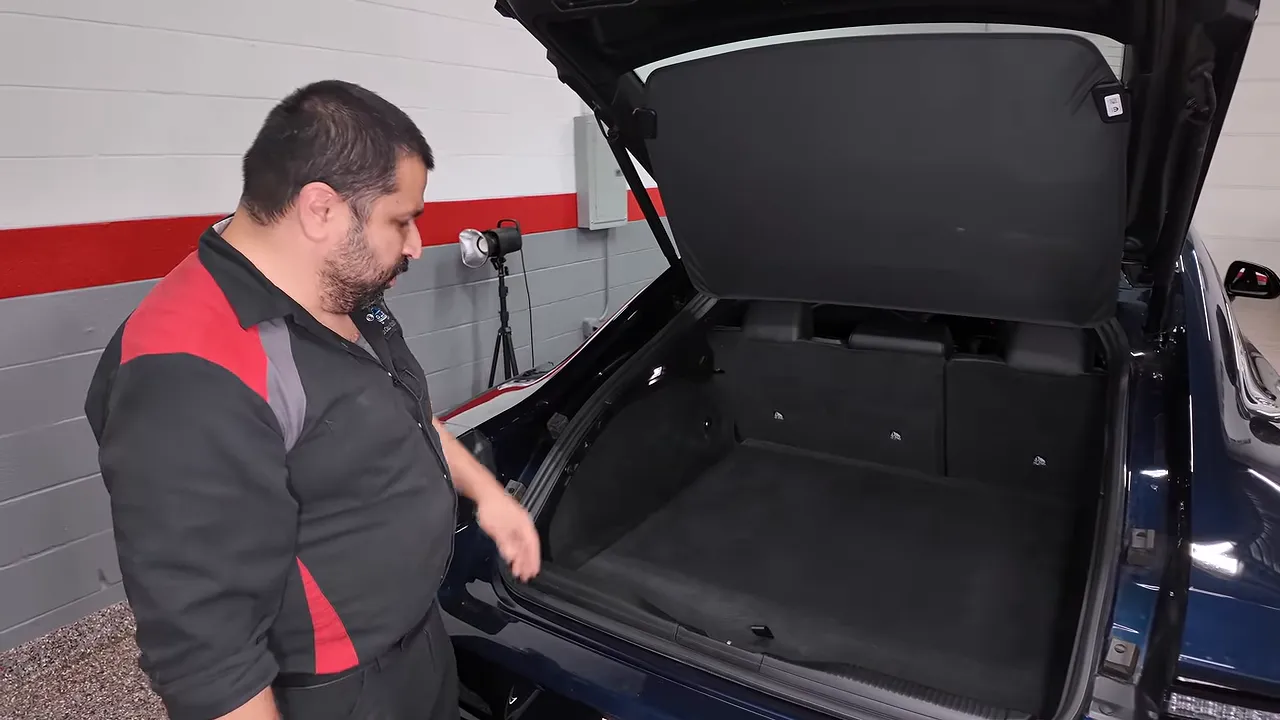
Underfloor storage is much less generous. There is no spare tire in the inspected car. Instead, that area contains a subwoofer, a fuse block, and a small auxiliary battery. That small battery is not the main vehicle battery.
The powered hatch uses two motors. I like that their wiring routes into the hatch in a way that appears more sensible for replacement, rather than forcing unnecessary disassembly deep into the body.
Some of the cargo-cover trim feels flimsy, but the main point remains: this is a striking performance car with a genuinely useful rear opening and cargo area. That combination deserves credit.
Interior: Beautiful Design, Excellent Uconnect, and Some Odd Decisions
The cabin carries the exterior’s retro inspiration forward without looking like an old dashboard with a screen attached.
There is a layered, double-deck design, patterned door trim that visually continues into the dashboard, Charger lettering, and ambient lighting that emphasizes the shapes. It is dramatic, occasionally almost cartoonish, yet somehow sophisticated.
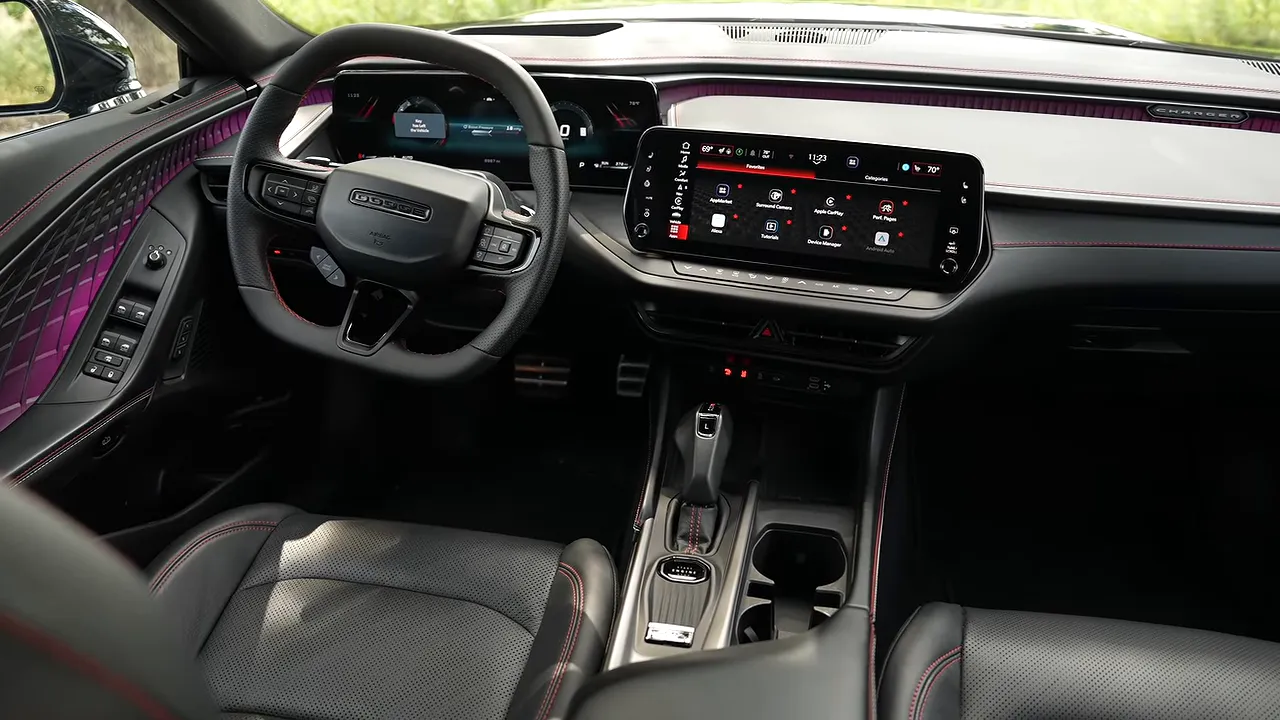
I do not often put Charger and sophisticated in the same sentence. Here, it works.
Digital instruments and steering-wheel controls
The instrument cluster is a large, customizable screen. The problem is that the steering wheel can obscure the upper corners and sometimes the sides, depending on the driving position.
The wheel itself feels nice, but its unusual shape may not be everybody’s preference during more involved driving. The shift paddles are also smaller than I would like. Reach slightly wrong and you can hit the audio controls behind them instead, changing a track or adjusting the volume when you intended to change gear.
A larger paddle would make more sense in a car with this mission. Having the drive-mode control on the steering wheel, however, is a good decision.
Uconnect is a highlight
The Uconnect infotainment system is excellent. It is quick, responsive, and does what you ask without making the process feel like work.
Below the display are separate capacitive climate controls. They are not traditional mechanical buttons, but at least the basic climate functions are not all buried inside the touchscreen.
Then there is the ambient-lighting menu, which Dodge calls Attitude Adjustment. Of course it does. In this interior, that name feels entirely appropriate.
Shifter and console ergonomics need work
The pistol-grip-style shifter looks right, but it is an electronic selector. Its action feels light and disconnected. A little more weight would have helped the interaction match the appearance.
The start button and electronic parking brake sit nearby. The center-console lid opens sideways, but only one way, making access awkward for the passenger.
What was wrong with a lid that opens toward the back? Or a side-opening arrangement that works from either side? This feels like a complication without much benefit.
Rear-Seat Space and Electronic Door-Release Concerns
For such a large car, the rear seat is merely okay.
I am 5 feet 7 inches tall. Sitting behind my own driving position, I had decent knee room, but my thighs were angled upward and headroom was limited. The exterior dimensions create expectations that the rear seating position does not fully meet.
The hard plastic on the front seatbacks also makes the cost-cutting obvious. I understand that manufacturers have to make choices, but on a roughly $66,000 test car, I would prefer those choices to be less apparent.
Our car did have heated outboard rear seats and rear climate controls, which are welcome.
Why I would prefer a mechanical rear-door release
The front doors have mechanical emergency releases. The rear doors use electronic release buttons, with a charged capacitor intended to provide a limited number of operations if normal electrical power is lost.
That backup is useful, but it does not answer every question. What if the stored charge is exhausted? What if the capacitor itself has a problem? What if the electronic latch fails?
I would much rather have a straightforward mechanical emergency release in the rear as well as the front.
For prospective owners, understanding emergency-release operation should be part of getting familiar with the car. The NHTSA recall lookup is also a useful independent resource when checking a specific vehicle’s open safety recalls before purchase.
How It Drives: Big Power, Harsh Ride, Mixed Character
The sporty front seats are firm but reasonably comfortable. The suspension is another matter.
Our Scat Pack rode roughly enough to feel jarring. That suggests Dodge is aiming for a more serious sports sedan, but the handling does not fully justify the ride penalty.
The test car had 305-section tires at all four corners. Even with that much tire, it felt heavy rather than especially athletic. For a Charger, its handling is impressive. Against the expectations of a dedicated sports car, it is not a standout.
The same applies to the sense of acceleration. There is no shortage of rated power, but it did not feel as forceful as I expected from 550 horsepower. The car’s mass is difficult to ignore.
The eight-speed ZF is better going up than coming down
The eight-speed ZF automatic can deliver very quick upshifts. Downshifts were less satisfying, sometimes feeling lazy when I wanted a more immediate response.
Our particular car also had some clunky behavior. I suspect it may have lived a hard life, so I would not automatically apply every rough shift from this example to the entire lineup.
Still, the overall impression was mixed: good upshifts, less decisive downshifts, and a drivetrain that did not always make the car feel as eager as its power rating suggests.
The exhaust sound is the biggest emotional disappointment
I can accept an inline-six. I can respect the engineering and acknowledge the power. But I do not like how this particular Charger sounds during ordinary use.
At startup and lower engine speeds, the exhaust has an unpleasant, aftermarket-like quality to my ears. It is loud, but loud is not automatically exciting.
Above roughly 3,000 to 4,000 rpm, the inline-six develops a more appealing scream. There is a good sound in there. The trouble is that everyday driving does not happen entirely in that part of the rev range.
A V8 Charger’s burble was part of the experience even when you were barely asking anything of it. This engine delivers the numbers, but the exhaust does not replace that sense of occasion.
The Charger’s Identity Problem Is Not About Horsepower
The Hurricane makes more power than many of the V8s associated with the Charger name. Apart from the extreme supercharged versions, 550 horsepower is a serious number in this family.
So when I say this car needs a V8 option, I am not asking for one because the inline-six cannot perform.
I am asking because this is a heritage car. Its appearance promises a certain kind of experience: a mean-looking American car, big straight-line performance, and a V8 soundtrack that makes its imperfections feel like part of the charm.
This new Charger looks more committed to that identity than ever. Mechanically and dynamically, however, it seems to be reaching toward a more sophisticated sports sedan or coupe.
That creates an awkward middle ground:
- As an old-school muscle car, it lacks the V8 character I associate with the name.
- As a polished sports sedan, it rides too harshly without feeling especially light or athletic.
- As an expensive daily driver, it has some material and ergonomic compromises that deserve scrutiny.
Other American performance cars have successfully become more mature and more capable. I am not against progress. I simply think the Charger needs to preserve the thing that makes people forgive its size, weight, and excess.
A V8 option on even one trim would go a long way toward resolving that conflict for me. That is a wish, not a promise about what Dodge will offer.
Price and Verdict: Should You Buy the 2026 Dodge Charger?
The Scat Pack we tested was approximately $66,000. The entry point discussed for the regular gasoline model was around $50,000.
Those are substantial prices for a car that is attractive and distinctive but not a luxury sedan. At that level, the rough ride, modest rear-seat accommodation, visible cost-cutting, and complicated engine packaging become harder to dismiss.
The availability of both two-door and four-door body styles is a real strength. So are the hatchback practicality, excellent infotainment, and interior design. There is a lot here that Dodge got right.
Where it makes sense
This Charger makes the strongest case for someone who loves its design, wants the gasoline Sixpack configuration, appreciates the selectable drivetrain modes, and values having something with genuine visual personality.
If you enjoy the inline-six’s sound and the driving experience suits your roads, my emotional objection may not be yours. That is exactly why a proper test drive matters more here than a horsepower comparison.
Where I would hesitate
I would be much more cautious if your priorities are a comfortable daily ride, straightforward long-term maintenance, generous rear-passenger space, or the traditional V8 Charger experience.
The engine’s complexity and plastic-heavy plumbing make long-term ownership a concern for me. They do not establish that the car is unreliable, but they are legitimate reasons to think beyond the first few years.
My verdict is simple: I love looking at this Charger, but recommending it is harder than admiring it. It is one of the most striking cars I have reviewed, with a cabin that carries the theme beautifully. Yet at $50,000 to start and roughly $66,000 as tested, appearance cannot answer every question.
Dodge created the look of a great Charger. I just wish the sound, ride, and overall character completed the picture.


