The 2026 Mazda CX-90 inline six is a beautiful three-row SUV with comfortable seats, sensible cabin controls, and a starting price that makes you stop and reconsider its shortcomings. It also has a powertrain that leaves me asking a very simple question: what are we getting in exchange for all this complication?
I like Mazda. I appreciate that this company tries things other manufacturers will not. But innovation needs to deliver something useful to the person paying for the car, driving it every day, and eventually repairing it.
With the CX-90, there is plenty to admire. There are also some significant concerns about drivetrain refinement, service access, and long-term ownership costs. My recommendation is to concentrate on the lower trims, consider an extended warranty, and spend real time evaluating the low-speed driving behavior before buying. Here is why.
Table of Contents
- Quick Summary
- Under the Hood: An Ambitious 3.3-Liter Inline Six
- The Eight-Speed Transmission and 48-Volt System
- Underneath the CX-90: Good Materials, Difficult Access
- Exterior Design: One of the CX-90’s Biggest Strengths
- Interior: Simple and Comfortable, but Not Quite Luxury
- How It Drives: The Powertrain Needs More Refinement
- Reliability and Ownership Costs: Concern Is Not Proof of Failure
- Should You Buy One? The Price Changes the Conversation
Quick Summary
- Lower trims offer the CX-90’s strongest value, with a starting price of $38,800 before destination.
- Difficult engine access and extensive mechanical complexity raise concerns about future repair labor and ownership costs.
- Low-speed hesitation and uneven power delivery undermine the inline-six powertrain’s premium ambitions.
- Elegant styling, comfortable seating, wide-opening rear doors, and a spare tire are meaningful strengths.
Under the Hood: An Ambitious 3.3-Liter Inline Six
The CX-90 has two main powertrain families: a turbocharged inline six and a four-cylinder plug-in hybrid. Split the six-cylinder into its standard-output and high-output versions, and there are effectively three choices. This review concerns the inline six, not the plug-in hybrid.
Remove the large engine cover, which has a hook to hold it out of the way, and the packaging immediately becomes interesting. The 3.3-liter engine sits far back in the engine compartment. Presumably, that helps keep more of its weight inside the wheelbase, but it also leaves a substantial portion of the engine tucked beneath the rear of the compartment.
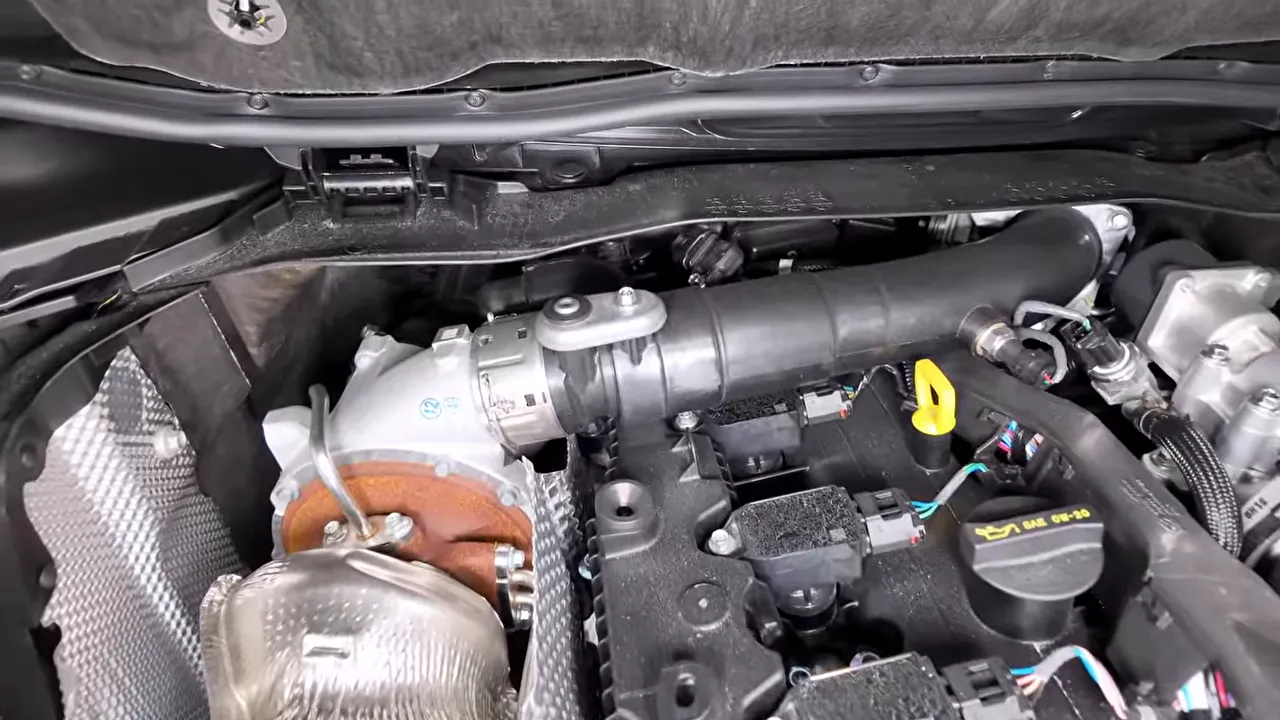
This is a dual-overhead-cam engine with a plastic valve cover and direct injection. Those features are not unusual by themselves. The concerns begin with where Mazda put some of the hardware.
Three Chains at the Back of the Engine
The timing-chain arrangement is at the rear of the engine, not the front. And it is not one simple chain.
The arrangement uses three chains:
- One connects the camshafts to an intermediate drive.
- Another connects that intermediate drive to the crankshaft.
- A third drives the electronically controlled variable-displacement oil pump.
The intermediate drive also operates a shaft for the high-pressure fuel pump. That pump lives underneath the intake manifold in a very difficult location.
Why is this important? Because an engineer can make a system work beautifully on paper, but somebody eventually has to reach its components. The service procedure I reviewed calls for engine removal to replace the high-pressure fuel pump. I hope practical repair methods emerge that avoid that, because that is a tremendous amount of disassembly for a fuel pump.
The engine uses direct injection only, with the injectors located beneath the intake rather than entering from the top. Between the pump location, the rear chain drive, and the engine’s position, this is not an engine laid out around easy service access.
The Turbocharger and Intercooler Have Some Good Details
Not everything here deserves criticism. The turbocharger is fairly large, but at least it is visible and relatively accessible. It uses both oil and coolant for cooling, along with an electronic wastegate.
I particularly like the stainless-steel coolant pipes near the turbo. Flexible hoses appear farther away, rather than being connected directly beside the hottest hardware. That is a detail worth appreciating.
The intercooler layout is another good piece of packaging. Instead of sending compressed air through long pipes to an air-to-air intercooler at the front, Mazda incorporates a liquid-to-air intercooler inside the intake manifold.
The airflow path stays short: compressed air leaves the turbocharger, passes through the throttle and intake assembly, and is cooled inside the manifold before entering the engine.
That intercooler has its own cooling circuit, separate from the engine’s:
- A dedicated coolant reservoir.
- A separate radiator mounted toward the side.
- An electric water pump that circulates coolant through the intercooler and radiator.
Yes, that adds components, but it also eliminates a lot of bulky charge-air plumbing. This is one area where I can see the benefit of the engineering.
A Simple Engine Cooling System, With Some Material Concerns
The main engine cooling system is refreshingly conventional. It has a mechanical water pump, an unusually small pump pulley, a thermostat, a radiator cap, and an overflow reservoir. There is no elaborate coolant-control valve arrangement to explain here.
However, there is a lot of plastic around the engine. Some pieces appear better quality than others. The separate plastic radiator-cap housing, with several hoses attached, strikes me as a needlessly elaborate way to provide a fill point.
My concern is not that every plastic component is automatically bad. Mazda generally does a good job with plastics, and the hose-and-clamp connections look decent. My concern is the amount of plastic living near a turbocharger and its heat.
There is also a proper oil dipstick, which I am happy to see. Reaching it, though, takes more effort than it should.
The Eight-Speed Transmission and 48-Volt System
The engine is only part of the story. Mazda pairs it with an eight-speed automatic that does not use a torque converter. Instead, it uses a hydraulically operated clutch for the launch function.
This is not a dual-clutch transmission. It is an eight-speed automatic with a different approach to getting the vehicle moving.
That distinction matters because a torque converter is very good at making initial movement smooth. In this CX-90, gentle takeoffs can produce a little lugging sensation, something reminiscent of a manual-transmission vehicle taking off without quite enough smoothness.
Interesting engineering? Absolutely. A better everyday experience? That is where I disagree.
What the Mild-Hybrid System Does
The inline-six powertrain also includes a 48-volt lithium-ion battery in addition to the conventional 12-volt battery. An electric motor sits between the engine and transmission.
Its job includes assisting the engine, supporting restart operation, and helping move things along before the turbocharger builds its response. The system can also support brief periods of engine-off movement under suitable conditions.
Mazda’s i-stop function therefore goes beyond simply switching the engine off at a traffic light. Engine shutdown can occur during deceleration and other operating conditions, with the electric motor supporting the transition back to engine power.
There are useful aspects to this arrangement:
- There is no conventional alternator.
- The 48-volt system supplies the 12-volt electrical system through voltage conversion.
- The motor allows broader use of engine stop-start operation.
A conventional starter remains, and you can generally hear it operating during an ordinary engine start.
My reservation is that a 48-volt mild hybrid is a partial step compared with a full hybrid system operating at much higher voltage. Here, Mazda has combined a turbocharged engine, a clutch-based launch system, and an electric motor between the engine and transmission. That is a lot of equipment to coordinate.
The motor’s location also makes me think about future repairs around the engine-to-transmission interface. Oil leaks in that area have caused trouble in other manufacturers’ systems. That is a serviceability concern, not a claim that this Mazda has already developed the same failure.
Does the Output Justify the Complexity?
The standard-output inline six produces 280 horsepower and runs on regular gasoline. Higher trims offer a high-output version rated at 340 horsepower.
Those are useful numbers. They are not extraordinary numbers for the amount of hardware involved.
For perspective, a 2005 Toyota Avalon with the much simpler 2GR-FE V6 was already in roughly the same horsepower territory as the standard-output CX-90. Modern turbocharged four-cylinder engines can also reach that general level. And other turbocharged inline-six engines, such as the Hurricane, demonstrate that the configuration can deliver substantially more than 340 horsepower.
Horsepower alone does not tell the whole story, of course. But the CX-90 does not compensate with a particularly exciting or exceptionally smooth driving experience, either. That is the central problem for me: the engineering effort does not translate into something sufficiently special from the driver’s seat.
Underneath the CX-90: Good Materials, Difficult Access
Underneath, Mazda has covered almost everything. There are extensive plastic panels, including coverage around portions of the exhaust.
The panels themselves feel like decent-quality pieces. There is a small service opening, and Mazda leaves an appropriate section of the front subframe exposed for lifting access. The overall presentation resembles something from a more expensive vehicle.
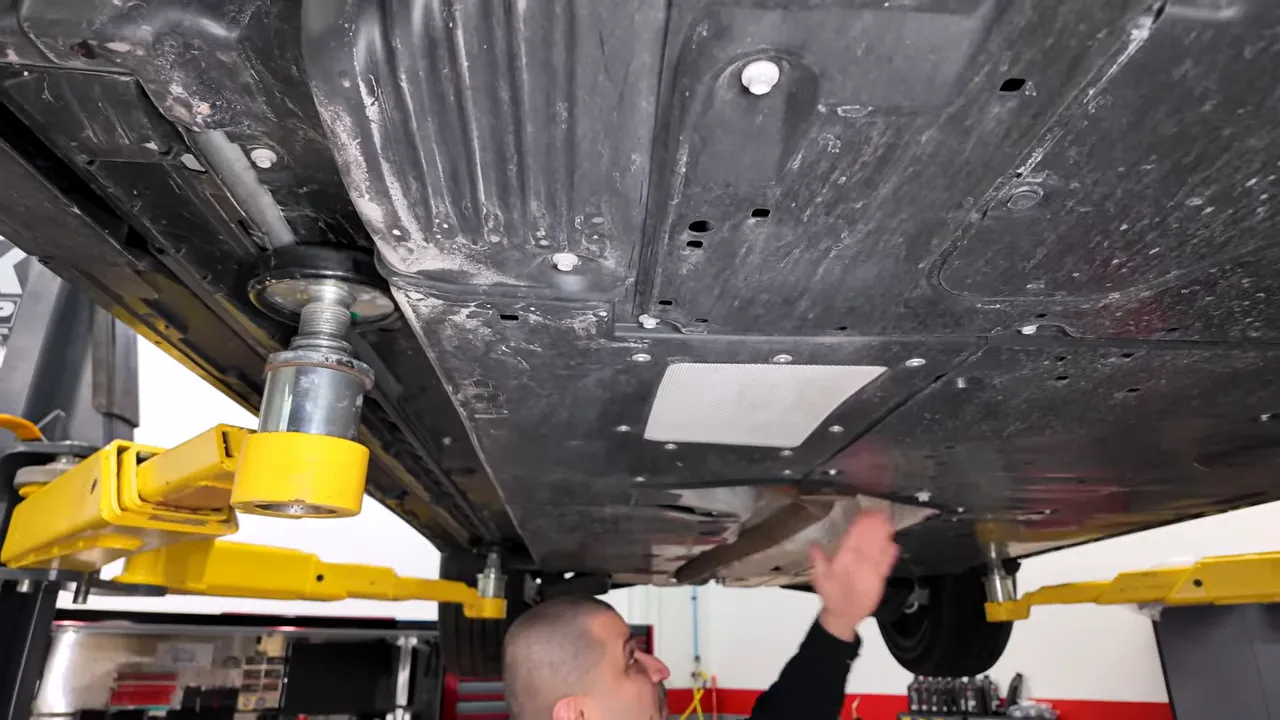
But there are two sides to this. Coverage is nice for protection. Coverage also has to come off when you need to inspect or repair whatever is behind it.
The driveshaft sits above shielding, with only a small section readily visible. Depending on the work required, accessing the transmission or driveshaft could involve substantial panel removal and potentially removing exhaust components. Even a proper visual inspection becomes more involved.
This is a rear-wheel-drive-based layout with all-wheel drive added to it. The front axle passes through the oil-pan area, a familiar packaging approach for this type of configuration, but the covers make it difficult to see much from underneath.
Suspension and Brakes
The front suspension mixes aluminum and steel components. There is an aluminum knuckle and an unusual two-piece lower-arm arrangement, with an aluminum section at the ball joint and a steel section extending toward the bushing. The upper control arm is steel.
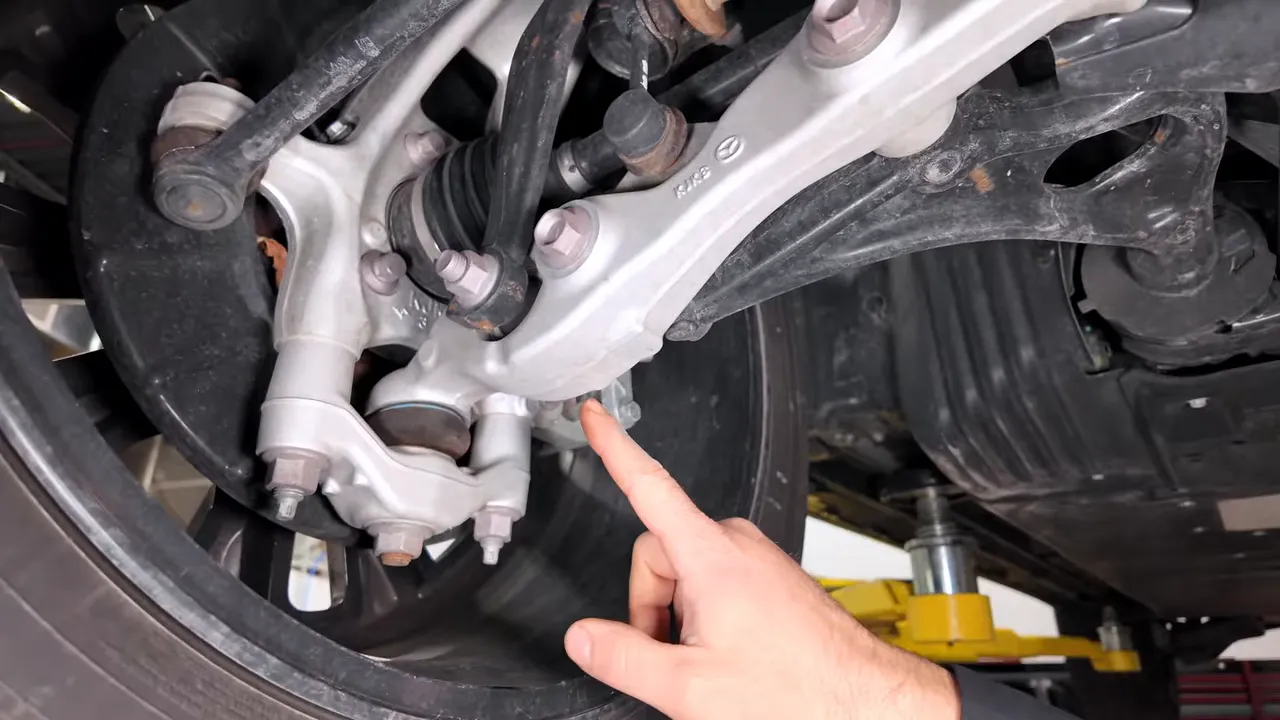
At the rear, the suspension also uses a mixture of steel and aluminum arms with an aluminum knuckle. Much of it is partly hidden by additional covers.
The front brakes use two-piston calipers. They are not enormous brakes, but the brake feel is good. The rear uses single-piston calipers with electric parking-brake motors.
One strange detail is the exposed charcoal canister near the exhaust. After seeing so much effort devoted to covering other areas, finding that component without comparable coverage makes the overall approach feel inconsistent.
Still, the exhaust quality looks decent, and the general quality underneath is respectable. My complaint is mainly access. Removing and reinstalling covers takes time, and repair labor is ultimately paid for by the owner.
Exterior Design: One of the CX-90’s Biggest Strengths
This is where Mazda gets a lot right. The 2026 changes are relatively minor visual and color updates rather than a wholesale redesign, and that is fine. The CX-90 already looks excellent.
Many three-row SUVs are either aggressively futuristic or completely anonymous. This Mazda manages to be large and elegant without covering itself in unnecessary styling details.
The grille is big, but it suits the proportions. The small headlights work beautifully. Even the way the hood edge changes direction near the headlight helps preserve a continuous styling line.
Along the side, the tall, relatively clean doors give it presence. There is not much decoration, and that restraint is precisely why it looks classy.
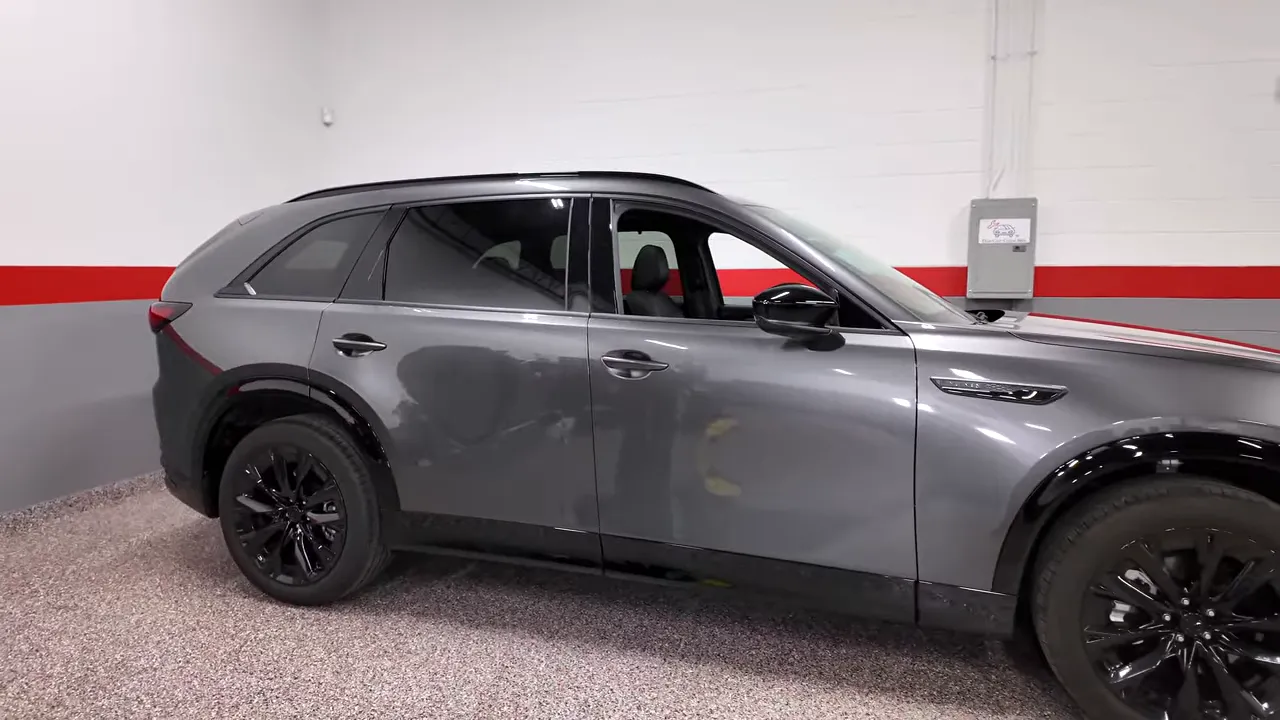
One missed opportunity is the touch-sensitive locking and unlocking. It works at the front doors, but not the rear doors. On a vehicle with premium ambitions, extending that convenience to the back would have made sense.
Rear Doors That Open Nearly 90 Degrees
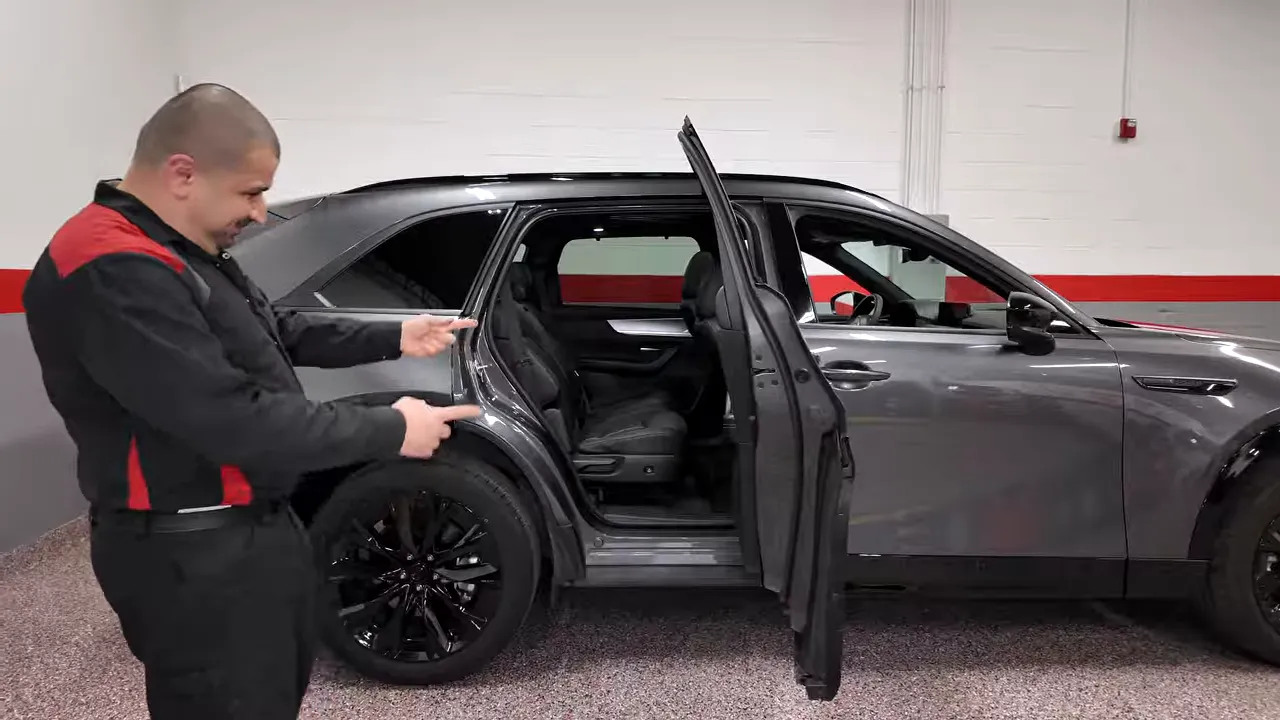
The rear-door opening is one of my favorite features of this entire SUV. The doors open to nearly 90 degrees, and the openings are tall.
That makes getting into the second row genuinely easy. This is practical design that every manufacturer should pay attention to. It is not complicated, it is not flashy, and it helps every time somebody gets in or out.
Cargo Space and a Real Spare Tire
The rear styling is just as attractive as the front, although the rear glass looks a little small for such a large SUV.
With the third row folded, the cargo area is spacious. Raising the third row is a basic manual operation, which I appreciate. There is no need to complicate this job.
With the seats upright, there is still usable luggage space, although the slope of the rear body and the angle of the seatbacks limit the upper portion. The backrests sit close to the liftgate.
Under the cargo floor, there is some storage and a tool tray. Lift out the necessary pieces, and there is an actual spare tire.
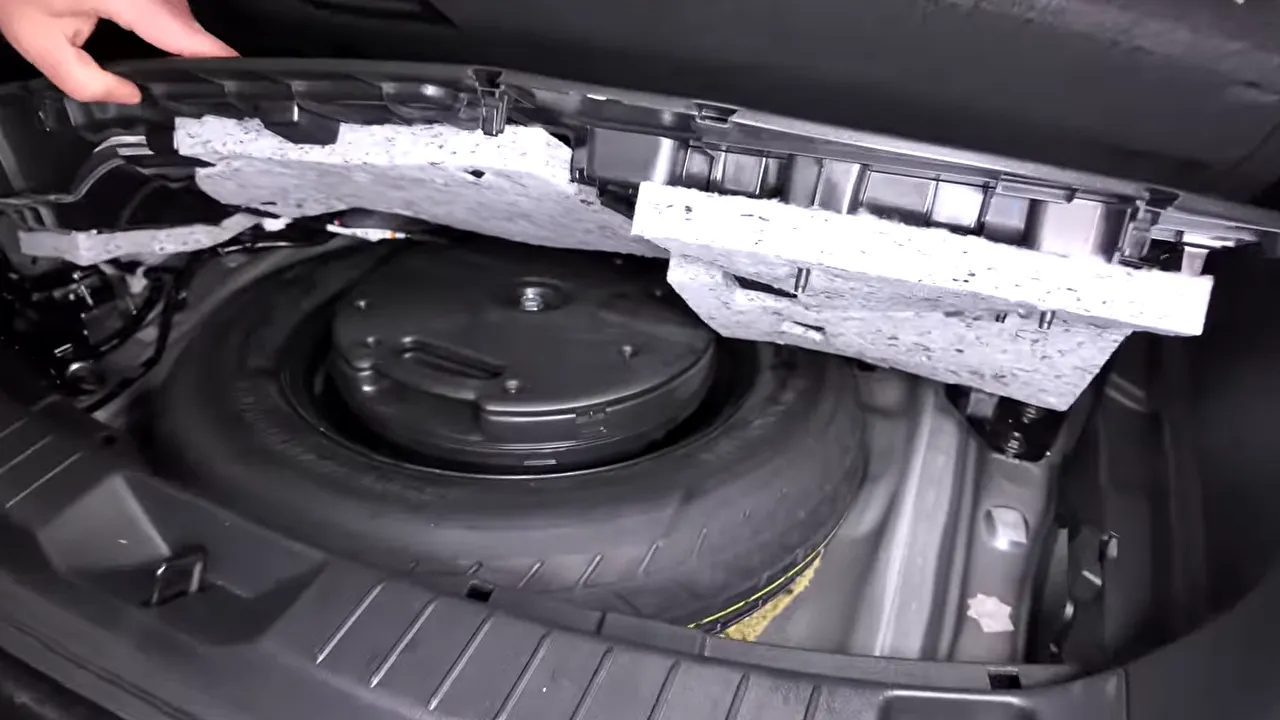
For a three-row SUV likely to take family trips, that matters. If a tire fails far from help, a spare is a lot more reassuring than discovering you have no replacement tire at all. Better yet, Mazda has packaged it without making it an obvious intrusion into the cargo area.
Interior: Simple and Comfortable, but Not Quite Luxury
At first glance, the CX-90 has a beautiful interior. Its strength is not excess. Its strength is a simple, elegant layout.
The climate controls are a perfect example: physical buttons with a small display. Straightforward, easy to understand, and exactly what I want for a basic function.
The infotainment system receives a modest update for 2026. The screen is a decent size and sits in a good position for visibility, although reaching it is a stretch. Mazda’s rotary controller works well here, and the nearby volume control is convenient.
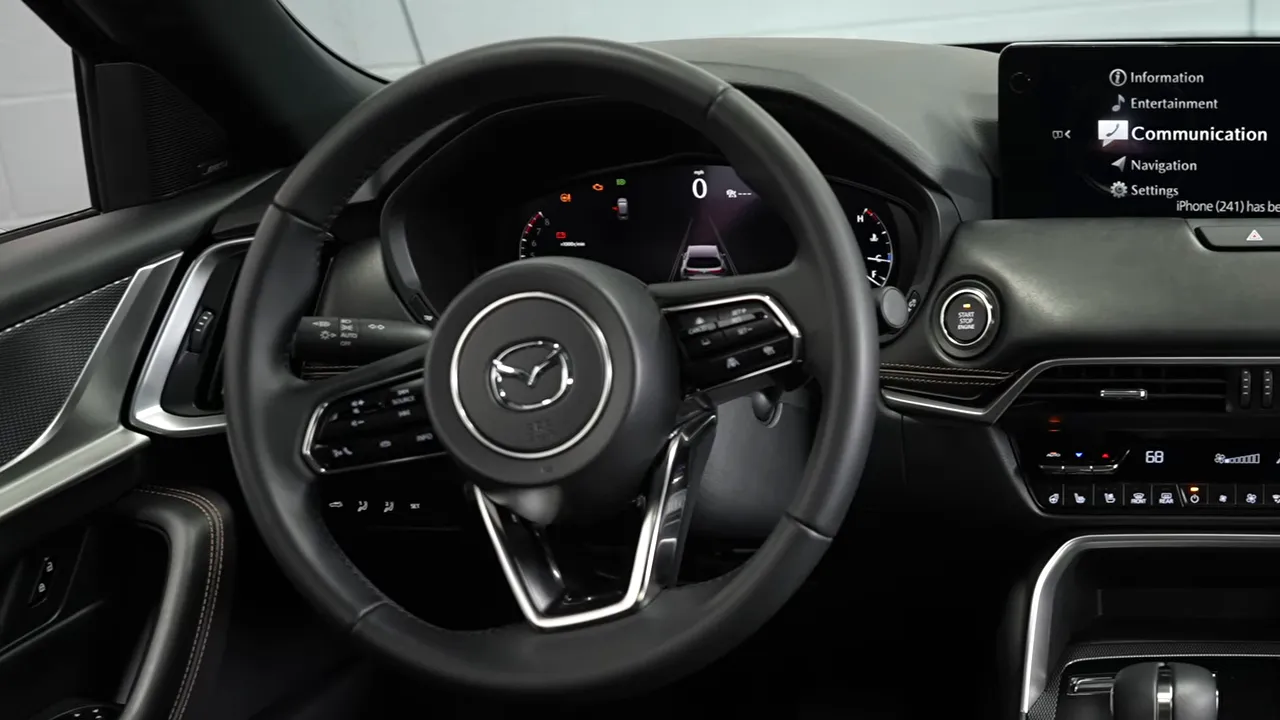
The steering wheel is also nicely arranged. The seats are very comfortable, there is plenty of storage, and most frequently used controls are easy to reach. Fit and finish is good, even if the materials are not especially extravagant.
But a few choices interrupt that good work.
- The shifter: Rather than a familiar straight movement, it requires pressing the button and moving sideways out of Park before continuing through the positions. I find it unnecessarily confusing.
- The digital instrument cluster: It already feels dated and does little to strengthen the premium impression.
- The door feel: Opening the door does not give me the substantial feeling I expect from a luxury vehicle.
- The overall materials and technology: They are pleasant, but they do not convincingly move the CX-90 into a luxury class.
Being different is valuable when it improves something. Making a basic control less intuitive simply to make it different is not an improvement.
Second- and Third-Row Comfort
The second row is very comfortable, helped by those excellent rear doors. For 2026, a bench seat is available on higher trims, allowing seven-passenger seating in the configuration discussed here: two in front, three in the middle, and two in the third row.
Do not assume the large exterior means a massive third row. It does not. I would treat those rearmost seats primarily as children’s seating rather than comfortable accommodation for adults.
That distinction is important if you regularly need all three rows. The CX-90 can do family duty, but maximum passenger space is not its strongest argument.
How It Drives: The Powertrain Needs More Refinement
I love the sound of this engine. It makes the right noises, and there is useful power available. But the delivery is delayed and uneven enough to distract from the experience.
Mazda describes transmission refinements for 2026. In the vehicle I evaluated, I did not feel the improvement I was hoping for. The hesitation on takeoff remained, and the occasional delays made the drivetrain feel less polished than it should.
There is another delay right at startup. Start the engine and immediately try to select Drive, and the vehicle may not be ready to move yet. The ready indicator flashes while the system finishes getting itself prepared. You have to wait a few seconds.
Individually, that might seem small. Add it to the lag during acceleration and the clutch-based takeoff behavior, and it becomes part of a pattern.
The ride itself needs a little distinction. On smooth roads, the CX-90 can feel smooth and comfortable. Over bumps, the suspension feels tuned more toward an athletic response than a soft, isolated one.
That would be easier to accept if the complete driving experience were especially engaging. To me, it is not. It does not deliver the excitement I associate with a good sporty German SUV, but it also does not deliver the soft, quiet character I expect from a comfort-oriented luxury SUV. At times, even a more ordinary Toyota Grand Highlander feels smoother.
The problem is not simply firmness or lack of power. It is the mismatch between ambitious engineering and inconsistent everyday refinement.
This is my driving impression, not a measurement that everyone has to agree with. If you like the CX-90, evaluate it yourself. Pay particular attention to gentle starts, low-speed acceleration, startup readiness, and broken pavement rather than judging it only during a strong acceleration run.
Reliability and Ownership Costs: Concern Is Not Proof of Failure
The CX-90’s mechanical complexity gives me significant concerns about long-term repair costs. That does not mean I can declare the 2026 model unreliable in advance.
The distinction matters. What I can see is an engine with difficult component access, rear-mounted chains, an awkwardly located high-pressure fuel pump, an integrated mild-hybrid motor, and extensive underbody coverage. Those choices can make future repairs more labor-intensive.
Any vehicle will eventually need something repaired. My concern is how much work could be required when that day arrives.
I genuinely hope this powertrain proves durable. The engineering is impressive in its ambition. But the owner does not receive a discount on labor because a component was clever to design.
For anyone moving toward a purchase, checking the specific vehicle through the NHTSA recall lookup is also a sensible part of the process. That is separate from predicting long-term durability.
Should You Buy One? The Price Changes the Conversation
After all those criticisms, here is the part that brings the CX-90 back into consideration: price.
The starting price discussed for the 2026 model is $38,800 before destination and other charges. Think roughly $40,000 with destination, not a final out-the-door total.
At that level, this is a lot of vehicle. You get the attractive body, the inline-six powertrain, three rows, and much of the practical appeal without paying luxury-brand money.
The base model naturally gives up equipment. But at around that price, I can understand accepting some compromises. The upper trims climb into the $60,000 range, and although those are well-equipped versions, the argument becomes less convincing.
Compared With the Grand Highlander and Lexus TX
The Toyota Grand Highlander is a useful comparison. In my opinion, it is one of Toyota’s better current vehicles, and it is more functional than the CX-90. It offers more interior room and a significantly better third row.
Its starting price is higher, though, and availability was a frustration at the time of this review. The Mazda also looks more interesting and feels classier in its design.
The Lexus TX takes the comparison in another direction. It costs more, but it also makes the CX-90’s limits as a luxury vehicle more obvious. Once an expensive CX-90 starts approaching the price of an entry-level TX, comparing actual equipment and refinement becomes very important.
That is why I find the Mazda’s lower trims more appealing than its higher trims. The underlying drivetrain concerns do not disappear when you add more equipment, and the premium features do not transform the fundamental driving experience.
My Buying Recommendation
If you love the design and are seriously considering a 2026 Mazda CX-90 inline six, my approach would be simple:
- Start with the lower trims. That is where the price makes the strongest case.
- Make sure the drivetrain behavior suits you. Do not assume the hesitation or low-speed feel will stop bothering you after purchase.
- Be realistic about the third row. If adults regularly need to sit there, compare room carefully.
- Consider an extended warranty. My recommendation comes from the potential complexity and cost of repairs, not certainty that a particular component will fail.
The CX-90 is not a bad vehicle. It is an attractive, comfortable SUV with some genuinely thoughtful features and a very compelling entry price. But it is not the fully convincing luxury SUV its engineering ambitions suggest.
Buy it for its design, its useful everyday features, and its lower-trim value, not because an inline six automatically makes it special. Keep the purchase price sensible, understand the compromises, and protect yourself against the ownership costs that concern you. That is where this Mazda makes the most sense to me.


