The 2026 Hyundai Santa Cruz makes a lot more sense when you stop asking whether it is a “real truck” and start asking how much truck you actually need.
For somebody who occasionally carries home improvement supplies or helps a kid move into college, an open bed is useful. But the rest of the year, that same person might just want a comfortable vehicle for the commute. That is where this little pickup has a very strong argument.
And for 2026, Hyundai made a change I really wanted to see: the turbocharged Santa Cruz now has a conventional eight-speed automatic instead of the previous dual-clutch transmission. Combine that with the exterior and interior updates introduced for 2025, and this is a surprisingly pleasant package. There are still mechanical concerns and compromises, though, especially if long-term ownership or rear-seat space is high on your list.
Key Takeaways
- The turbo model’s conventional eight-speed automatic is the most important improvement for 2026.
- A smooth ride, comfortable front seats, and useful bed make the Santa Cruz an appealing daily driver.
- Tight rear seating is the biggest interior compromise, especially for regular adult passengers.
- Some mechanical details raise serviceability concerns, and long-term reliability remains unproven.
Table of Contents
- Under the Hood: Two 2.5-Liter Engines
- The Best 2026 Change: A Conventional Eight-Speed Automatic
- Mechanical Quality: Some Sensible Choices, Some Cheap Details
- Underneath the Santa Cruz: Suspension, AWD, and Service Access
- Exterior Design: The Refresh Helped
- The Bed Is Small, but It Is Thoughtfully Useful
- Interior: Modern Without Getting Carried Away
- Hyundai Santa Cruz vs. Ford Maverick and Honda Ridgeline
- Should You Buy the 2026 Hyundai Santa Cruz?
Under the Hood: Two 2.5-Liter Engines
The Santa Cruz offers a naturally aspirated 2.5-liter engine and a turbocharged 2.5-liter engine. The vehicle examined here has the turbo. The two engines share much of their basic architecture, so many of the underlying design observations apply to both.
Starting at the top, there is a plastic valve cover over a two-piece cylinder-head arrangement. The upper section carries the camshaft assembly, while the lower section contains the valves. The valvetrain uses hydraulic lifters and roller rockers.
This is a timing-chain engine with two chains:
- One connects the crankshaft to the camshafts.
- The other drives the oil pump and balance-shaft assembly from the crankshaft.
The block is aluminum. None of that is particularly unusual today, but the timing controls, cooling system, and fuel routing deserve a closer look.
Electronic Variable Valve Timing, With a Serviceability Catch
On the intake side, Hyundai uses electronic variable valve timing. An electric motor works through a gear arrangement to adjust the camshaft’s timing relative to the crankshaft.
Think of it this way: when the motor and camshaft are turning at the appropriate matching speeds, the timing position stays where it is. Changing that relationship moves the cam timing in one direction or the other.
It sounds complicated, but this type of system has been around for a while. Hyundai is not alone in using it. Toyota and Mazda use similar concepts.
My complaint is not that an electric motor exists. It is that replacing this motor requires a special tool. With comparable Toyota and Mazda arrangements, the motor is much more straightforward to remove. That is the kind of serviceability difference that matters after the new-car excitement is gone.
The exhaust side uses oil-controlled variable valve timing. Its oil-control arrangement is localized at the cam gear, using the gear’s center-bolt area rather than routing control oil through a more spread-out setup. That is a sensible design.
Cooling System: Good Intentions, Awkward Access
The mechanical water pump sits toward the back of the engine. I am not a fan of that location from a service-access standpoint.
There is also a plastic coolant distribution valve tucked into the engine bay. Instead of simply sending coolant everywhere all the time, this valve can direct or restrict flow to different areas. The purpose is faster warm-up and more efficient temperature management.
That is useful functionality. But it also adds another assembly, and its placement does not make it especially easy to inspect or reach.
Port and Direct Injection, With Unusual Fuel Routing
One thing I welcome is the use of both port and direct fuel injection. The systems can operate independently or together.
The port injectors sit outside the combustion chambers, with their low-pressure fuel rail visible along the front of the engine. The direct injectors are underneath the intake manifold. A high-pressure fuel pump takes fuel supplied by the in-tank pump and raises its pressure to approximately 3,000 psi for the direct-injection system.
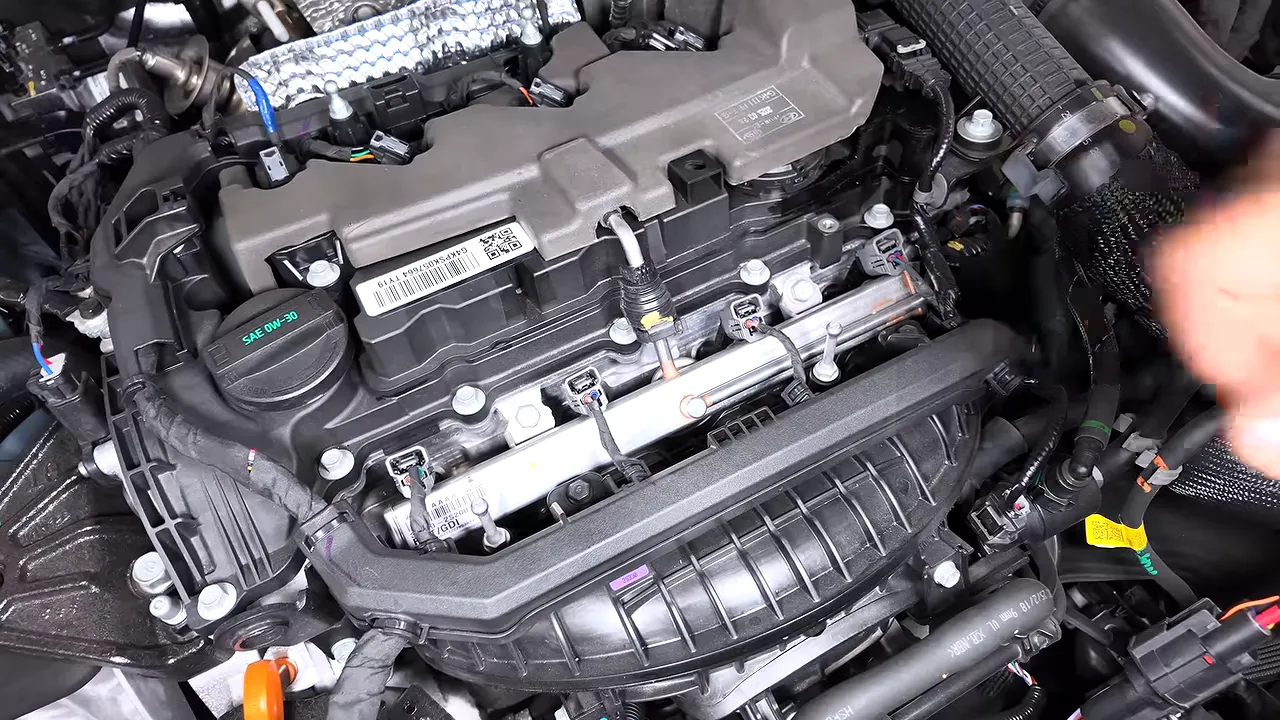
The unusual part is how fuel reaches those components. A common arrangement splits the supply line from the tank into two branches, one feeding the port-injection rail and the other feeding the high-pressure pump.
Here, fuel goes into the port-injection rail first. Another line then carries fuel from that rail to the high-pressure pump.
It initially looks strange, but the logic is understandable. The low-pressure fuel supply already exists at the rail, so Hyundai uses that path rather than adding a separate split. It also means the high-pressure pump’s supply depends on that shared upstream path.
Turbocharger and Intercooler Layout
The turbocharger is mounted at the rear of the engine. It uses both oil and coolant for thermal management and has an electronically controlled wastegate.
Charge-air cooling comes from an air-to-air intercooler positioned toward one side behind the grille. Air travels to the turbo, passes through the intercooler, and then returns to the throttle body.
All that routing makes the turbo engine bay busy. There is no magic way to eliminate the plumbing when the components are laid out this way. The turbo itself is not completely buried, which is a positive, but the overall arrangement is still crowded.
The Best 2026 Change: A Conventional Eight-Speed Automatic
Previously, the naturally aspirated Santa Cruz used a conventional eight-speed automatic, while the turbocharged version used a dual-clutch transmission.
I did not like that dual-clutch choice for this application. This is not a race car. It is a vehicle that will sit in traffic, creep through parking lots, and handle ordinary daily driving. A transmission needs to suit the job, not just look interesting on a specification sheet.
For 2026, the turbo gets a conventional eight-speed automatic as well. Thank you, Hyundai. This is a much better match for the character of the Santa Cruz.
The shifts are smooth, and the turbo engine delivers its power in a linear, usable way. It feels capable without being constantly buzzy or intrusive. The combination is genuinely pleasant.
Now, does that mean the new transmission will be reliable for the long haul? We do not know yet. Smooth operation today and long-term durability are two different things. I like how it works, but I am not going to turn a good driving impression into a reliability guarantee.
Mechanical Quality: Some Sensible Choices, Some Cheap Details
My overall impression of the underhood quality is middle of the road. It is not the best, and it is not the worst. But some of the small components lean too far toward inexpensive construction.
The hose connections are a good example. In one location, there is a straightforward hose and clamp. Nearby, there is a more elaborate plastic connector doing a similar job. The coolant reservoir connection is particularly disappointing to me: a decent reservoir and hose, joined by a plastic fitting that looks like the cheapest part of the assembly.
To be clear, these are construction and serviceability concerns, not proof that the parts have failed. Still, as a mechanic, these are the details I notice. A vehicle can drive beautifully while leaving questions about what some of its small plastic components will look like years down the road.
For any specific vehicle you are considering, it is also worth checking its VIN through the NHTSA recall lookup. That is a separate step from judging how well the vehicle drives.
Underneath the Santa Cruz: Suspension, AWD, and Service Access
The front underside is largely covered. Hyundai does provide an access panel for oil service, which I appreciate. What I do not appreciate is the mixed fasteners: clips that need a screwdriver and bolts that need a 10 mm tool.
Why not make them consistent? It is a small thing, but small things add up when you work on cars.
Front Suspension and Brakes
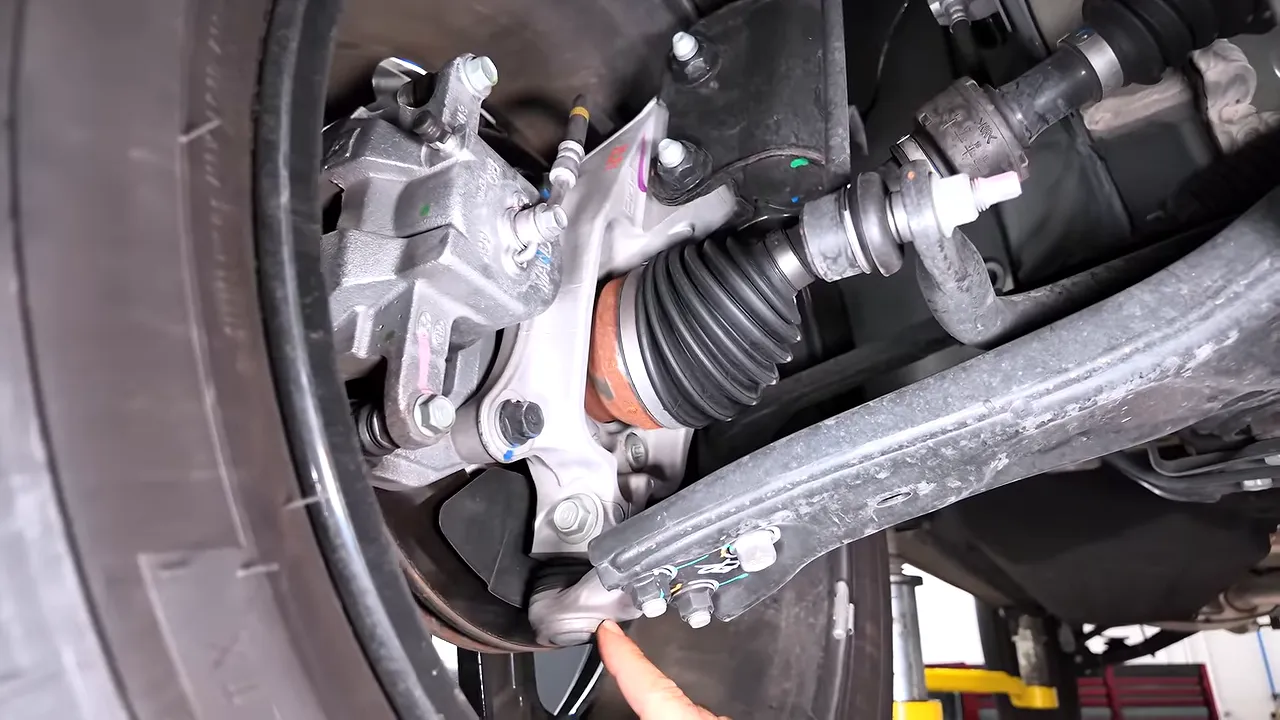
The front suspension uses a straightforward combination:
- Steel lower control arms with separate ball joints.
- Aluminum steering knuckles.
- MacPherson struts.
- Single-piston brake calipers.
- Sway-bar links that appear to have plastic construction, although that was difficult to confirm during inspection.
The separate ball joint is a design choice I like. It keeps the ball joint from being inseparable from the entire control arm as a service item.
The engine feels smooth in operation, although the mount arrangement is something I would pay attention to as the vehicle ages. Again, that is an inspection observation, not a current vibration complaint.
Exhaust, Drain, and Underbody Protection
The exhaust system leaves a mixed impression. One section looks nicely finished, but the remaining pipe and muffler do not give me the same sense of quality.
There is also an insect-blocking fitting at the air-conditioning drain. Its purpose makes sense, but this style of restriction can itself become a place where debris collects and the drain clogs.
Underbody coverage continues along the sides, with more exposed areas through the middle. Some of the protective material is quite nice, and I would like to see more of it, although weight is always part of the compromise. At the back, coverage is uneven, with a more substantial cover on one side and a much smaller piece on the other.
All-Wheel Drive and Rear Suspension
On this all-wheel-drive example, the front transfer unit sends power through a driveshaft to the rear differential. A rear coupling engages and disengages the rear drive as needed.
The differential is compact, but it is a little more substantial than I expected for this vehicle.
The rear suspension is simple in layout, with a steel trailing arm, steel control arms, and an aluminum knuckle. There are large rear shock absorbers, and the single-piston rear brake calipers incorporate the parking-brake mechanism.
The spare tire is mounted underneath the bed. It lowers through a mechanism normally operated using the access point in the rear bumper. The mechanism itself is visible from below, which helps explain how the system works.
Exterior Design: The Refresh Helped
The exterior update introduced for 2025 really helped the Santa Cruz. The design is growing on me, and I particularly like the chrome treatment on this example. Chrome can look right on a pickup, and here it works.
The headlights sit low in the front fascia, with the running lights higher up across the grille area. The radar sensor is near the bottom. You can still see the relationship to the Hyundai Tucson, which shares its underlying vehicle architecture.
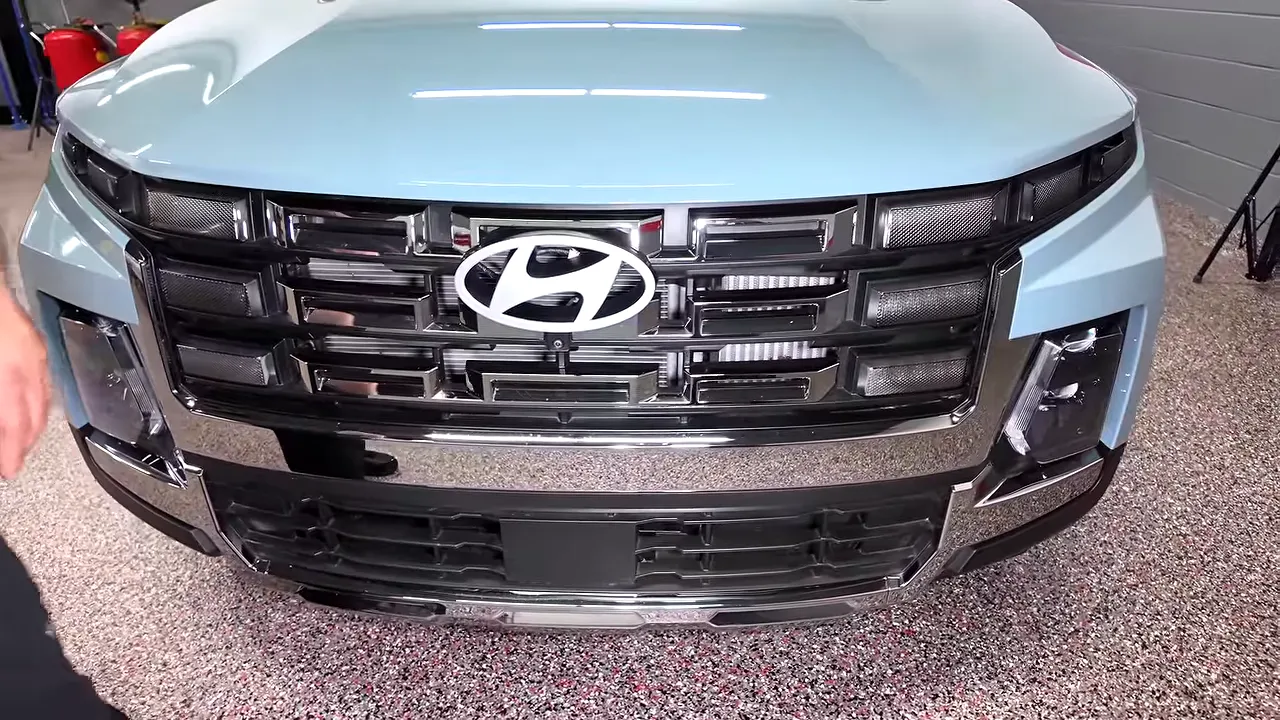
I do not love every detail. The raised tab in the wheel-arch cladding, complete with a little vehicle graphic, looks unnecessary to me. Maybe this is a fashion I am not understanding, but I would rather have a clean wheel-arch outline.
The sharp door-side sculpting is another detail I could do without. A simpler line would look better to my eyes.
On the other hand, I like the sloping transition from the cab toward the bed. It gives the Santa Cruz its own shape instead of trying to imitate the upright cab-to-bed break of a traditional pickup.
At the rear, the stamped Santa Cruz name, conventional taillights, and chrome accents work well enough. More importantly, the bumper has useful stepping surfaces, including corner steps. Those are practical pickup details, not just decoration.
The Bed Is Small, but It Is Thoughtfully Useful
The tailgate has a damped opening action, and this example has a retractable bed cover. Release its latch and the cover retracts toward the cab. A long pull strap lets you bring it back, and the latching arrangement allows an intermediate position rather than forcing it to be fully open or fully closed.
When this vehicle first arrived, the cover was unusually stiff to move. After driving the vehicle, it operated much more freely. I would check its operation on the individual vehicle rather than assume either behavior is universal.
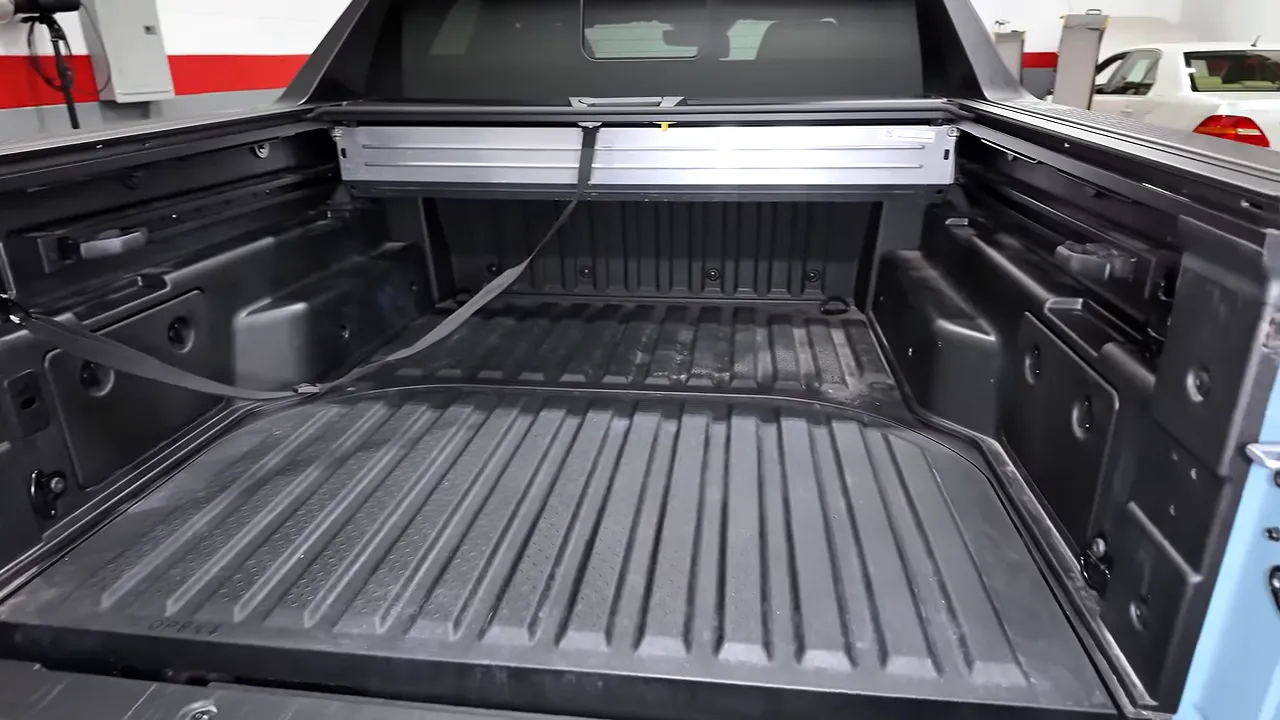
No, this is not a huge bed. But if you are a homeowner rather than somebody running a construction company, how often do you actually need a huge bed?
The useful features include:
- Bed lighting.
- Small storage compartments in the bed sides.
- A covered storage bin beneath the bed floor.
- A drain in that lower bin so it can be used with ice as a cooler.
- An internal emergency-release provision for the enclosed storage compartment.
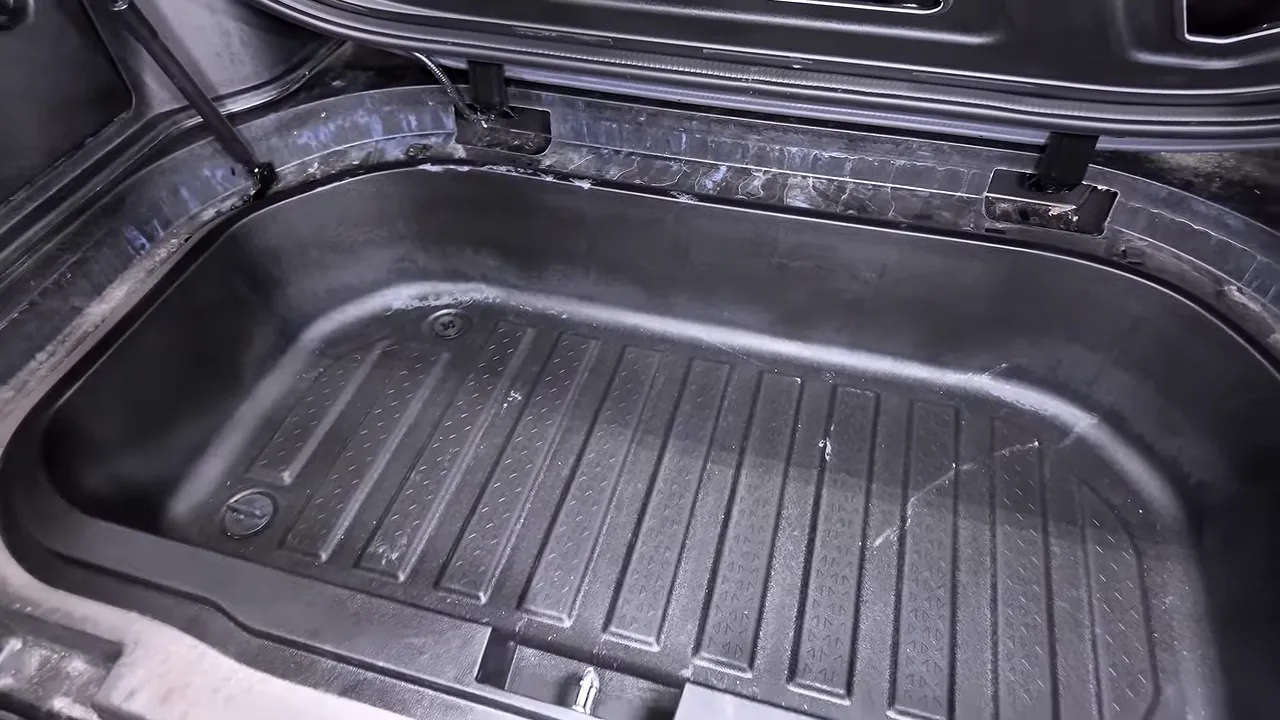
I really like this approach. You get an open cargo area for the things you do not want rubbing against an SUV’s headliner or interior trim, plus extra storage for smaller items.
That is the point of this segment. It does not need to replace every traditional truck. It only needs to cover the jobs its owner actually does.
Interior: Modern Without Getting Carried Away
The 2025 interior update made a substantial difference. This does not feel like a few decorative pieces were changed. The dashboard presentation feels much more modern, even though this was not a complete redesign.
The curved display assembly combines the instrument cluster and infotainment screen into a clean-looking layout. The cluster includes the blind-spot camera display associated with turn-signal use on this equipped vehicle.
The newer Hyundai infotainment system is responsive and works very well. Just as importantly, Hyundai did not put every function behind a touchscreen menu.
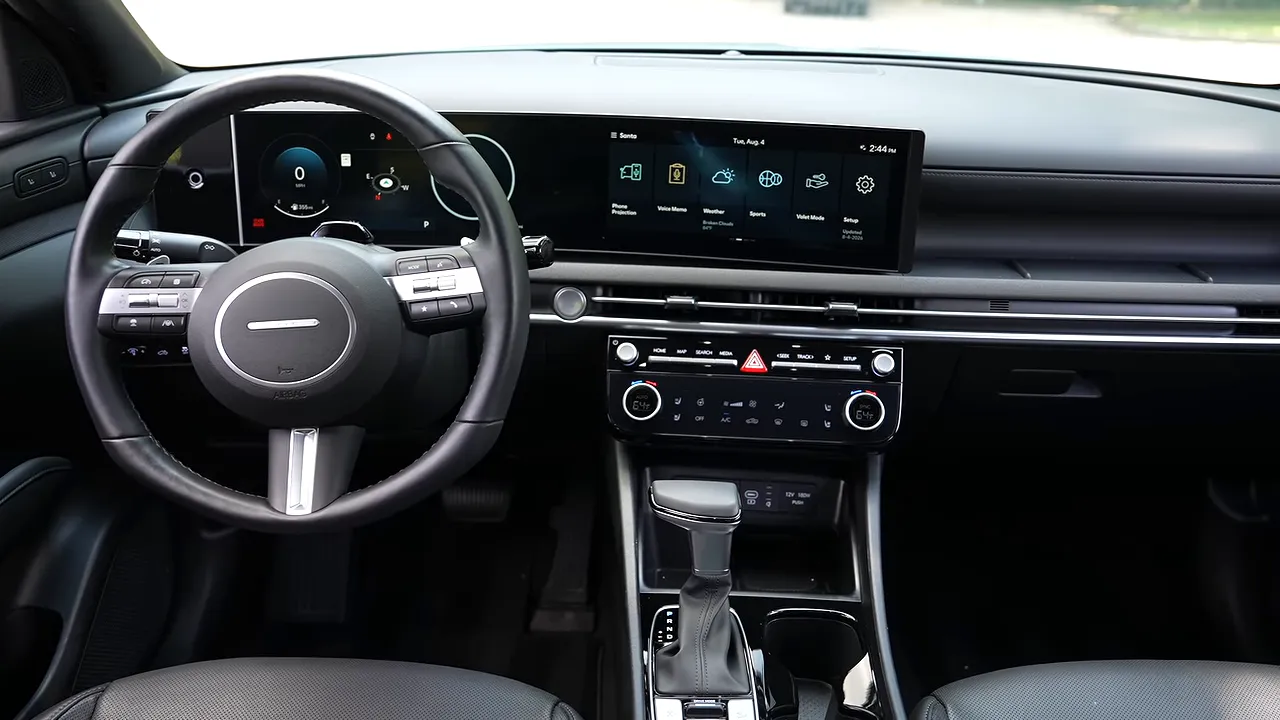
There are physical audio controls below the display. The climate panel underneath uses capacitive controls for many functions, but they remain visible rather than disappearing into a screen menu. I can live with that arrangement.
The steering-wheel controls are laid out sensibly, and there is a conventional physical gear selector. Nothing about the basic operation feels like it is trying too hard to be different.
Comfort Is the Santa Cruz’s Strongest Argument
The front seats are very comfortable. The cabin is also quieter than I expected, and the turbo engine does not constantly announce that it is working.
But the ride is the real surprise. This is a very smooth, comfortable vehicle to drive. It gives you the everyday character of a crossover with the usefulness of an open bed.
Traditional body-on-frame pickups have their own strengths, but their construction comes with compromises. The Santa Cruz is not chasing that same experience, and I think it is better for it.
The interior materials are not exotic. They do not need to be. The cabin feels cohesive, looks nice, and works sensibly without a collection of annoying gimmicks.
The Back Seat Is the Big Compromise
Rear-seat room is much less impressive. I am 5 feet 7 inches tall, and sitting behind my own driving position leaves very little knee room.
There is a recess in the headliner to help with headroom, but the sunroof installation still limits available space. Taller passengers will need to pay particular attention to how their head lines up with that recess.
The rear seating position is fixed, so there is no sliding adjustment to create more room. You do get rear air vents and USB-C connections, and the seat itself is comfortable. There simply is not much space around it.
The bed’s usefulness comes with a packaging trade-off. If you regularly carry adults in the back, try the rear seat with the front seats set for the actual people who will use them.
Hyundai Santa Cruz vs. Ford Maverick and Honda Ridgeline
The Ford Maverick is the Santa Cruz’s most direct competitor. The Honda Ridgeline follows a similar crossover-like pickup idea, but it is larger and feels like it belongs a step above these two in size.
Between the Santa Cruz and Maverick, my impression is that they appeal to different priorities.
- Ford Maverick: Generally the lower-cost choice, with a more utilitarian feel and a stronger emphasis on being a small working pickup.
- Hyundai Santa Cruz: Nicer-feeling, more comfortable, and more focused on everyday refinement and amenities.
- Honda Ridgeline: A similar comfortable-vehicle-with-a-bed concept, but in a larger package.
If you consistently plan to treat a small pickup as a work tool, I can see the Maverick’s appeal. It feels more serious about that part of the job, even if the cabin and overall experience feel less polished.
The Santa Cruz feels more like a normal daily family vehicle that happens to have a bed. In my opinion, it is nicer to drive and nicer to look at. Price remains an important reason to choose the Maverick, although its rising prices make it worth comparing actual vehicles rather than relying on its original budget reputation.
If your needs involve demanding towing, serious hauling, or more challenging off-road use, that is a different discussion. Buy the vehicle for the work it must perform, not just the shape you like.
Should You Buy the 2026 Hyundai Santa Cruz?
Yes, it deserves serious consideration if you want crossover comfort and occasional pickup utility. The conventional eight-speed automatic makes the turbo model much more appealing, and the earlier styling and cabin updates modernized the vehicle without making it frustrating to use.
The reasons I like it are straightforward: smooth ride, comfortable front seats, useful power delivery, easy everyday operation, and a clever little bed.
The reservations are just as important. The rear seat is tight. Some underhood plastic fittings and component locations do not impress me. Exhaust quality is mixed. And long-term reliability, including the newly adopted transmission application, remains something to establish rather than assume.
If the reliability holds up, the Santa Cruz has the makings of an overlooked good choice.
Before buying a bigger truck, ask yourself one honest question: do you need its additional capability, or would something like this handle the jobs you actually do? If the answer is the latter, there is a lot to like here. You do not have to buy more truck than you need.


