The 2026 Hyundai Palisade has an interior that can make some luxury cars feel ordinary. The design is beautiful, the materials in the Calligraphy trim are impressive, and the amount of seat adjustment borders on excessive. Then you open the hood, put it on a lift, and a different picture starts to appear.
That is the conflict with this SUV. Hyundai has pushed the Palisade’s presentation to another level, but some of the materials and decisions behind the scenes leave me concerned.
There are real improvements here, especially in the new hybrid system. There is also excellent family space. But before getting carried away with the leather and powered seats, we need to look at the whole vehicle.
Key Takeaways
- The redesigned hybrid system eliminates Hyundai’s previous belt-driven starter-generator arrangement.
- Underhood materials, coolant routing, and underbody finishing raise concerns about long-term ownership.
- The Calligraphy interior and spacious, adjustable second row are the Palisade’s strongest attractions.
- Engine and suspension noise do not match the luxury expectations created by the cabin.
Table of Contents
- Under the Hood: The Palisade Hybrid’s 2.5-Liter Turbo Engine
- The Redesigned Hybrid System Is a Welcome Improvement
- Engine-Bay Packaging and Materials Raise Questions
- Under the Palisade: Suspension, AWD, and Underbody Details
- Exterior Design: Striking, but Very Busy
- Cargo Space and Powered Seats: Useful Space, Elaborate Controls
- The Calligraphy Interior Is the Main Attraction
- Driving the Palisade Hybrid: Premium Appearance, Not Luxury-Car Isolation
- Should You Buy the 2026 Hyundai Palisade?
Under the Hood: The Palisade Hybrid’s 2.5-Liter Turbo Engine
The 2026 Palisade offers a naturally aspirated 3.5-liter V6 or, for the first time in this model, a hybrid powertrain. My testing and technical inspection focus on the hybrid, so the driving impressions and engine-bay observations here apply to that version.
The hybrid uses a turbocharged 2.5-liter four-cylinder connected to a six-speed automatic transmission. Before discussing the electric side, there is quite a bit to understand about the engine itself.
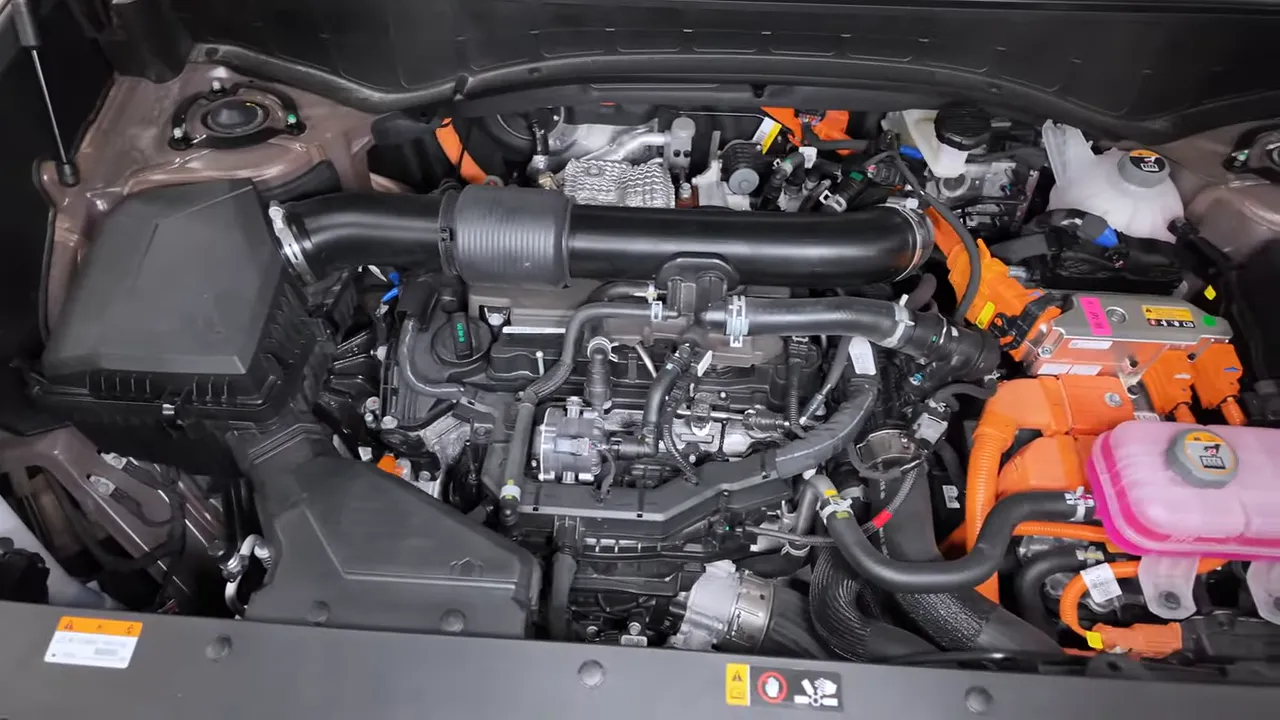
Mechanical construction and valve timing
At the top is a plastic valve cover, partly obstructed by the intake plumbing. Underneath, the engine uses a two-piece cylinder-head arrangement: an upper section carrying the camshafts and associated hardware, and a lower section containing the valves.
The basic mechanical layout includes:
- Dual overhead camshafts.
- Roller rockers and hydraulic lifters.
- A timing chain connecting the crankshaft and camshafts.
- A second chain driving the combined oil-pump and balance-shaft assembly.
- Continuously variable valve timing, which Hyundai calls CVVT.
The intake cam’s timing adjustment is electrically controlled. That might sound like another complication, but I actually like the design. It is straightforward and does not rely on oil pressure to make that adjustment.
The exhaust side uses oil-controlled variable valve timing, a conventional approach that makes sense for that side of the engine.
Cooling, fuel injection, and turbocharging
The cooling system is more involved. The engine retains a mechanical water pump driven by a stretch belt. A mechanical pump is not automatically a problem, but its location is not my favorite: it sits at the back of the engine, underneath the turbocharger, in a hot and awkward area.
There is also a coolant-management valve that routes coolant to help the engine warm up faster. Separate from the mechanical pump, there are two electric coolant pumps: one serving the hybrid cooling circuit and another maintaining heater circulation when the engine shuts off.
The engine uses direct injection only. The injectors sit underneath the intake manifold, while the high-pressure fuel pump is accessible higher up and insulated to reduce its operating noise.
The turbocharger is mounted at the rear of the engine and uses both oil and coolant for cooling. It has an electronic wastegate and feeds an air-to-air intercooler positioned toward the side of the front cooling package.
My concern is not simply that this is a turbocharged hybrid. It is the number of plastic fittings close to that hot turbocharger, combined with how some of the surrounding components feel and are routed. Those are details I pay attention to when thinking beyond the first few years of ownership.
The Redesigned Hybrid System Is a Welcome Improvement
The hybrid system is one area where Hyundai has made changes I genuinely appreciate.
This is still based around a regular six-speed automatic transmission. Between the engine and transmission are a large electric motor and an engine-disconnect clutch. The clutch allows the engine to be connected to or separated from the driveline.
The main motor has two jobs:
- Propulsion: It can drive the transmission and move the vehicle electrically.
- Generation: When driven by the vehicle’s motion during regeneration, it can produce electricity to recharge the hybrid battery.
No more large belt-driven starter-generator
Earlier Hyundai hybrid systems used a large belt-driven hybrid starter-generator where an alternator would normally sit. That required a substantial belt and tensioner arrangement.
Here, that arrangement is gone. Hyundai has moved the second motor to the side of the transmission, roughly in the area where you would expect a conventional starter.
This motor can start the engine, generate electricity, and assist propulsion while the engine is running. That additional assistance is an important part of the redesign.
To me, this packaging makes much more sense than the old belt-driven setup. Interestingly, the crankshaft pulley still has the large ribbed section associated with the previous belt arrangement, even though that belt is no longer there.
A smaller hybrid control unit
The hybrid power-control unit is also considerably smaller. Its responsibilities remain substantial:
- Supplying AC electricity to the electric motors.
- Converting generated AC electricity into DC electricity to charge the high-voltage battery.
- Supplying the high-voltage electric air-conditioning compressor.
- Using a DC-to-DC converter to reduce high voltage to 12 volts for the vehicle’s electronics and 12-volt battery.
The 12-volt battery is not sitting under the hood, but Hyundai provides underhood jump-start points.
The hybrid redesign is a positive. Getting rid of the large starter-generator belt arrangement and shrinking the control unit are changes I welcome. Unfortunately, that praise does not extend to everything surrounding the system.
Engine-Bay Packaging and Materials Raise Questions
The Palisade looks expensive inside and out, yet it remains priced in the same general territory as its competitors. My impression is that some of the compromises needed to deliver that presentation are visible under the hood. That is an assessment of what I found, not access to Hyundai’s development budget.
Too many components seem awkwardly placed
The air-filter and intake arrangement occupies a large amount of space across the engine. It obstructs access, and parts of the plastic intake feel unusually flimsy. Looking at the available space elsewhere in the bay, I would have liked to see a more thoughtful arrangement of the air box and fuse block.
The coolant-reservoir plumbing is another example. There are separate engine and hybrid cooling circuits, but one reservoir has a long, lightly secured hose that takes an unnecessarily indirect route to the radiator. It travels across the bay, turns, and doubles back.
From a serviceability standpoint, I would much rather see a reservoir positioned closer to its connection with a shorter, more direct hose. There may be packaging constraints we cannot see, but the result here does not look especially tidy or robust.
One electric coolant pump and its hoses also sit over the valve-cover area, adding more hardware above components that may eventually need service. The other pump’s lower location bothers me much less.
The concern is the overall execution
Some hoses and clamps look perfectly reasonable. Then those hoses connect to plastic fittings and larger plastic pipes that feel noticeably less substantial.
I generally place Hyundai somewhere in the middle for this kind of execution: not the best, not the worst. On this Palisade, I notice a decline in the feel of several underhood pieces compared with other Hyundai models I have inspected.
That does not prove those pieces will fail. A new vehicle inspection cannot establish long-term reliability. But it does explain why I am cautious. I like the revised hybrid architecture; I am less comfortable with some of the materials and packaging around it.
Under the Palisade: Suspension, AWD, and Underbody Details
The front underside is largely covered. There is access for routine oil-change service, but the main cover needs to come off for work beyond those basic service points.
Front and rear suspension hardware
At the front, the Palisade uses MacPherson struts, aluminum steering knuckles, single-piston brake calipers, and aluminum lower control arms.
The lower control arm has an integrated ball joint. Aluminum helps reduce weight, but I do not like combining a wear item such as a ball joint with the larger arm assembly from a repairability standpoint.
The front sway-bar links use plastic internal components, which are not my preferred construction. The axle shafts are painted, which is a welcome detail.
At the rear, the suspension combines several materials and components:
- Aluminum lower control arms and knuckles.
- Steel toe links, upper control arms, and trailing arms.
- Separate coil springs and shock absorbers.
- Sway-bar links with plastic internal components.
- Single-piston calipers with integrated electric parking-brake motors.
The hybrid inspected here still uses a mechanical all-wheel-drive arrangement, including a transfer case, driveshaft, and rear differential with a disconnect mechanism. It does not replace the rear mechanical driveline with a separate rear electric motor.
The driveshaft has one center support bearing. From visual inspection, that bearing does not appear separately serviceable, although I would want to confirm the parts information before treating that as a definitive repair limitation.
Exposed A/C plumbing and drain design
The air-conditioning lines run underneath the vehicle beside the hybrid battery. One connection is positioned in an area that looks exposed to road debris and contamination. That is not where I want a connection that may eventually need to come apart for service.
The A/C drain outlet also raises a question. Its design appears intended to discourage insects from entering, but I am concerned that the restriction could itself become a place for debris to collect and cause a blockage.
The exhaust and seam sealing are disappointing
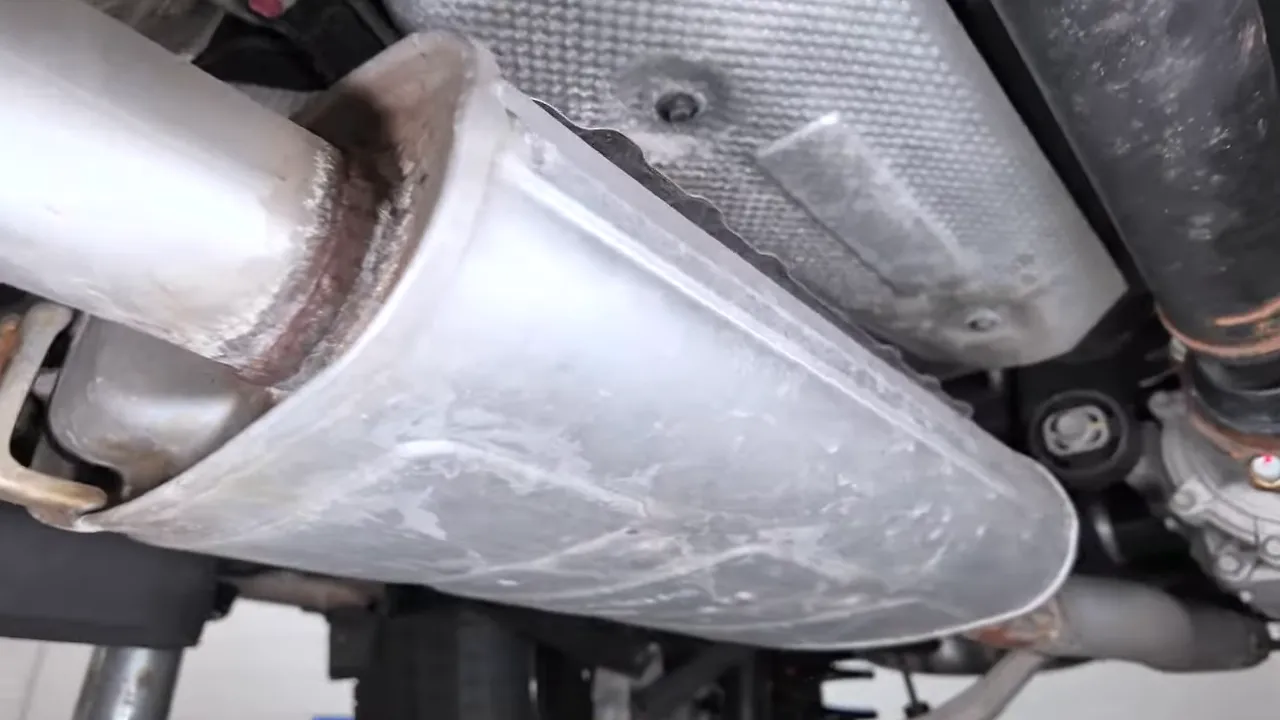
The exhaust is one of the biggest disappointments underneath this SUV. The muffler’s construction and finish look more like an inexpensive replacement part than something I would expect under a vehicle with this level of interior presentation.
Again, appearance alone is not a durability test. But after inspecting several Hyundai models, this exhaust stands out to me for how inexpensive it looks and feels.
The seam-sealer application is inconsistent as well. In several places, sealer is applied along part of a panel while an adjacent opening remains exposed. That makes me question the completeness of the application.
There are good details underneath, too. Some protective or damping material is present, although I would like to see more of it, and the covers around portions of the rear underside are nicely done. One side has a smaller cover, but it still provides useful coverage.
The problem is the contrast. Some areas show care, while others feel unfinished or built down to a cost.
Exterior Design: Striking, but Very Busy
There is no subtle way to describe the 2026 Palisade’s exterior. It is over the top, and then it goes a little further.
The front is dominated by an enormous grille and exceptionally large headlight assemblies. The headlights occupy a huge portion of each front corner. I hope those assemblies are durable, because there is a lot of lens area exposed if something strikes that corner.
I do like the metallic-looking finish on the surrounding trim. Hyundai got the color and surface appearance right. Even the small opening flaps in the front fascia have decorative detailing, though, which tells you how thoroughly styled this vehicle is.
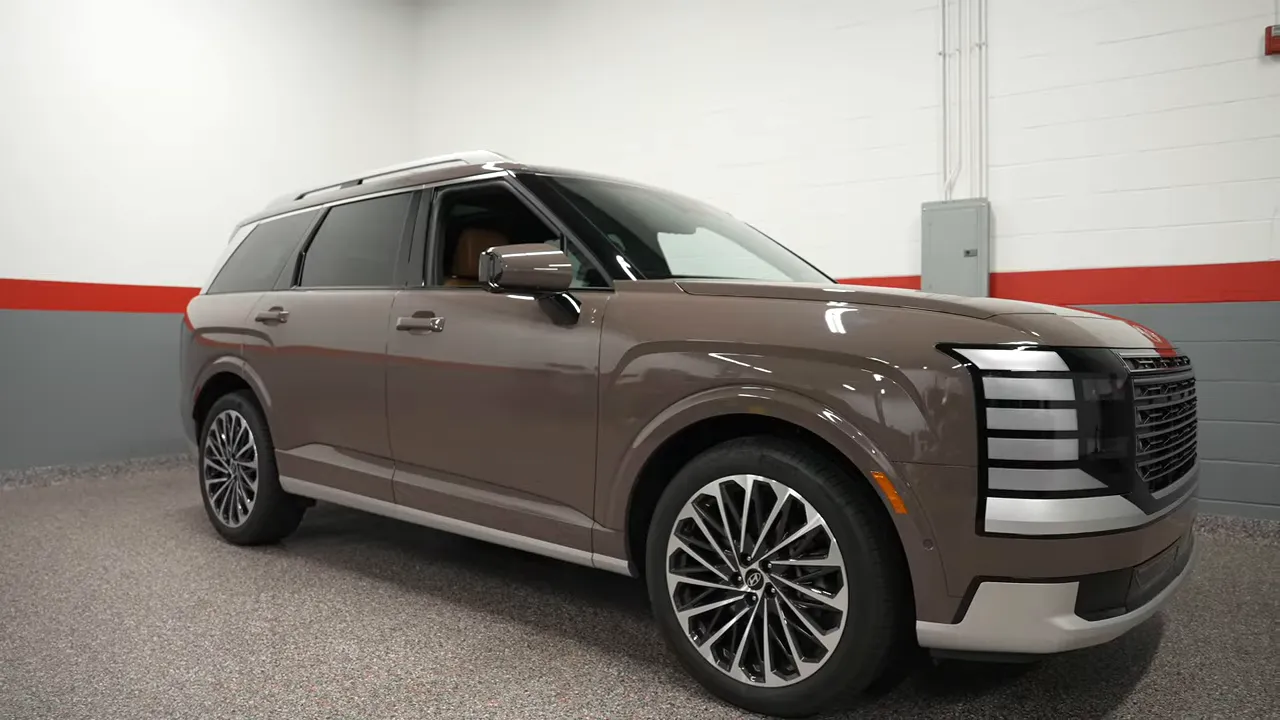
From the side, the Palisade has an upscale presence that looks beyond its class. It also strongly reminds me of a Range Rover. That resemblance is not necessarily unattractive, but I would rather praise an original Hyundai design than recognize another manufacturer’s shape.
The large windows are a genuine benefit, particularly the expansive rear side glass. They help visibility and make the vehicle feel open. There is also an angular detail near the upper glass that reminds me of the Cybertruck, an unusual touch on an otherwise rounded, substantial SUV.
The wheels are distinctive, although their directional pattern looks backward to my eye. At the rear, the taillights extend farther into the surrounding bodywork than I think they need to. There are multiple cameras, prominent Palisade lettering, a hybrid badge, and very little visually protruding bumper.
I like the overall rear appearance. I just find the styling derivative and wonder how well some of the more elaborate details will age.
More concerning is the paint finish on the example I inspected. It was not as good as I normally expect from Hyundai. This is a vehicle with tremendous presence from a distance, but the close-up finish deserves attention before purchase.
Cargo Space and Powered Seats: Useful Space, Elaborate Controls
The powered liftgate uses two motorized supports, with wiring routed through the headliner area. Inside the cargo opening, the brown plastic trim is beautifully finished, and the speaker integration adds another carefully styled detail.
The cargo-area controls for the second and third rows are unusually elaborate. You can:
- Fold or raise all the rear seats together.
- Select the second or third row.
- Adjust individual seats forward and backward.
- Fold individual seat sections separately.
Some of this seems excessive, but I will give Hyundai credit for the all-seat function. Powered folding seats often irritate me because they take too long. These operate at a reasonable pace, and being able to fold everything with one command is genuinely convenient.
The two second-row seats in the test vehicle did not fold at exactly the same speed. One consistently lost that little race. It was an observation on this example, not enough by itself to call something defective.
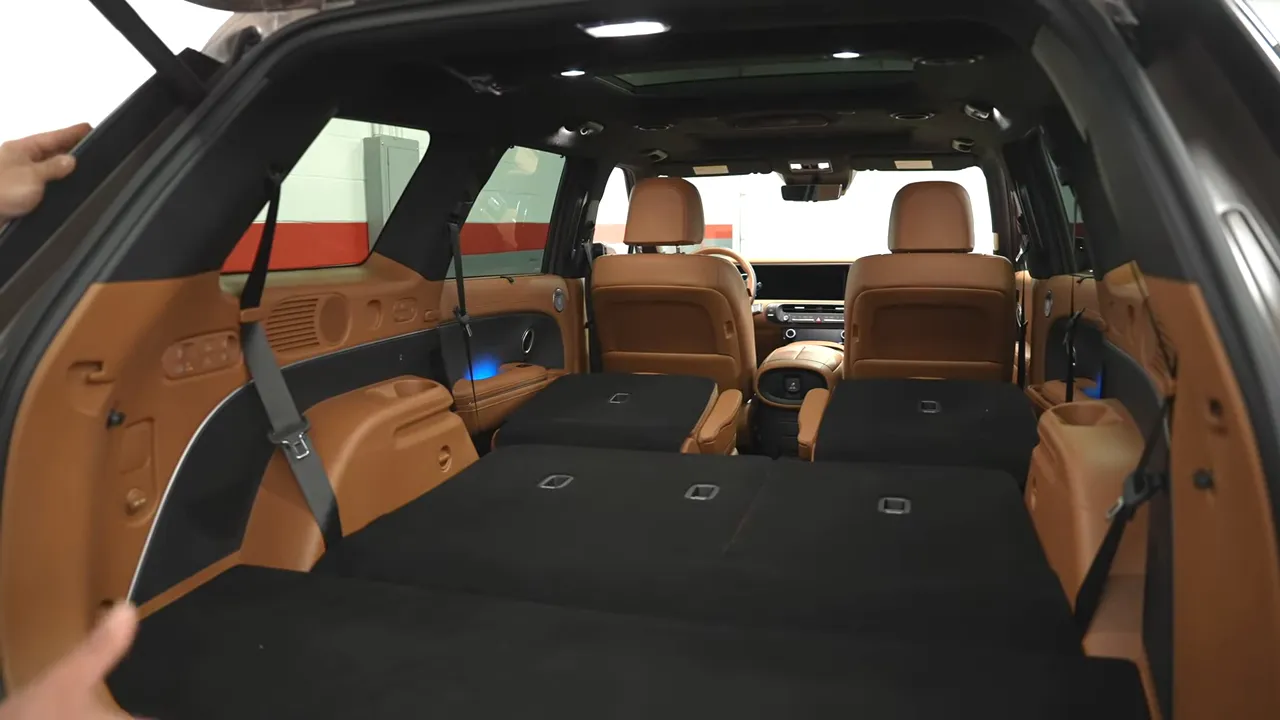
More important than the controls is the space. There is an impressive amount of usable cargo room behind the third row for a three-row SUV of this size. You do not have to fold the third row every time you need to carry something.
Underfloor storage is limited because battery hardware occupies space below. The inspected hybrid does not have a spare tire. Instead, it carries a tire-repair kit and tools in neatly finished cases.
The cargo-floor cover itself feels strong and well made. There are plenty of thoughtful touches back here, even if the seat-control system seems to have more functions than most families will regularly use.
The Calligraphy Interior Is the Main Attraction
The interior is where the Palisade becomes truly impressive.
Its broad horizontal dashboard is simple, brave, and elegant. The large display panel does not dominate the cabin the way you might expect, because the rest of the design is so visually strong.
In Calligraphy trim, the headliner and pillar materials are excellent. The front doors have generous leather coverage, and the overall combination of design, materials, and execution is remarkable for a Hyundai.
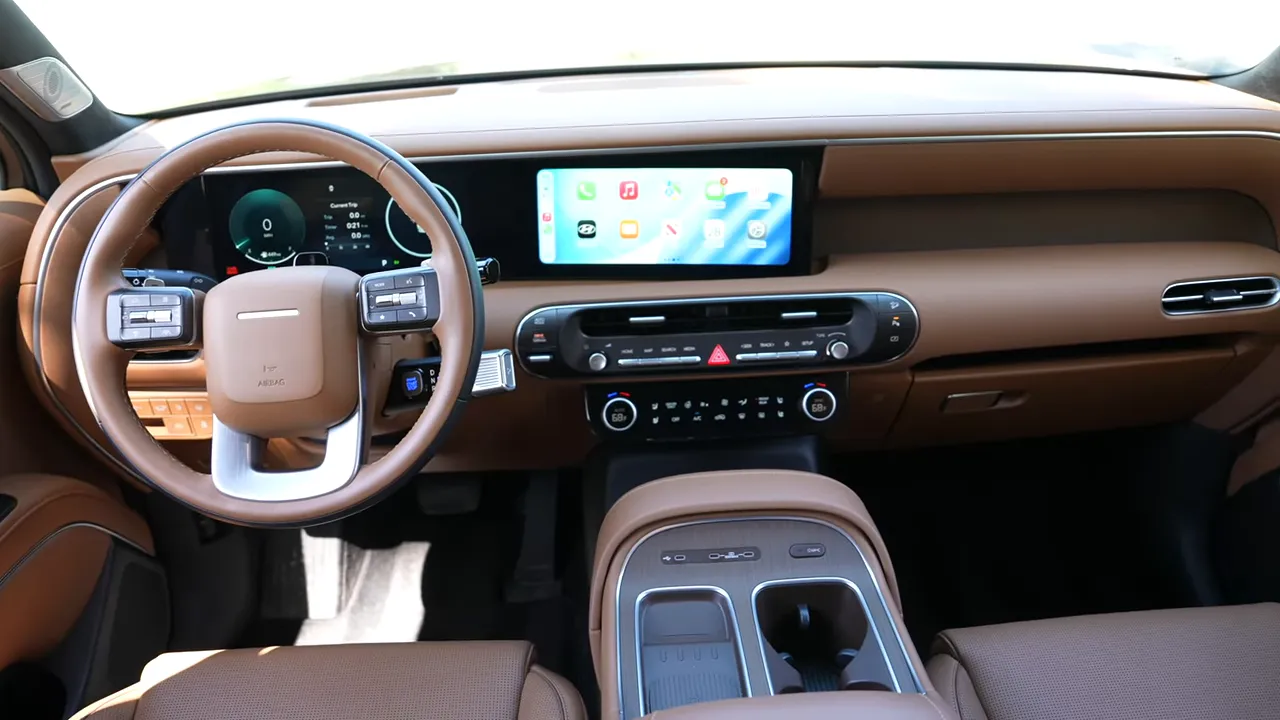
This is not faint praise. There are luxury vehicles whose interiors do not look or feel this special.
Physical controls keep it easy to use
Thankfully, Hyundai did not use the clean design as an excuse to remove the buttons.
There are physical audio controls, dedicated climate controls, drive-mode and terrain-selection controls, and straightforward steering-wheel switches. The everyday functions remain easy to find.
The shifter has moved to a steering-column stalk, and the start button is integrated into that assembly. The shift operation feels backward to me, but it is something I could get used to. More importantly, relocating it frees up the center console.
The floating console provides useful storage underneath. There is one wireless charging pad. After seeing two in the Santa Fe, I wish Hyundai had found a way to include a second one here.
Not every feature earns its place
The center console includes a UV sanitizing compartment. Put your items inside, press the button, and the system is intended to sanitize them.
For me, that is competing very strongly for gimmick of the year.
The seats have a stretching function that is easy to mistake for a conventional massage feature. It can be comfortable, but the settings take too much searching through the interface. Pressing the dedicated seat button does not immediately bring up the menu I would expect.
There are also relaxation or “zero gravity” seating positions, including one for the driver when parked. Additional controls let someone operate the front passenger seat and its relaxation position remotely.
Some of these functions feel designed around a chauffeur-driven experience. Folks, this is a Palisade. I am not sure how many owners need someone else to put the passenger into a relaxation position when that passenger can reach the seat controls.
The second row is exceptionally comfortable
The tested vehicle has second-row captain’s chairs, with dedicated climate controls, heated and ventilated outboard seats, window shades, and USB-C ports integrated into the front seatbacks.
Headroom and knee room are generous. The seats themselves are very comfortable and fully powered, with an amount of adjustment that exceeds what some competing vehicles provide for their front seats.
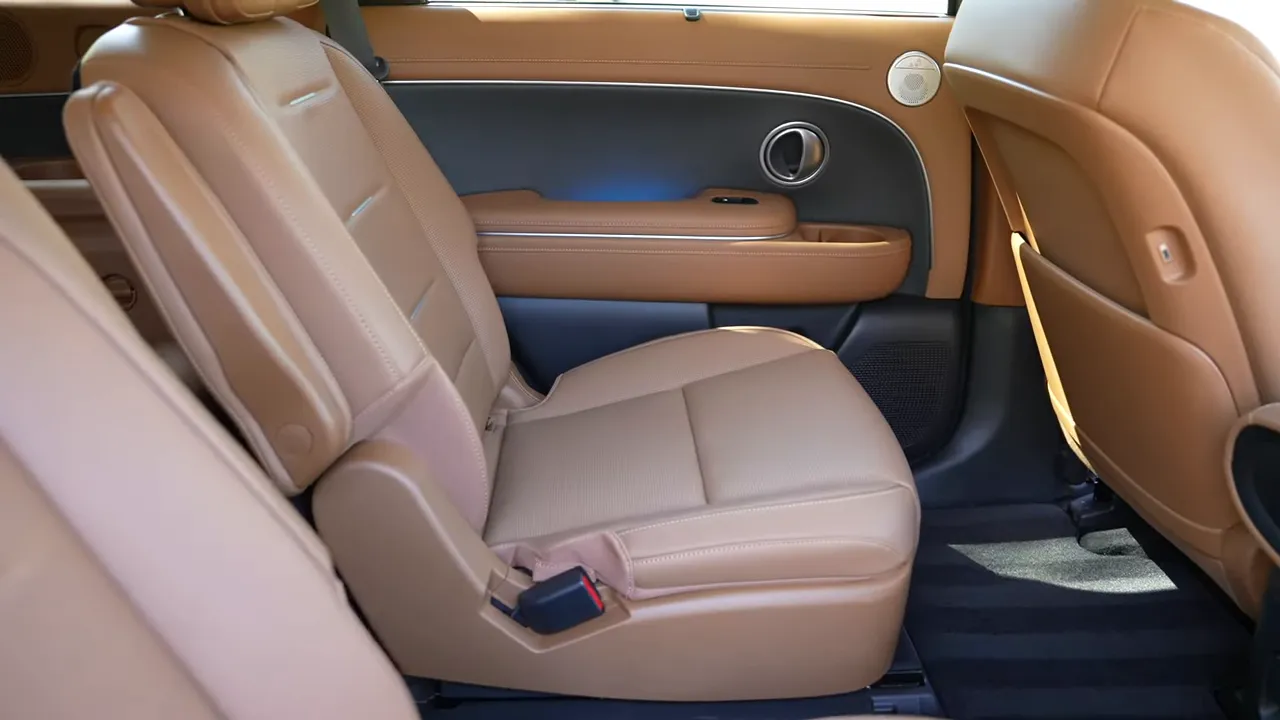
Material quality is less consistent back here, though. The rear doors have less leather coverage than the front doors, and the plastic front seatbacks are a noticeable contrast with the luxurious presentation up front.
That is what makes the extra passenger-seat controls a little puzzling. Hyundai adds features suggesting an executive rear-seat experience, but the rear passengers still face large plastic panels. I would have preferred a more consistent finish over a few of those extra buttons.
Driving the Palisade Hybrid: Premium Appearance, Not Luxury-Car Isolation
The interior sets your expectations very high. You settle into the seat, take in the materials and design, and expect the rest of the vehicle to deliver the same experience.
Then the four-cylinder engine starts.
In my testing, the engine was loud and intrusive relative to what the cabin’s appearance led me to expect. Over bumps, suspension noise was also noticeable, and the overall isolation did not match the luxury-car atmosphere inside.
That needs context. The Palisade is a mainstream three-row SUV, not a luxury vehicle. Its interior is so convincing that it encourages you to judge everything else by a different standard.
That does not mean every noise makes it a bad vehicle. It means the visual and tactile experience promises something the driving refinement does not fully deliver. The cabin looks like it belongs in a higher segment, while the sound isolation and suspension behavior remind you where this SUV is actually positioned.
A proper test drive matters here. Do not make the decision while sitting in the showroom. Pay attention to engine operation and suspension noise on the roads you normally use.
Should You Buy the 2026 Hyundai Palisade?
The previous Palisade already stood out for offering a particularly nice interior in a mainstream family SUV. This generation takes that idea much further, especially in Calligraphy trim.
There is plenty to appreciate:
- A genuinely outstanding front cabin with beautiful design and impressive materials.
- A welcome hybrid-system redesign that eliminates the old belt-driven starter-generator arrangement.
- Comfortable, highly adjustable second-row seating.
- Useful cargo space behind the third row.
- Physical controls that keep everyday operation straightforward.
But my biggest concern remains the quality of the pieces you do not normally see. The intake plastics, coolant plumbing, component placement, exhaust construction, and inconsistent underbody finishing leave me less confident than the interior does.
My suspicion is that delivering this cabin, a new V6 offering, and a substantially revised hybrid system at a competitive price required compromises elsewhere. The inspection gives me reasons to question those compromises, but it does not establish what Hyundai spent or prove that the vehicle will be unreliable.
That distinction matters. These are long-term ownership concerns, not a record of demonstrated failures. I hope the Palisade proves durable and my concerns turn out to be unfounded.
The intended buyer is another question. The tested vehicle is around $60,000. At that level, someone primarily seeking leather, luxury features, and an upscale atmosphere may also consider Genesis, depending on the model and configuration. Meanwhile, a family buying a Palisade to keep for many years may care more about durability and repair costs than remote relaxation-seat controls.
Hyundai’s advertised 10-year/100,000-mile powertrain warranty provides some reassurance, but it is worth reading the official warranty coverage and eligibility details rather than assuming every component carries that coverage.
My answer is cautious. If cabin design, passenger comfort, and family space are your priorities, the 2026 Palisade deserves consideration. If your main goal is long-term ownership with minimal repair expense, I would not let that spectacular interior make the decision for you.
Hyundai has made the Palisade incredibly appealing where your eyes and hands spend the most time. I simply wish the parts underneath and under the hood inspired the same confidence.


