The 2026 Honda Passport finally has an identity of its own. It is no longer simply the Honda you consider and then ask, “Why wouldn’t I just buy a Pilot?” This redesign gives it a clear purpose: a comfortable, functional SUV with a naturally aspirated V6, useful off-road hardware, and remarkably few gimmicks.
And folks, they did this one very well.
That does not mean it is perfect. There are engine design choices I would change, some transmission behavior worth discussing, and a few software glitches. But after inspecting the engine bay, getting underneath it, and spending time with the interior, this is one of the most complete SUVs I have reviewed in a long time.
The vehicle examined here is a 2026 Honda Passport TrailSport Elite. Keep that in mind, because some of its equipment and convenience features depend on trim.
Quick Summary
- The updated V6 eliminates manual valve adjustments but retains a timing belt, direct injection, and cylinder deactivation.
- Torque-vectoring AWD and substantial protection give the TrailSport Elite meaningful off-road equipment.
- Upright packaging, physical climate controls, and flexible spare-tire storage make the Passport exceptionally practical.
- Occasional transmission hesitation and infotainment glitches are the main driving and usability complaints.
Table of Contents
- Under the Hood: The Latest Honda V6, Finally
- The 10-Speed Automatic and Torque-Vectoring AWD
- Underneath: Serious Protection, With a Few Exposed Areas
- Exterior Design: A Box That Actually Looks Good
- Cargo Space: Good Packaging and a Clever Spare-Tire Option
- Interior: Keep What Works, Improve What Does Not
- What I Would Consider Before Buying
- Should You Buy the 2026 Honda Passport?
Under the Hood: The Latest Honda V6, Finally
The Passport now gets the J35Y8 V6 used in the Pilot. This is an updated version of Honda’s familiar V6 family, but the mechanical changes are substantial enough that you should not think of it as simply the old engine with a different cover.
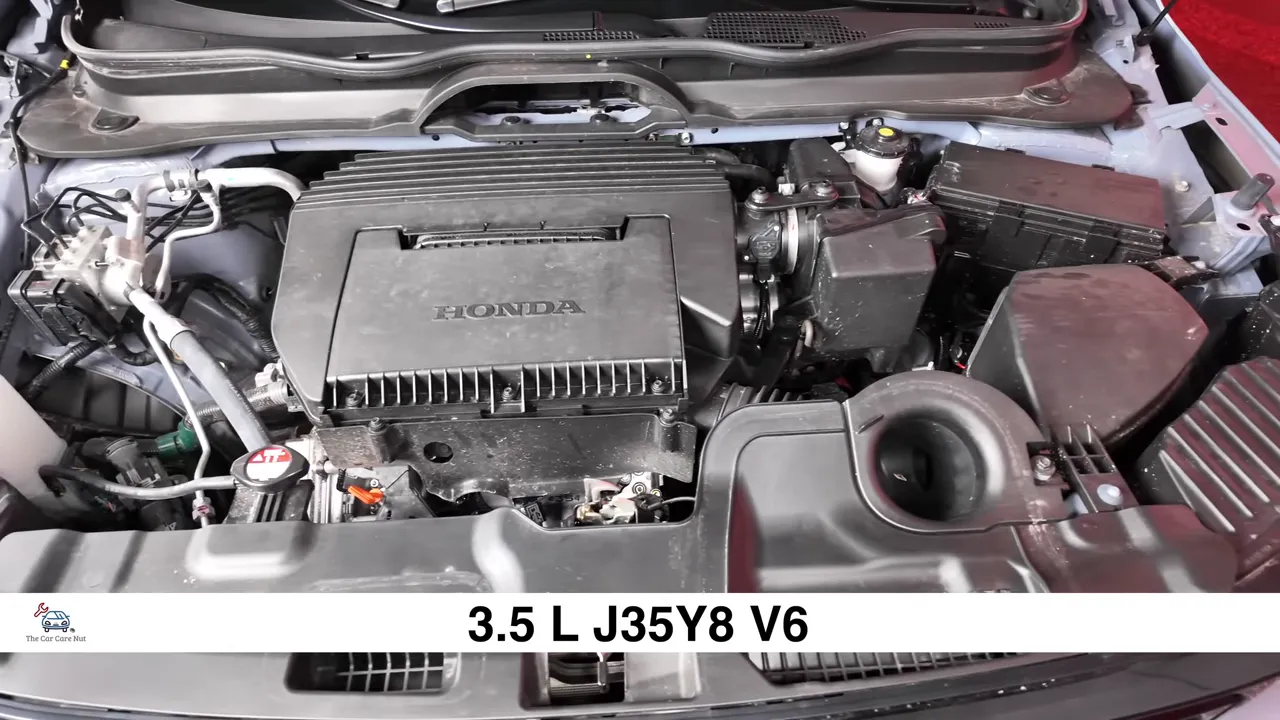
Dual overhead cams and an unusual valve cover design
This engine moves from a single overhead cam layout to dual overhead cams. The aluminum valve covers are also part of the camshaft support structure, with the cam caps integrated into them.
That explains why Honda did not use plastic covers here. These are doing more than keeping oil inside the engine. It also means they use sealant rather than a conventional valve cover gasket, and removing one is not the same straightforward operation as removing an ordinary cover.
The big maintenance improvement is in the valvetrain. Honda uses hydraulic lash adjustment and roller rockers, so the traditional manual valve adjustment is no longer part of this V6’s maintenance requirements. That is a welcome change.
It still has a timing belt
This remains a timing belt engine, now with a substantial belt serving the dual overhead cam arrangement. Timing belt service requires a special tool to hold the camshafts in position.
The water pump is driven by that belt. The oil pump is driven directly from the nose of the crankshaft and sits behind the timing belt area. You still have the familiar crankshaft and camshaft seals associated with this kind of layout.
A timing belt helps keep operation quiet, but it also represents a maintenance obligation. Do not buy this assuming there is no scheduled timing drive service simply because the engine is new. For vehicle-specific maintenance information, use Honda’s official owner resources.
Two engine choices I wish Honda had changed
My first reservation is direct injection only. I would have preferred a system combining port and direct injection. Honda chose not to do that here.
The second is Variable Cylinder Management, or VCM. Under certain driving conditions, the engine can deactivate three cylinders and operate on the remaining three. The valvetrain allows the affected valves to stop opening, taking those cylinders out of normal operation.
I like this V6 very much. It is smooth, it feels strong, and there is no turbocharger involved. But retaining cylinder deactivation and direct injection only keeps it from being exactly the engine configuration I would have chosen.
A complicated-looking intake in a service-friendly engine bay
The intake system is the strangest-looking part of the engine compartment. It branches into large chambers, covers the battery, and feeds a substantial air filter housing over the engine. Additional chambers sit along the route toward the throttle body.
It looks unnecessarily elaborate. Battery access requires removing part of that arrangement, and the large housing initially hides the spark plug area.
However, appearance and actual service difficulty are two different things. Once that upper housing is removed, spark plug access is straightforward. There is not an intake plenum stretching across the rear that makes access unnecessarily difficult.
More importantly, there is real working room around this engine, including at the timing belt end. Electric power steering eliminates a hydraulic power steering pump from that area. The materials feel good, the layout is approachable, and the hood even has support struts. From a mechanic’s perspective, there is a lot to appreciate.
The cooling system is also refreshingly conventional, with a belt-driven water pump, thermostat, and familiar hose arrangement. One plastic coolant connection near the radiator has a specific removal precaution: the component needs to be unbolted before its hose is removed. That is the kind of detail that matters during a repair. The cooling fans also use an offset arrangement to fit the available space.
The 10-Speed Automatic and Torque-Vectoring AWD
The 2026 Passport uses a 10-speed automatic transmission. Most of the time, it shifts very smoothly and suits the V6 well.
There are moments, though, when it seems to spend a little too long deciding which gear it wants. In our test vehicle, we noticed occasional gear hunting and a slight delay in engagement or response. It is not the dominant driving characteristic, but it is something I would pay attention to during a test drive.
The all-wheel-drive system is more interesting than a basic arrangement that simply sends some power rearward. A transfer unit feeds a driveshaft running to Honda’s i-VTM4 torque-vectoring rear unit. That rear unit can distribute drive between the rear wheels, directing power to either side or both as conditions require.
At the front, the differential is open. The vehicle can apply braking to a slipping front wheel to help the opposite wheel make better use of the available drive. That is different from having an independently controlled front torque-vectoring differential, but it is useful off pavement.
This combination is an important part of why the Passport’s off-road personality feels more substantial than a styling package.
Underneath: Serious Protection, With a Few Exposed Areas
The underside of our test vehicle had clearly been put to work before it arrived. Mud covered much of the front exhaust, and the protective panels already showed scrapes. That gave us a useful look at where the hardware had actually contacted the terrain.
Recovery points are useful, but direction matters
The front has three recovery points, including the visible orange loops and another point underneath. That is impressive equipment for a unibody SUV.
However, do not assume those loops can withstand a pull from any direction. Their permitted working angle is narrow, described during the inspection as approximately 15 degrees. A strong sideways pull can damage the mounting arrangement.
Recovery hardware is not permission to pull at any angle. Follow the vehicle’s specific recovery instructions rather than judging capability by the size or color of the hook.
A strong front shield does not protect everything
The main front protective shield is substantial. This is not a thin panel that looks useful until it touches something.
My concern is what sits just behind it: part of the transfer unit protrudes below the shield’s protective line. A rock that passes the shield can still contact that exposed component. I would have liked Honda to extend the protection farther back.
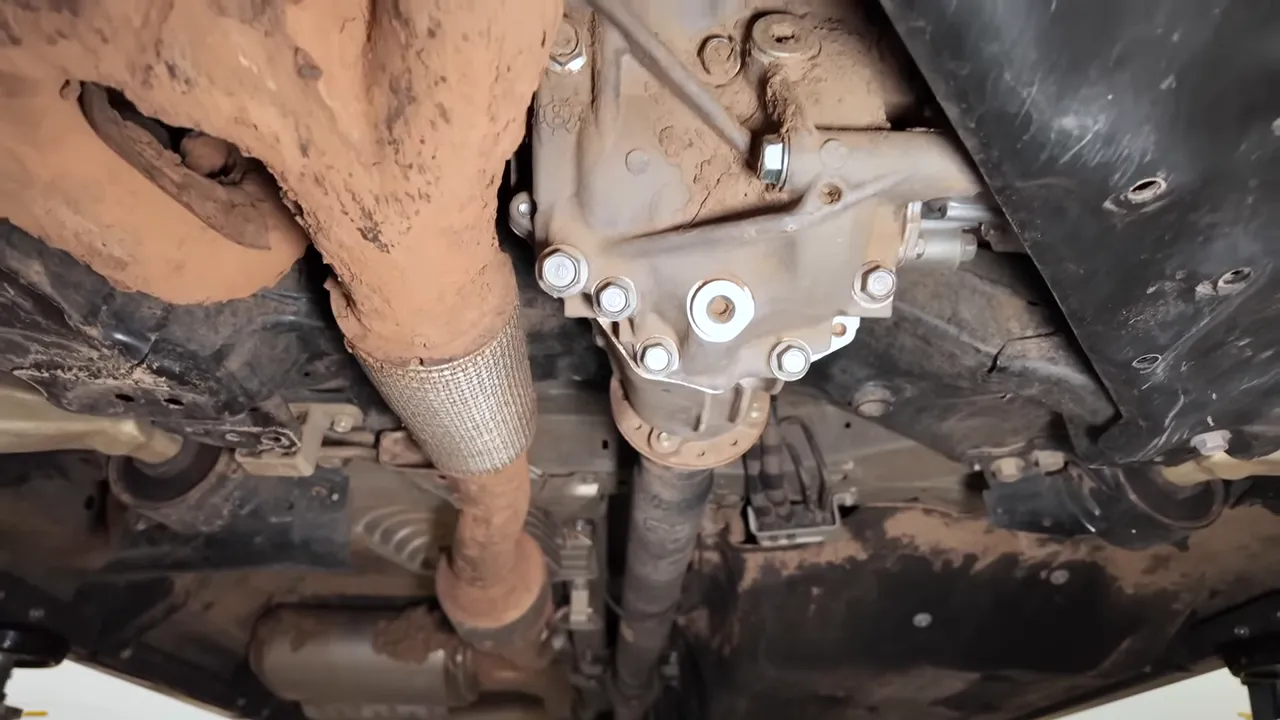
The driveshaft is also relatively exposed, which is consistent with Honda’s usual approach. There is some local shielding, but not continuous protection along its length.
Farther back, the fuel tank gets a proper full-size protective cover. The scrapes on this vehicle’s cover made a good argument for having it. The side rock sliders are bolted to reinforced portions of the unibody and incorporate marked lifting locations. These are useful details, not just rugged-looking trim.
Front suspension and a brake service detail worth remembering
The front suspension uses:
- Aluminum lower control arms with integrated ball joints.
- Steel steering knuckles.
- MacPherson struts.
- Aluminum sway bar links.
- Dual-piston front brake calipers.
I would prefer a different material choice for the sway bar links, but the overall arrangement is straightforward. There is also a separately serviceable control arm bushing, which is a nice repair-friendly detail.
The front brakes have a small pad return spring that should be replaced with the pads. Overlooking it can contribute to uneven brake wear. It is a small part, but small parts can make the difference between a proper brake service and a repeat visit.
Rear suspension, exhaust, and towing hardware
At the rear, the three control arms are steel, while the knuckle is aluminum. The coil spring and shock absorber are separate. The rear brakes use single-piston calipers with integrated electronic parking brakes.
I like the steel control arms. I would not object to a steel knuckle either, although there is obviously a weight consideration. The rear sway bar links have an unusual angle and plastic construction within the assembly, which would not be my first choice.
The exhaust includes a catalytic converter integrated into the front pipe rather than a separately flanged converter section. That matters when considering how much of the assembly may need replacement during a future repair. Mud prevented a fair assessment of the front exhaust finish, but the visible rear sections looked well made.
There are fairly open areas around the rear exhaust outlets and body cavities. Mud had made its way high into those spaces. A little more coverage would have been welcome.
One small engineering detail also seemed unnecessarily complicated: the rear washer supply routing uses a hose, then a hard line, then another hose. It works, but the route looked like it could have been simpler.
On the positive side, the trailer hitch looks properly integrated into the vehicle’s design. It has a seven-pin connector, recovery provisions, and a straightforward bolted mounting arrangement. It does not look like something Honda remembered to add after the rest of the SUV was finished.
The transfer unit’s drain and fill plugs also retain Honda’s familiar square-drive arrangement, accepting a 3/8-inch ratchet. Simple, practical details still count.
Exterior Design: A Box That Actually Looks Good
My first impression of this Passport was that it had a little Honda Element in its personality. Not because the two look identical, but because Honda has committed to a simple, upright shape instead of covering the body in unnecessary drama.
That takes some confidence in today’s market. And it works.
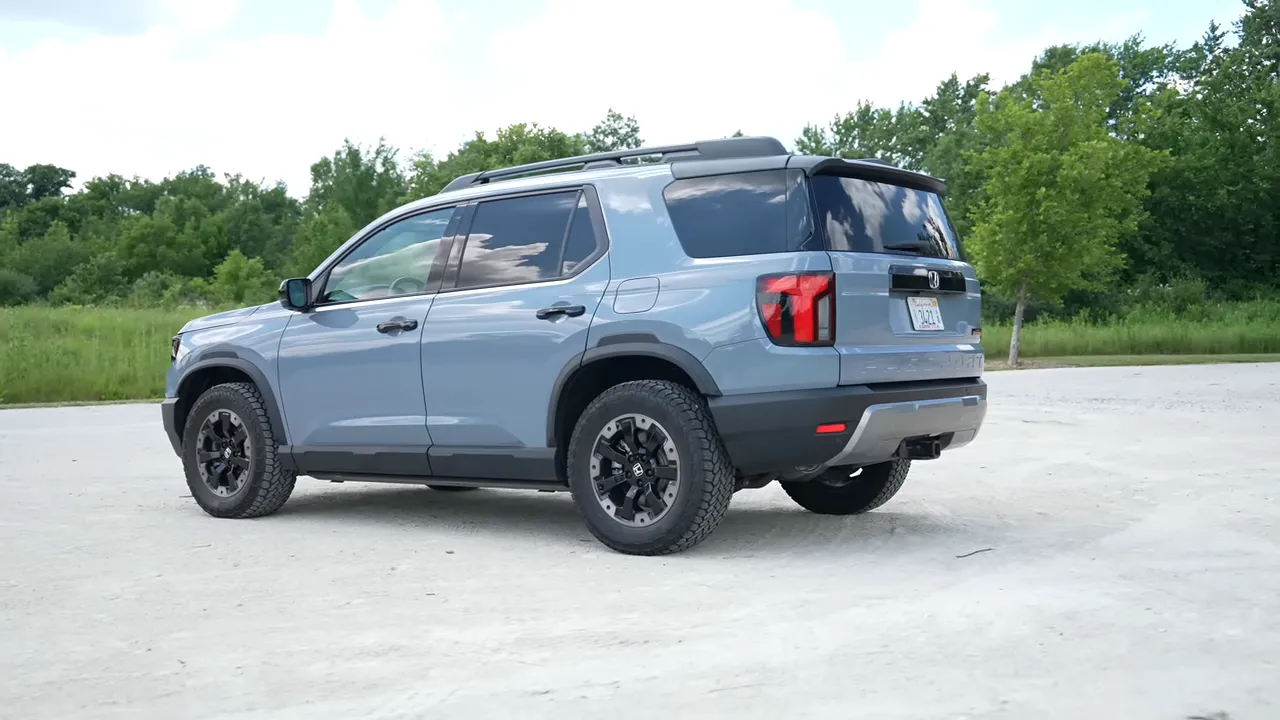
The headlights are essentially boxes with a modest curve. The grille is restrained. The hood uses only a few lines. At the rear, you get conventional-looking taillights rather than a giant illuminated bar stretching across the tailgate.
The badging is equally restrained: a small Honda emblem, Passport lettering stamped into the tailgate, and the TrailSport badge. It does not need an additional collection of labels announcing every mechanical system underneath.
The body-side character line is particularly well done. It adds definition without making the doors look busy, then carries visually into the pillar and rear bodywork. Large windows and an upright rear section reinforce the functional shape.
There are a couple of details I could do without. The decorative vent above the grille adds very little, and the small trim piece near the front fender feels like effort spent on something the design did not need.
Useful exterior details
- Keyless access at the rear doors: You can lock and unlock from the rear handles, not just the fronts.
- Textured upper trim: Rough, unpainted surfaces are intended to tolerate contact while loading items onto the roof.
- No roof-mounted shark-fin antenna: Antenna elements are incorporated into the glass instead.
- A front camera washer: A useful idea for an SUV likely to get dirty, although I remain skeptical of how thoroughly these little sprayers clean.
The lack of a shark fin deserves special praise. It removes an obstruction from the roof area and avoids having that vulnerable little component where cargo can strike it. More manufacturers should take that approach.
The TrailSport Elite’s General tires have a fairly aggressive tread for this type of SUV. They produce a little hum, but the wheels look good and the overall package suits the vehicle.
One practical concern is the small rear bumper projection. There is not much distance between the outer bumper and the tailgate, so contact with an obstacle could reach the door sooner than I would like.
The fuel door now opens by pushing on it rather than using the previous interior release. There is an emergency release inside. The filler is capless, which is not my personal preference.
The trim structure is refreshingly manageable: RTL, TrailSport, and TrailSport Elite.
Cargo Space: Good Packaging and a Clever Spare-Tire Option
The boxy design earns its keep in the cargo area. The rear roof and glass are nearly upright, so the space is usable higher up instead of disappearing beneath a sloping tailgate.
That means tall items can occupy more of the available footprint. It is a simple packaging decision with a real benefit.
Honda also makes good use of the areas around the wheel housings, adding large side storage pockets. Depending on equipment, there is a household-style power outlet in the cargo area as well as another inside the passenger compartment.
The power tailgate on this trim uses one powered actuator and a conventional support strut on the other side. The powered unit’s lower mounting location is behind the taillight area rather than up in the roof, which I like.
There is also a walk-away closing feature. Press the appropriate button, pick up your heavy cargo, and move away; the tailgate closes after a delay. That is a convenience feature with an understandable purpose.
A temporary spare for daily use, a full-size option for trips
Under the cargo floor is a temporary spare tire. Simply having a spare is becoming noteworthy, but that is not the clever part.
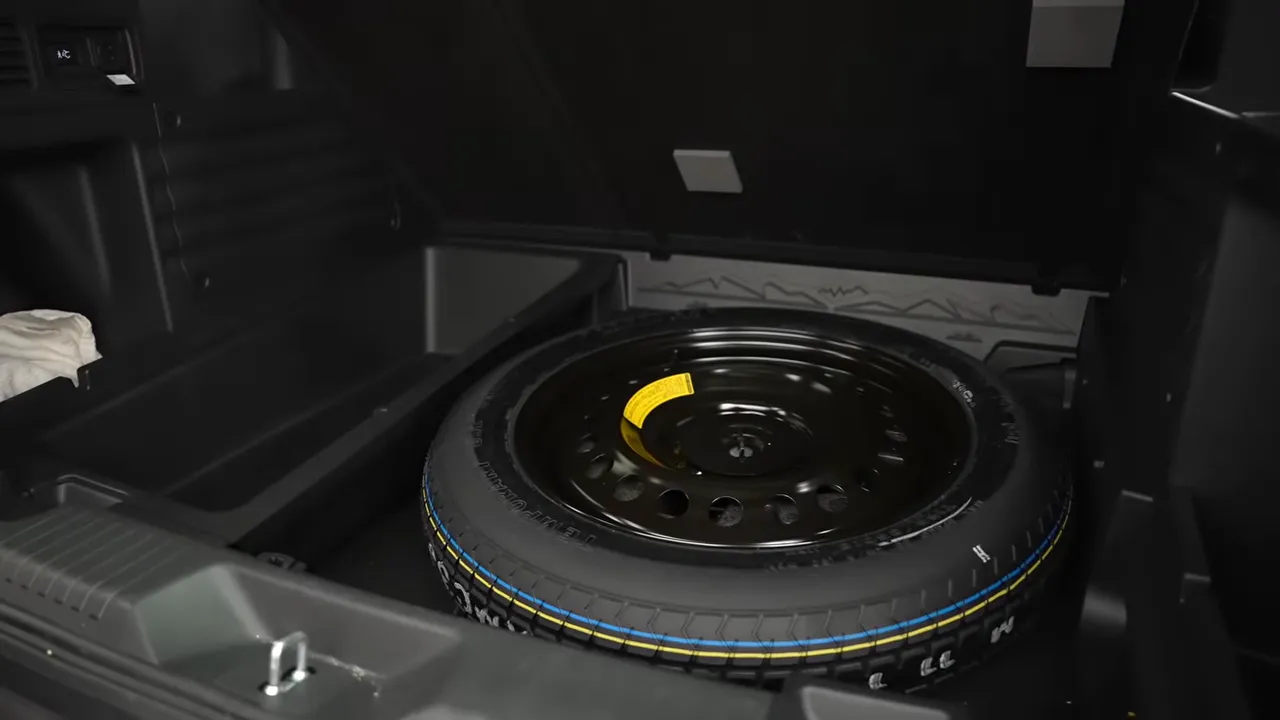
Honda also provides an accessory arrangement for carrying a full-size spare in the cargo area, with a dedicated mounting provision and cover.
I love the flexibility here. Use the compact spare arrangement during normal daily driving. Keep the full-size spare in the garage, then install it for that remote trip where a temporary spare would be a poor substitute.
Yes, carrying the full-size tire uses cargo space. But Honda gives you a way to secure it properly rather than leaving you to invent a solution. That is a good option, not a gimmick.
Interior: Keep What Works, Improve What Does Not
The interior feels like Honda examined the previous Passport and made sensible decisions. Good ideas stayed. Weak areas were updated. The result is not a showcase of exotic materials, but it is comfortable, clearly organized, and very easy to live with.
Screens that serve a purpose
The steering wheel has a simple control layout, including the heated steering wheel button exactly where it belongs: on the steering wheel.
Behind it is a 10.2-inch digital instrument display. I am not automatically impressed by a screen replacing gauges, but this one provides useful functions, including a map display. TrailSport and TrailSport Elite models also have off-road information screens.
The central infotainment screen measures 12.3 inches. Its basic software layout is intuitive, and the Passport lettering beneath it is a tasteful detail.
Our test vehicle did have glitches, including prompts involving location services and occasional hesitation. A software update may be able to improve that, but that is a possibility, not a fix I can promise.
My smaller complaint is the volume knob’s position on the driver’s side of the screen. The driver already has steering wheel volume controls. Putting the knob nearer the passenger would make more sense.
Excellent physical climate controls
The climate controls are one of the interior’s strongest features. They are physical, clearly labeled, well laid out, and feel good to operate. Rear climate settings are also easy to control from the front.
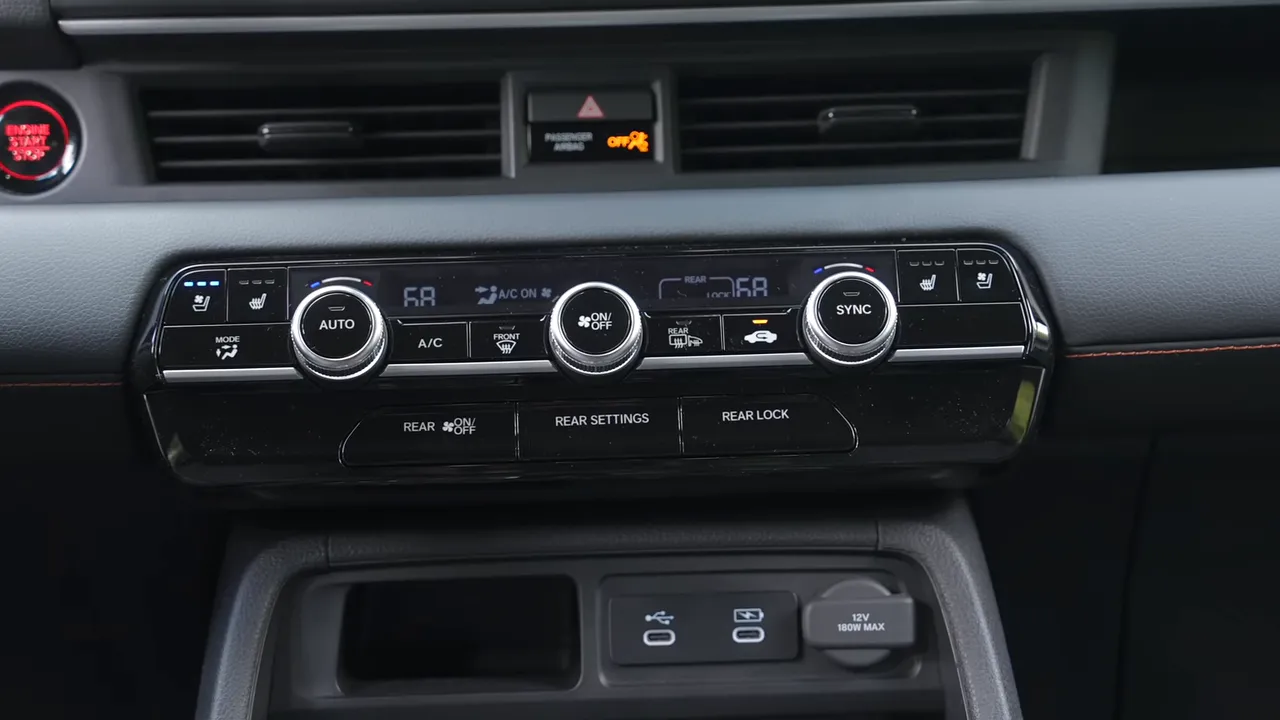
This is how straightforward climate controls should be. You do not need a complicated interface to change the temperature or fan speed.
The lower center stack has open storage and a wireless charging pad where equipped. The transmission uses push buttons. That is not my favorite shifter format, but I prefer it to many rotary selectors and unusual electronic designs.
There are seven drive modes, selected with an orange-accented control. Normally that many modes would seem excessive, but given the Passport’s intended range of uses, I can understand the choice.
The other controls are easy to find:
- Hill descent control, operating from approximately 2 to 12 mph.
- An automatic engine stop-start disable button.
- Brake hold.
- An electronic parking brake switch.
Add a huge center console, a useful dashboard shelf, and generous door storage, and you have an interior that prioritizes everyday function.
Comfortable on the road, even with the tires
The Passport rides smoothly and feels comfortable, even with this trim’s more aggressive tires. Insulation is good, although some tire hum remains.
It is not Acura-level quiet, and I would not describe it as the quietest SUV available. But the overall impression is well judged. You get in, operate the controls, and things feel right.
There is very little here demanding your attention merely to prove it exists. That restraint is one of the interior’s best qualities.
A rear seat that does not punish the middle passenger
At 5 feet 7 inches tall, I had plenty of knee room behind my own driving position and plenty of headroom, even with the panoramic sunroof.
The seats are comfortable, and the floor is flat across the middle. That makes the center position more accommodating than it would be with a large tunnel occupying the foot space.
The TrailSport Elite’s leather-trimmed seating has orange stitching, and the front seatbacks include useful phone pockets. Rear passengers get their own climate zone, window shades, USB-C charging, and a household-style outlet in this trim.
That is a very sensible collection of amenities. It provides what passengers actually need without making the rear seat unnecessarily complicated.
What I Would Consider Before Buying
My complaints fall into three main categories.
- Engine compromises: VCM remains, fuel injection is direct only, and the timing belt adds scheduled maintenance. I still like the engine, but those details belong in the ownership discussion.
- Occasional transmission hesitation: The 10-speed is generally smooth, but our vehicle sometimes hunted for gears or took an extra moment to respond.
- Infotainment glitches: The updated system is a welcome improvement in concept, but the software did not operate flawlessly during testing.
If off-road use is a priority, I would also look carefully at the exposed transfer unit area and understand the recovery-point restrictions. The protective hardware is meaningful, but it does not make every part underneath immune to contact.
These are reservations about a vehicle I otherwise like very much. They are not reasons to ignore everything Honda got right.
Should You Buy the 2026 Honda Passport?
Yes, this Passport deserves a serious place on your shopping list.
The early Passport generations were Isuzu-built vehicles. The previous Honda-developed generation was pleasant, but to me it often felt like a parts-bin alternative to the Pilot without enough distinction of its own.
This one changes that.
The 2026 Honda Passport has a clear place between the CR-V and Pilot, and it brings its own personality rather than merely occupying a gap in the lineup. The shape looks good and creates genuinely useful space. The cabin is comfortable and functional. The V6 is smooth and strong. The off-road hardware goes considerably beyond appearance.
I normally associate the more serious off-road equipment with body-on-frame vehicles. This unibody SUV makes a much more convincing effort than I expected, right down to multiple front recovery points, substantial shielding, and a practical full-size spare option.
For the overall execution, this is a 10-out-of-10 vehicle in my book. That is not a claim of perfection or a prediction of flawless long-term reliability. It is recognition of how well the design, mechanical package, comfort, and usefulness come together.
Minimal gimmicks. Good looks. Real function. The Passport finally makes complete sense, and that is what makes it such an easy SUV to like.


