The 2026 Honda CR-V Hybrid gets something right that too many new cars get wrong: it knows how to stay out of your way. It is smooth, quiet, easy to operate, and refreshingly light on gimmicks. There is plenty of technology here, but most of it works in the background instead of demanding your attention.
That does not mean everything is perfect. Under the hood, Honda has made some excellent serviceability decisions and a couple of genuinely frustrating packaging choices. Underneath, there is impressive component quality alongside some questionable finishing. And the hybrid battery creates compromises that matter in a family SUV.
The example here is the new-for-2026 CR-V TrailSport Hybrid. The important question is not simply whether it looks more adventurous. It is whether the engineering, practicality, and everyday experience add up to an SUV worth buying.
Quick Summary
- The 2026 CR-V Hybrid delivers a particularly smooth driving experience with straightforward, physical cabin controls.
- The naturally aspirated engine combines excellent EGR access with an awkwardly positioned engine air filter.
- Battery placement limits underfloor cargo storage, while the unfiltered cooling intake remains a concern.
- Mechanical all-wheel drive gains a 50/50 distribution capability for 2026.
Table of Contents
- Under the Hood: A Refreshingly Straightforward Hybrid Engine
- How the Honda CR-V Hybrid System Works
- All-Wheel Drive: A Mechanical Connection to the Rear Wheels
- Engine Bay Packaging: Good Quality, Some Strange Choices
- The Hybrid Battery Is My Biggest Packaging Concern
- Underneath the CR-V: Strong Components, Mixed Finishing
- Exterior: Recognizably CR-V, Without Overstyling
- Cargo Space: Generous Overall, but Not Completely Flat
- Interior: Simple Does Not Mean Lacking
- How It Drives: Refinement Is the Main Attraction
- Should You Buy a 2026 Honda CR-V Hybrid?
Under the Hood: A Refreshingly Straightforward Hybrid Engine
The hybrid uses a naturally aspirated 2.0-liter four-cylinder engine, rather than the 1.5-liter turbocharged engine found in the non-hybrid CR-V. This review is about the hybrid, and I like the starting point: no turbocharger, a timing chain, and an engine that is relatively straightforward mechanically.
Valve timing without unnecessary drama
At the top is a compact plastic valve cover over dual overhead camshafts. This is not a VTEC engine. Instead, it uses variable cam timing, with different approaches on the intake and exhaust sides.
The intake cam uses electrically controlled variable timing. A small motor changes the relative position within the cam timing gear. Speeding or slowing that motor relative to the mechanism advances or retards the timing; matching its speed holds the position.
That explanation can sound more complicated than the hardware really is. The attractive part is that intake timing adjustment does not depend on an oil-operated actuator. On the exhaust side, Honda uses a more conventional oil-controlled arrangement.
Excellent access to the EGR system
The exhaust gas recirculation system is one of my favorite details under this hood. The valve and cooler are right there, accessible rather than buried behind layers of unrelated components.
Looking at the layout, removing the valve appears to be roughly a five-minute job, the cooler about ten minutes, and the complete assembly around fifteen. Those are access estimates, not a promise for every repair situation, but the point stands: Honda has made this system unusually easy to reach.
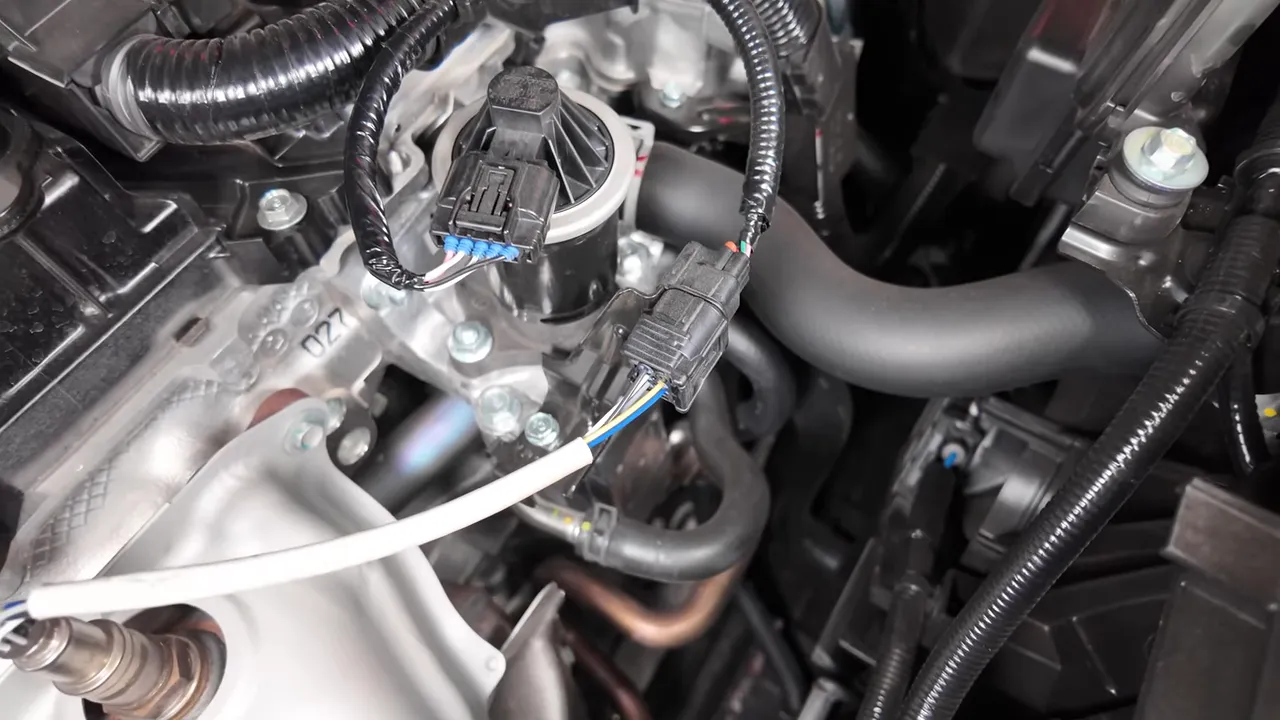
Why can’t more manufacturers do it this way? Toyota, the main competitor here, could take a lesson from this particular layout.
Direct injection, but a smart fuel pump location
The engine uses direct injection only. I would prefer dual injection, but Honda deserves credit for how it packaged the high-pressure fuel pump.
On many direct-injected engines, the cam-driven pump sits on the valve cover and becomes another component that must come off before the cover can be removed. Here, the pump sits on a separate extension beside it. The valve cover can come off without disturbing the pump. It is a small decision that makes a real difference during service.
A simple cooling system and no accessory belt
The engine cooling system uses a conventional thermostat rather than an elaborate collection of coolant control valves. The electric water pump is mounted externally, around the area where a conventional belt-driven pump would normally live.
There is no accessory drive belt. There is also no conventional alternator or starter motor: the hybrid motor starts the engine, while a DC-to-DC converter handles the low-voltage charging role.
Looking around the accessible cooling connections, I see proper metal fittings and conventional hose clamps rather than an abundance of plastic junctions and complicated connectors. That is encouraging. Overall, the engine bay feels solid, including the plastic pieces that are present.
How the Honda CR-V Hybrid System Works
Honda did not simply copy Toyota’s hybrid layout. It built a different two-motor system, and the result is one of the strongest reasons to consider this SUV.
The simplest way to understand the arrangement is to separate the jobs:
- The engine-connected motor starts the gasoline engine and can generate electricity when the engine turns it.
- The traction motor drives the wheels and recovers energy during regenerative braking.
- The clutch arrangements allow the system to establish a direct mechanical connection from the engine to the wheels under suitable conditions, with low and high engine-drive ranges.
This is not a conventional automatic transmission, and it is not the planetary power-split arrangement used in Toyota hybrids.
Three operating situations explain most of it
- Electric driving: The gasoline engine stays off and the traction motor moves the vehicle using battery power.
- Engine-generated electric driving: The engine runs the generator motor, and that electricity supplies the traction motor. Hearing the engine does not necessarily mean it is mechanically driving the wheels.
- Direct engine drive: Under appropriate conditions, the system connects the engine mechanically to the wheels rather than relying on the electrical path alone.
That second situation is the interesting one. When the battery needs support or the vehicle needs more power, the engine can start to generate electricity while the electric motor continues doing the driving.
The e-CVT does not feel like a typical CVT
Honda calls this an e-CVT, but do not confuse it with a normal belt-and-pulley CVT. Much of the relationship between engine speed and road speed comes from electrical control rather than a conventional transmission changing through gears.
Sometimes the engine revs rise and fall as though the vehicle is shifting. Those changes can be computer-commanded even while the traction motor is moving the car and the engine is generating electricity.
Yes, that familiar shifting sensation is simulated. But the execution matters more than the label. It is convincing enough to reduce the sustained engine drone people often associate with hybrids.
The 2026 model feels exceptionally smooth and linear. Compared with the occasional hesitant starts I noticed in the 2023 model, this one feels better sorted.
The mechanical tradeoff is that Honda uses clutches inside the drive unit. Compared with Toyota’s clutch-free power-split approach, that adds complexity. I still really like how the Honda system behaves in actual driving.
All-Wheel Drive: A Mechanical Connection to the Rear Wheels
The CR-V Hybrid’s all-wheel-drive system does not use a separate electric motor on the rear axle. It has a transfer unit, a driveshaft running rearward, and a rear differential, much like a conventional gasoline AWD vehicle.
For 2026, Honda has revised the system to allow a 50/50 front-to-rear distribution, compared with the previous model’s 60/40 limit. That is an interesting change, particularly for an SUV with a more outdoors-oriented trim.
It moves the conversation closer to Subaru territory, but it does not make the Honda system identical to Subaru’s symmetrical AWD. Nor does it turn the CR-V into a serious off-road machine. Keep the vehicle’s intended role in perspective.
Engine Bay Packaging: Good Quality, Some Strange Choices
This particular CR-V was built in the United States. Before checking its origin, I actually thought it might have been built in Japan because the visible component quality impressed me that much. Credit where credit is due: this is a nicely put-together engine bay.
However, good construction and good packaging are not always the same thing.
The air filter feels like an afterthought
The intake manifold sits toward the back of the engine, with the exhaust at the front. The rear of the engine bay is already crowded, and Honda has placed the engine air filter all the way back there as well.
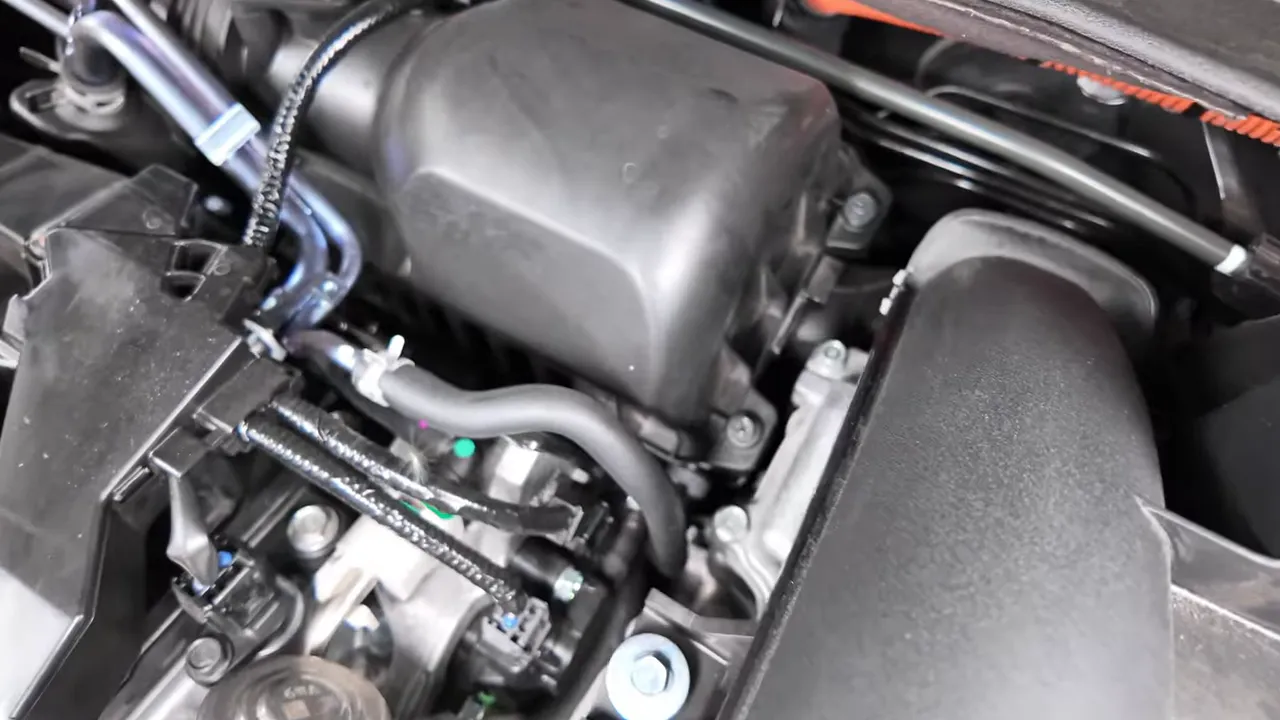
This is one of those layouts that makes you wonder whether everything else was designed first and somebody asked about the air filter afterward. A routine maintenance item should not be placed in such an awkward location.
Honda partially makes up for that by putting the 12-volt battery under the hood in a normal, accessible position. And, yes, the excellent EGR access deserves another mention.
Separate cooling for the hybrid electronics
The inverter and associated power electronics manage where electrical energy goes within the hybrid system. They have a separate cooling circuit, including their own reservoir with a radiator-style pressure cap.
That means there are two cooling systems to recognize under the hood, not simply one engine coolant reservoir and nothing else.
The brake system could be packaged more neatly
Like other hybrids, the CR-V blends regenerative braking with hydraulic braking. The computer evaluates the requested braking force and determines how much should come from regeneration, the friction brakes, or a combination.
The concern here is not how that concept works. It is how spread out the hardware appears. There is a pedal-connected actuator and another substantial assembly elsewhere in the engine bay. I would like to see a future version combine the equipment into a smaller, more condensed package.
The Hybrid Battery Is My Biggest Packaging Concern
The lithium-ion hybrid battery sits toward the rear, beneath the cargo floor. I would rather see a more compact package positioned farther forward, ideally making better use of the area beneath the rear seat.
There are two separate concerns here: the cargo space it occupies and how it is cooled.
The battery is air-cooled, with an intake beneath the second-row seat. There is no filter at that intake. For a family SUV, that location and lack of filtration concern me.
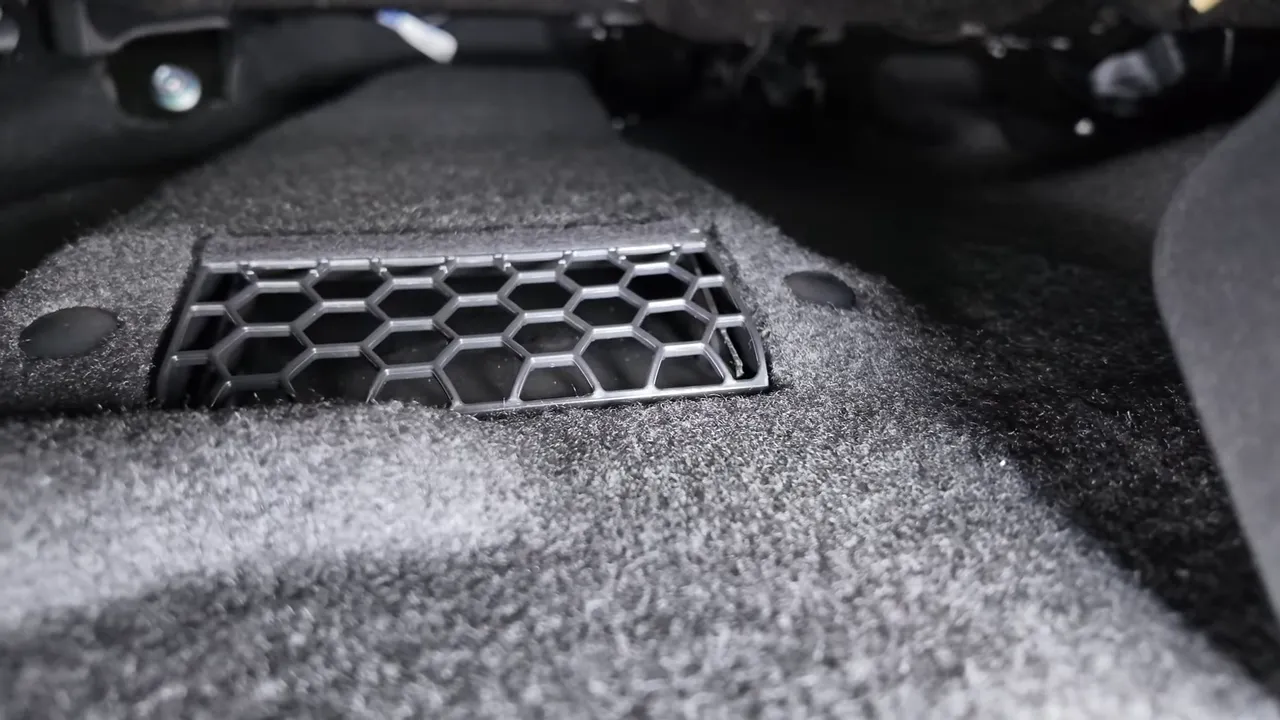
If the intake becomes clogged, airflow through the battery cooling system is reduced. That is not good for the battery. This is a design concern, not a claim that this particular vehicle has already suffered a failure.
For model-specific care instructions, the Honda owner’s manual resources are the appropriate place to check rather than treating the opening as an ordinary cabin vent.
Underneath the CR-V: Strong Components, Mixed Finishing
The front underside has extensive coverage, and the quality is better than the thin, flimsy plastic panels found on some vehicles. Part of that protection is metal.
Unfortunately, the access opening is not large enough to make draining the oil straightforward with the panel installed. You have to remove the larger cover. Extending the opening slightly would have been a much more service-friendly decision.
The aluminum oil pan also deserves care. Overtightening the drain plug can damage its threads. That is not an invitation to blame the pan for improper service, but it is a reminder that tightening harder is not better.
Front suspension and brakes
There is a lot to like in the front suspension:
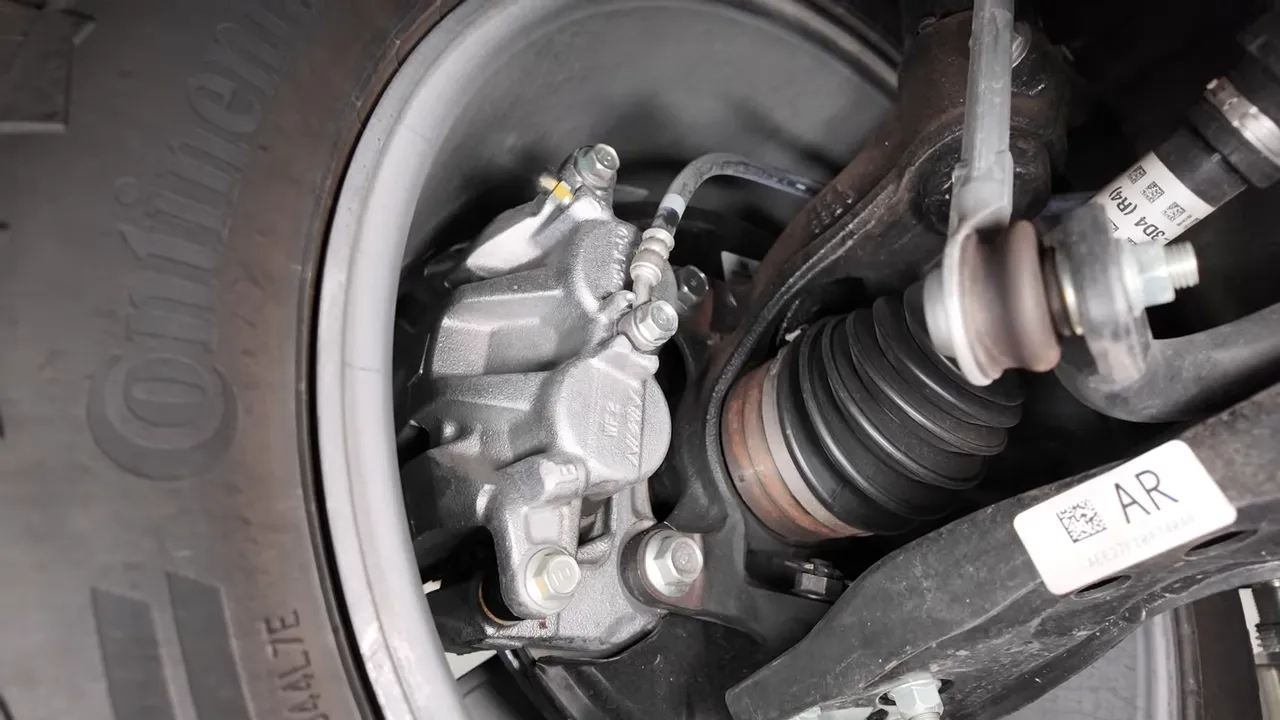
- A steel lower control arm with a separately serviceable ball joint.
- A steel steering knuckle with a MacPherson strut arrangement.
- Substantial front brakes with two-piston calipers for this vehicle class.
The separate ball joint is particularly welcome from a repair standpoint. Honda has also painted the middle sections of the axles while leaving the ends unfinished, something increasingly common across manufacturers.
Exhaust and driveline quality are reassuring
I usually am not enthusiastic about exhaust flex pipes, but the one here looks well made. The rest of the exhaust also shows the kind of quality I generally expect from Honda.
The mechanical AWD hardware looks good, too. The driveshaft and its associated components give a solid impression.
The seam sealer application is disappointing
Move toward the center of the floor and the picture becomes less consistent. Some areas have seam sealer, while adjacent sections appear open. At one point, the seam itself is visibly unsealed.
That undermines the purpose of applying sealer in the first place. Why carefully seal part of an area while leaving a nearby opening?
There are some useful underbody coverings and braces. Honda also puts a protective bar around the fuel tank, a thoughtful detail that not every manufacturer includes. But the finishing is not uniformly as impressive as the component quality.
A straightforward rear suspension
At the back, the suspension uses an aluminum knuckle, steel trailing and upper arms, and an aluminum spring-carrying arm. The spring and shock absorber are separate.
The rear brakes use single-piston calipers with integrated parking brakes. There is also a relatively small rear anti-roll bar.
The rear differential is compact, which fits the vehicle’s purpose. Again, this is an AWD family SUV, not something intended for demanding off-road use.
Behind the rear suspension, there are large open areas around the exhaust packaging, including an unused-looking hanger on one side. More coverage would give the underside a more complete finish.
Exterior: Recognizably CR-V, Without Overstyling
The 2026 updates are subtle, particularly around the lower exterior details. That is a good thing. This generation already has a clean, chiseled look with enough sophistication to avoid feeling basic, but not so much styling that it becomes busy.
The hood is a good example. A restrained crease curves near the edge, while much of the panel stays flat. Designs like this tend to look less dated than something covered in competing lines.
The large Honda emblem conceals the front radar sensor, and the TrailSport badge announces the new trim. Along the side, the familiar rear-quarter shape makes this unmistakably a CR-V. At the back, the tall taillights reinforce that identity.
What the TrailSport treatment adds
The TrailSport has black cladding and more aggressive tires than I would normally expect on a CR-V. Personally, I would prefer body-colored trim, but I understand the intent.
The pleasant surprise is tire noise. There is a little, but these tires are not excessively loud in this application.
My smaller complaints are mostly about consistency. There is a lot of badging, including hybrid identification on a trim that is already hybrid, and an AWD marking that is essentially a sticker. Several exterior details are blacked out, but the rear Honda emblem is not. None of that changes how the car works, but it makes the design treatment feel slightly unfinished.
Cargo Space: Generous Overall, but Not Completely Flat
The power liftgate uses one powered strut and one conventional support strut, rather than two powered units. Its visible wiring route is not my favorite, although it is manageable.
Inside, the battery prevents the cargo floor from providing the kind of removable underfloor storage panel I would like in an SUV. That space matters. A smaller battery package, positioned farther forward, could potentially have made room for useful storage.
Fold the second-row seats and there is plenty of carrying room. However, there is a pronounced step between the lower cargo floor and the folded seatbacks.
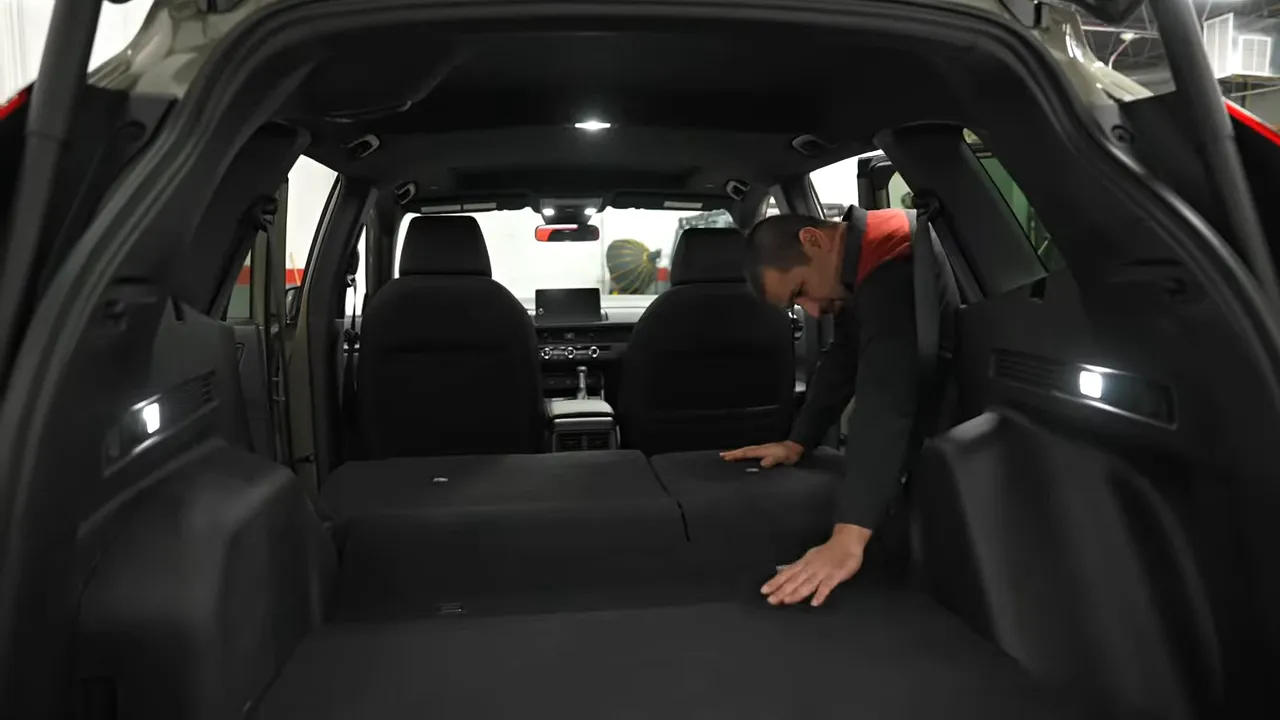
There is a tradeoff: the lower rear floor gives you more vertical space in that section, but the raised folded seats interrupt the load surface. Before buying, make sure that arrangement suits the things you actually carry.
Interior: Simple Does Not Mean Lacking
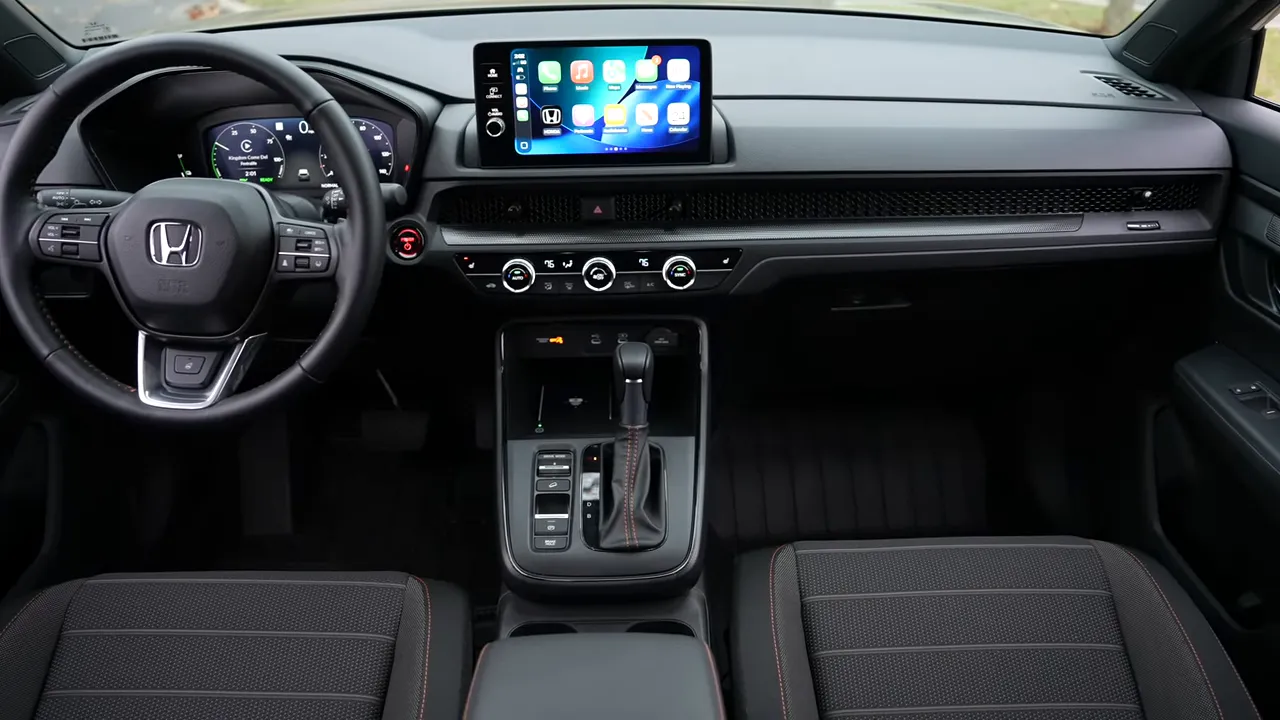
Open the door and sit behind the wheel, and the CR-V’s greatest strength becomes obvious. It feels normal. Not outdated, not stripped down, just sensible.
Some people will call that boring. I call it an excellent quality in a daily driver. I like cars, but I do not need every grocery run to involve learning a new interface.
Physical controls where they belong
The steering wheel is straightforward and has the controls you need, including a dedicated heated-wheel button. The climate controls are physical, with knobs that feel good to operate.
Even the vents are nicely executed. Their adjustment mechanism preserves the clean appearance of the dashboard rather than disrupting it with bulky, visually busy pieces.
The materials are not exotic. There is plenty of ordinary plastic. But it feels solid and well assembled rather than cheap. Good execution matters more than an impressive material list.
Then there is the conventional shift lever. Honda uses push-button selectors in other vehicles, yet this technically interesting hybrid gets a normal shifter. Good. There is no need to reinvent something that works.
Updated screens without taking over the dashboard
The vehicle reviewed has an updated 10.2-inch digital instrument display and a 9-inch infotainment screen. The instruments provide a modern presentation without overwhelming the driver.
The infotainment works well, although removing the back button is annoying. It supports wireless Apple CarPlay and Android Auto, and I did not encounter glitches during my use.
No, the screen does not stretch across the entire dashboard. It does not need to. It plays music, handles phone integration, and performs the everyday functions people actually use.
A genuinely comfortable back seat
At 5 feet 7 inches tall, sitting behind my own driving position, I have plenty of knee room and decent headroom. More importantly, the seat supports my thighs properly rather than leaving my knees raised with little cushion support.
The rear floor is almost flat, so the middle passenger does not have to straddle a large tunnel. Rear air vents and USB-C ports cover the basics without unnecessary complication.
This is a roomy, usable second row. That matters more to me than a collection of attention-grabbing features.
How It Drives: Refinement Is the Main Attraction
The CR-V Hybrid feels smooth and composed in a way that is difficult to communicate through a feature list. The powertrain transitions are well managed, the cabin is on the quieter side for this segment, and the controls do not get in your way.
There is a mature feeling to the whole vehicle. It is not trying to convince you that it is a sports car, a luxury lounge, or an extreme off-roader. It simply feels good to drive.
That is what ties the engineering and interior together. The hybrid system may be technically unusual, but the experience is easy and natural.
Should You Buy a 2026 Honda CR-V Hybrid?
Yes, the 2026 Honda CR-V Hybrid belongs near the top of a compact SUV shopping list. Its strongest argument is not one isolated specification. It is how well the complete vehicle works in everyday use.
The subtle refresh makes sense because Honda did not need to reinvent this SUV. The infotainment is improved, the driving experience is very polished, and the cabin remains easy to operate.
My main reservations are clear:
- The hybrid battery takes up valuable space beneath the cargo floor.
- The battery cooling intake lacks a filter and sits in a location that deserves attention.
- The engine air filter is awkwardly positioned for a routine service item.
- Some underbody sealing and coverage look less carefully finished than the major components.
Those concerns do not erase the positives. The accessible EGR system, straightforward engine layout, solid construction, comfortable rear seat, and exceptionally smooth hybrid operation make a strong case.
The Toyota RAV4 is the obvious rival. Compared with the RAV4 before its 2026 redesign, I find this CR-V more refined and more mature in how it feels. The 2026 RAV4 changes that comparison enough that it deserves a fresh evaluation rather than an automatic verdict.
For my money, the CR-V and RAV4 are the starting points in this segment, with a substantial gap before much of the competition. That is my opinion, but this Honda earns it.
If you want an SUV that is smooth, quiet, practical, and modern without making every interaction complicated, the CR-V Hybrid gets very close to the right formula. It is simple without being lacking. In today’s market, that is a breath of fresh air.


