The 2025 Honda Odyssey is getting old. There is no way around that. This is the second facelift for this generation, and underneath the updates is a minivan built around some very familiar Honda engineering.
But old does not automatically mean bad. In several important ways, the Odyssey’s age is exactly what makes it appealing. It has a smooth V6, a conventional automatic transmission, straightforward controls, and an interior that puts family life ahead of trying to impress anyone.
The question is whether those strengths outweigh the engine concerns, missing powertrain options, and higher entry price for 2025. From under the hood to the third row, there is quite a bit to like here, along with a few things prospective owners need to understand.
Table of Contents
- Key Takeaways
- Under the Hood: An Old-School Honda V6
- The 10-Speed Automatic Is a Welcome Conventional Design
- Engine-Bay Serviceability: Plenty of Thoughtful Details
- Underneath the Odyssey: Simple, Exposed, and Showing Its Age
- Exterior Updates: Still a Bit of a Spaceship
- Cargo Space and Seat Flexibility Are the Real Selling Points
- The Interior Puts Function Ahead of Fashion
- How Does the 2025 Honda Odyssey Drive?
- The Biggest Drawbacks: VCM, Aging Technology, and Entry Price
- Honda Odyssey vs. Toyota Sienna: The Value Changes by Trim
- Should You Buy the 2025 Honda Odyssey?
Key Takeaways
- The Odyssey excels at practical seating, usable cargo space, and straightforward physical controls.
- VCM is the main long-term engine concern, while timing-belt replacement adds a scheduled ownership expense.
- The conventional 10-speed automatic delivers smooth operation without an unusual underlying transmission design.
- Dropping the EX weakens entry-level value, while higher trims remain competitive against the Sienna.
Under the Hood: An Old-School Honda V6
The Odyssey uses Honda’s 3.5-liter J35 V6, identified here as the J35Y6. It is not the newer J35Y8 found in the latest Pilot. This is an older engine design that has received updates over the years, rather than Honda’s latest approach to the V6.
Its basic construction is familiar:
- Plastic valve covers.
- A single overhead camshaft for each cylinder bank.
- A timing belt with a hydraulic tensioner.
- A mechanical water pump driven by the timing belt.
- A conventional thermostat.
- Direct fuel injection.
- Variable Cylinder Management, Honda’s cylinder-deactivation system.
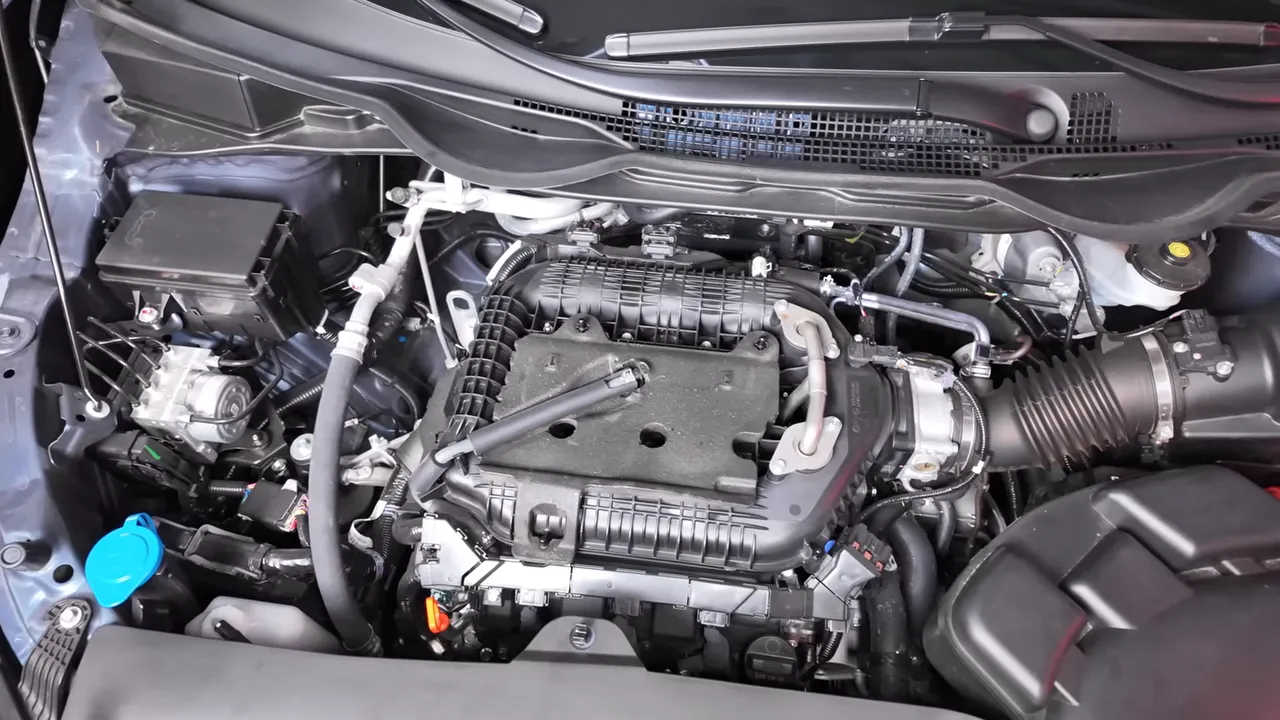
There is something refreshing about a cooling system that does not try to reinvent anything. The thermostat is conventional, the water pump is mechanical, and the overall arrangement is straightforward. The oil pump sits at the nose of the crankshaft, another familiar part of this engine’s layout.
The timing belt is also a familiar Honda job. From a service perspective, it is relatively straightforward. But a straightforward maintenance job is still an ownership expense. This is not a timing-chain engine, and the belt’s replacement requirement belongs in your long-term budget.
For the maintenance requirements that apply to your vehicle, use the information in the 2025 Odyssey owner’s manuals rather than assuming an interval from another Honda model.
Direct Injection and Carbon Buildup
This engine uses direct injection only. That naturally raises the question of intake-valve carbon buildup.
I have not seen enough evidence to label chronic carbon buildup a defining problem for this particular engine. It has been around with direct injection for a good while. Still, direct injection does not make that possibility disappear, and operating conditions and driving habits can play a role.
The sensible position is neither to panic about it nor pretend it cannot happen.
VCM Is My Biggest Long-Term Concern
Variable Cylinder Management sounds attractive on paper. When the engine does not need all six cylinders, it can deactivate cylinders, including an entire bank during suitable cruising conditions. Under greater load, all six cylinders return to work.
The valve mechanism makes this possible through rocker arms and a hydraulically controlled locking arrangement. With the rockers coupled, camshaft movement opens the valve. With them disconnected, the cam-driven rocker can move without opening that valve. Fuel injection and ignition are also stopped for the deactivated cylinder.
That is clever engineering. It is also additional complication.
The system depends on its hydraulic components, control solenoids, and moving mechanisms continuing to operate properly. Maintenance matters a great deal with this engine.
My concern extends beyond the mechanism itself. When a cylinder stops producing combustion, its thermal conditions change relative to the cylinders still working. The long-term issues that concern me with cylinder deactivation include oil consumption and cylinder-wall wear or damage.
That does not mean every 2025 Odyssey will develop those problems. It does mean I would not describe this as a completely complication-free old-school V6. A minivan is often bought to stay in the family for many years, and VCM is the part of this powertrain I would keep in mind throughout that ownership.
The 10-Speed Automatic Is a Welcome Conventional Design
Earlier versions of this Odyssey generation used a ZF nine-speed automatic in some trims. Since the 2020 model year, the lineup has used Honda’s own 10-speed automatic.
The important detail is not simply the number of gears. It is the construction: this is a conventional automatic with a torque converter and planetary gearsets.
Honda has used some unusual transmission designs in the past, and the Odyssey has had transmission problems during parts of its history. That history deserves context rather than being applied automatically to every newer transmission.
Here, there is no unusual mechanical concept to explain away. The 10-speed is conventional in its basic approach, and its operation in this van is very smooth. That is a positive. It is not a guarantee of lifetime reliability, but I like both the layout and the way it behaves.
Engine-Bay Serviceability: Plenty of Thoughtful Details
Look closely around the engine bay and you find some things that make you say, “They do not build everything like this anymore.”
At the back of the engine bay, for example, two coolant hoses connect through a metal pipe. If this arrangement were designed from scratch today, I would not be surprised to find plastic there instead. The quality of several plastic components is also impressive. Some could have been made much flimsier without immediately affecting their function, but Honda did not take that approach.
There are practical service advantages, too:
- Accessible rear spark plugs: The intake plenum does not cover them, and there is useful room behind the engine in the Odyssey.
- An easy-to-reach fuel-line disconnect: It is right in front of you rather than buried unnecessarily.
- Clips on the air-filter housing: These replace the small bolts that could become troublesome or break on older arrangements.
The air-filter clips themselves feel a little flimsy, even though the housing is nicely made. Still, I would take them over the old bolts.
Not everything is ideal. The AGM battery is partly hidden beneath the air-intake ducting, a Honda habit that makes a basic component less accessible than it could be. Most of the air-conditioning connections are an improvement over older arrangements, but at least one of the connection styles I dislike is still present lower down. Those older connections can seize and become difficult to separate.
One other important detail is the brake booster. This van uses an electronic booster rather than a conventional vacuum booster. The immediate, confidence-inspiring brake response is one of the things I particularly like about how it drives.
Underneath the Odyssey: Simple, Exposed, and Showing Its Age
The underside makes the age of this platform especially obvious. There is a small cover toward the front, but much of the engine, subframe, and underbody remains exposed.
That can make components easy to see and reach. It also means the underside does not have the extensive covering and finishing common on newer designs.
Front Suspension and Brakes
The front suspension uses MacPherson struts and a one-piece aluminum lower control arm with an integrated ball joint. I would prefer a separately serviceable ball joint, but this is a familiar Honda arrangement.
The surprise is the unpainted ferrous steering knuckle. On this example, it already has very visible surface rust. I do not consider that appearance alone evidence of a functional problem, but it is disappointing to see.
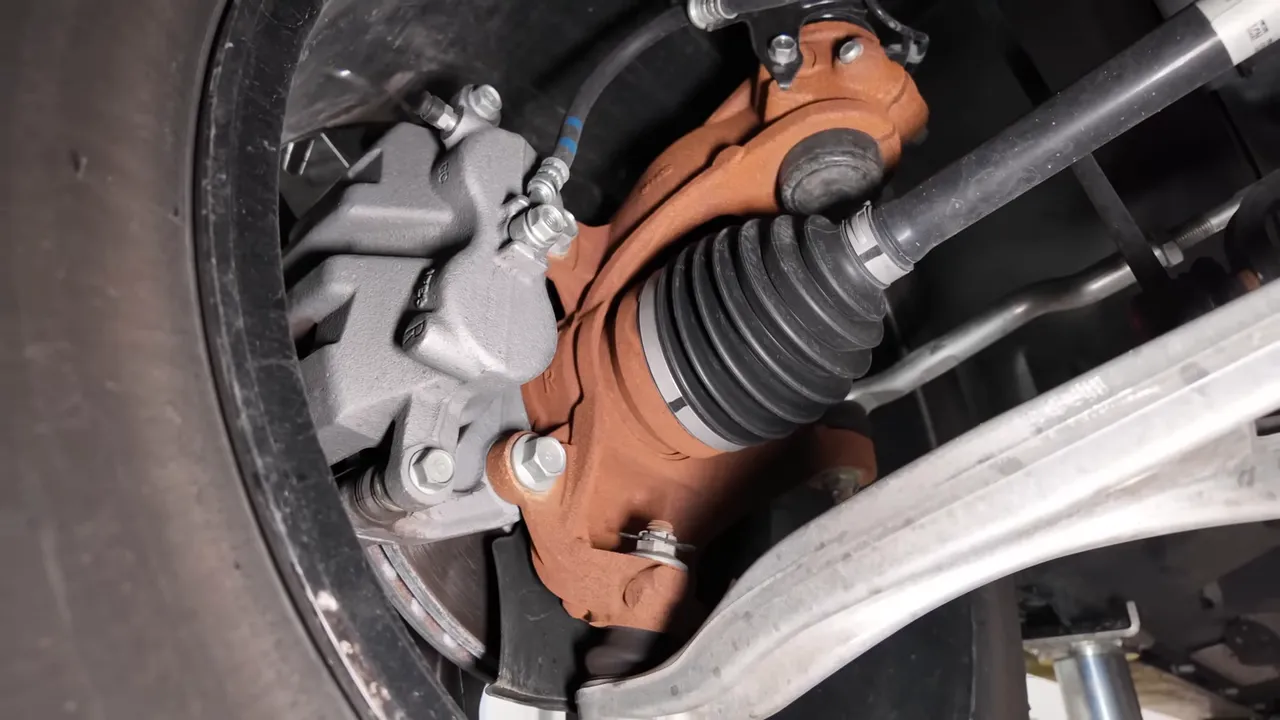
The strut-to-knuckle attachment is also not my favorite design for future service, particularly in a climate where corrosion becomes an issue. Up front, the brakes use two-piston calipers. The finish on exposed axle components is inconsistent as well, with protection visible in one area and absent in another.
Oil Pan and Transmission Access
The aluminum engine oil pan has Honda’s familiar drain plug with a 17 mm head. The warning is familiar, too: overtightening the drain plug can strip the aluminum pan’s threads.
This is a small detail with potentially annoying consequences. An oil change should not become an oil-pan repair because someone treated the drain plug like a suspension bolt.
The transmission has its pan toward the front rather than a conventional downward-facing pan underneath. It is an interesting packaging choice and another detail worth noting when inspecting the van from below.
The Exhaust Has an Unfortunate Repair Tradeoff
The exhaust includes a flex section near the engine and then makes a sharp turn toward the side of the vehicle.
Older Honda arrangements separated the catalytic converter with flanges, allowing certain exhaust components to be replaced independently. In this generation, the flex section and catalytic converter are part of the same assembly.
That is a step backward for serviceability. If the flex pipe fails and the repair follows replacement of the complete assembly, you are also paying for a catalytic converter that may not be the problem.
Farther back, the exhaust curves around the spare-tire storage area, returns inward, and curves again on its way to the tailpipe. The unusual route makes more sense once you understand the packaging underneath the passenger compartment.
Underbody Protection and Rear Suspension
Some areas have a substantial protective coating that I really like. The frustrating part is that the treatment is not extended consistently across the underside.
There are also open sections around seams and structural areas where I would prefer more comprehensive sealing or coverage. This is not a prediction that the body will fail. It is an observation that the finishing looks dated beside newer vehicles.
The rear suspension is straightforward, with trailing-arm and control-arm components, separate springs and shocks, and an aluminum arm among otherwise different materials. The rear brakes use single-piston calipers with the electronic parking-brake motors integrated into them, an arrangement I like.
At the very back, some areas are covered nicely while nearby sections remain open. Once again, the issue is not that Honda did nothing. It is that a little more consistency would have made the underside better.
Exterior Updates: Still a Bit of a Spaceship
I have a soft spot for the Odyssey name. I owned a 2002 Odyssey, and I still think that generation was a very handsome minivan. Completely biased opinion, folks, but there it is.
This generation takes a different direction. It looks more like a spaceship, especially along the side. The 2025 update looks good overall, although the headlights retain a relatively old-school character.
The dipping side-window line is still an unusual styling choice. It creates a complicated set of lines in the bodywork, but there is a practical explanation I can appreciate: visibility.
The side glass is large. A straighter, higher window line would take away some of that glass area. I may not love every line from outside, but I do appreciate the view from inside.
Smart-key locking and unlocking are provided at the front door handles, not the sliding-door handles. At the rear, the badging is restrained, and the Elite trim reviewed here keeps things fairly simple.
There is even a little supercar connection to enjoy: the rear bumper reflector treatment resembles the Acura NSX’s. A family minivan with an NSX-like detail. That should at least earn you a smile.
Sliding Doors: Smooth Operation With a Service Compromise
The power sliding doors operate smoothly, although they are a little slow, especially near the end of their travel.
Honda places the motor mechanism in the body rather than in the moving door, with a cable acting through the door’s hinge mechanism. I like keeping that equipment out of a panel that constantly moves, vibrates, and closes.
The tradeoff comes when repairs are needed. Accessing the body-mounted equipment requires removing a large interior trim panel. There is good and bad in everything.
A small detail I particularly appreciate is the separate open and close switches. Rather than pressing the same button and relying on the system’s current state, the command is explicit. Simple, useful, and exactly appropriate for a family vehicle.
The Power Tailgate Uses an Older Mechanism
The tailgate’s drive mechanism is incorporated into the hinge area, with equipment buried near the headliner. That is an older approach and can complicate access for repairs.
The upside is that there are no bulky powered struts intruding along the opening. The tailgate has height adjustment and a close button, but not a combined close-and-lock command. It works, but this is another place where the age of the design shows.
Cargo Space and Seat Flexibility Are the Real Selling Points
The Odyssey makes its strongest argument when you stop thinking about screens and start moving people and luggage.
Behind the third row is a deep cargo well. With the seats upright, that gives you useful luggage space without immediately having to sacrifice passenger capacity.
Fold the third row into that well and the space opens up dramatically. Even in this high trim, the seat mechanism remains manual and straightforward. Pull, fold, and stow. Bringing it back is similarly uncomplicated.
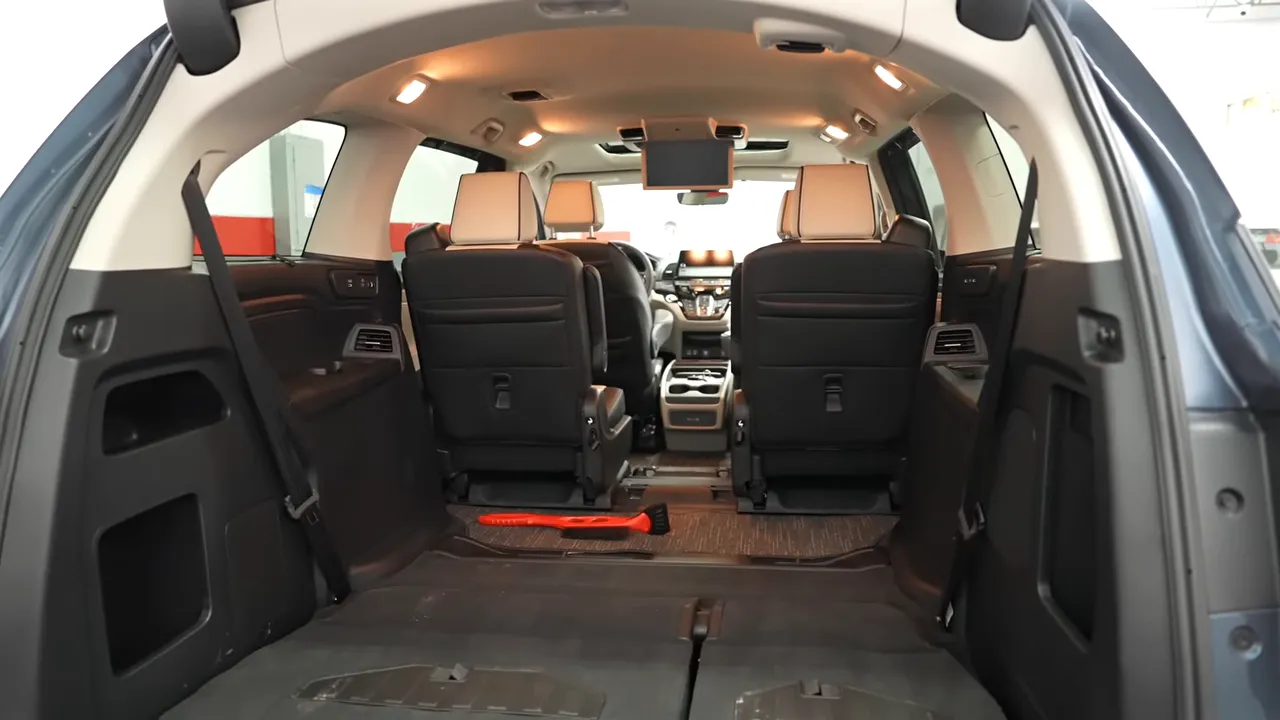
This is the kind of feature that does not need to be made more complicated. The mechanism is quick to use, and the cargo opening preserves a great deal of usable height. There is only a modest change in the upper opening rather than an aggressively sloped shape eating into the space.
The second-row seats are removable, unlike the current Sienna’s second row, but removing them is a cumbersome process. Honda makes up for that with something much more useful during everyday family duty: lateral seat movement.
The Sideways-Sliding Second Row Is Excellent
Pull a handle and the second-row seat slides sideways. It is that simple.
Instead of removing a seat and reinstalling it in another position, you can move it across to create a more convenient path to the third row. For children climbing in and out, that is a genuinely practical solution.
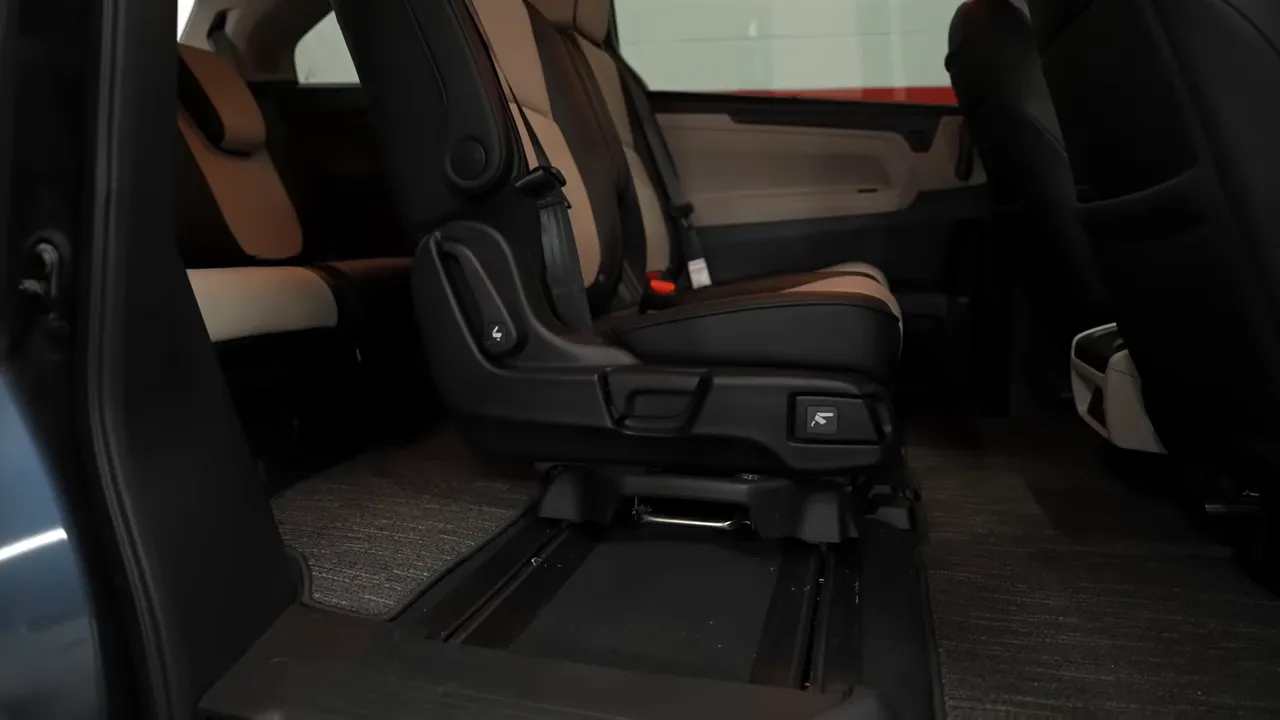
This is one of my favorite features in the Odyssey. It is clever without feeling gimmicky. It solves an actual problem with a handle and a set of tracks rather than a complicated routine.
The Interior Puts Function Ahead of Fashion
The cabin feels a little old the moment you get in. Whether that bothers you depends on what you want.
If you want the latest design language and the largest displays, this will feel behind the times. If you want something familiar, focused, and easy to use, the Odyssey has a lot going for it.
The original interior was thought out well enough that it remains functional in 2025. In some respects, it makes newer vans feel as though they are trying too hard.
- Instruments: A digital display works alongside a physical gauge.
- Steering-wheel controls: Straightforward buttons without unnecessary tricks.
- Climate controls: Physical controls with an easy-to-understand layout.
- Transmission selection: Honda’s familiar push-button arrangement.
- Storage: A large center console, useful space up front, and generous door storage.
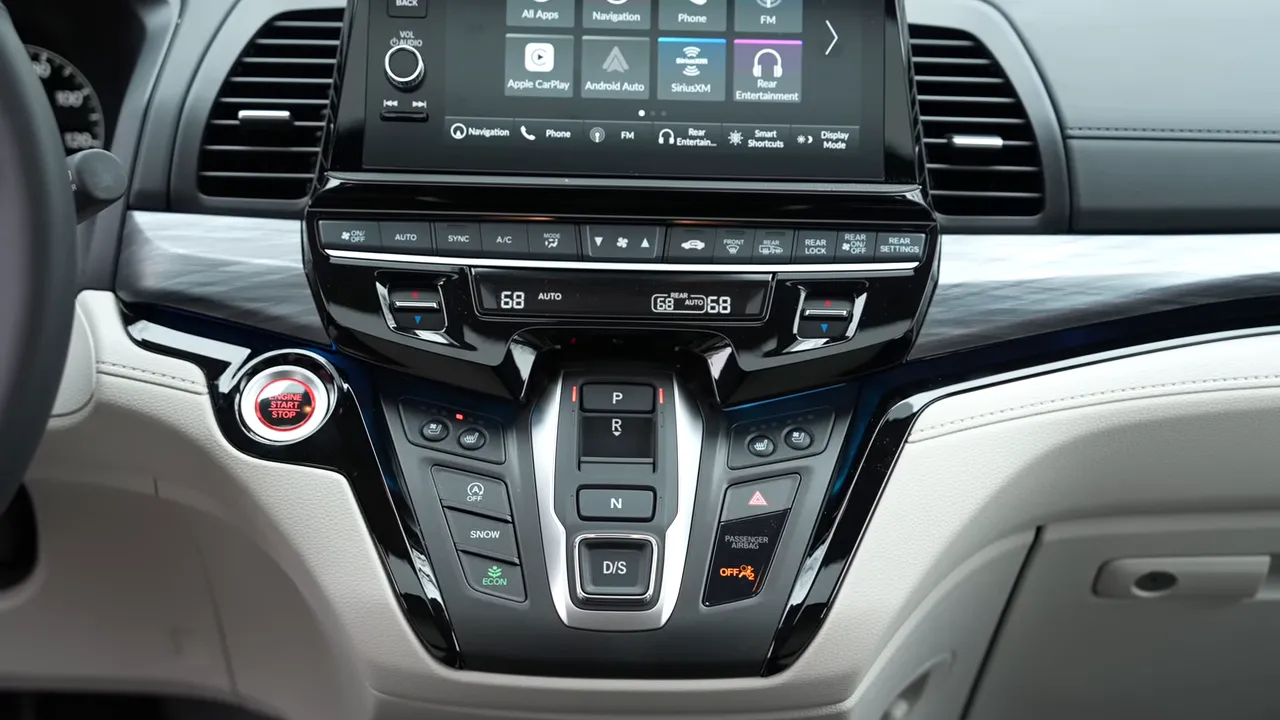
The infotainment system is updated for 2025. It supports wireless Apple CarPlay and Android Auto, responds well, and does not occupy half the dashboard.
Its integration does feel like an update fitted into an older design rather than a cabin designed around the system from the beginning. But the system itself works well. It is not trying to compete with the largest tablet in your house, and I consider that a positive.
The materials and shapes are not going to overwhelm you with luxury. The stronger impression is that this interior will stay out of your way while you get on with family life.
Second-Row Comfort and Family Equipment
At 5 feet 7 inches tall, I had plenty of room behind my own driving position. The second row is comfortable, spacious, and easy to access through the sliding doors.
The Elite model also includes family-oriented equipment such as an overhead entertainment display, an in-cabin camera for checking on rear passengers through the front screen, and window shades.
The shades are especially useful when a small child is sitting beside a sunny window. These are not dramatic features individually, but together they show that the cabin was designed around real passenger needs.
A Third Row You Can Actually Use
The third row is comfortable enough that I would be happy spending a long trip back there. There is useful room even before moving the second row farther forward.
Three adults across will make it tight. Two adults, however, can be very comfortable. And importantly, you still have useful cargo space behind them.
Rear-passenger provisions include low-mounted air outlets rather than roof vents, USB-C connectivity, headphone connections with volume control, and third-row shades. The headphone setup allows rear passengers to enjoy entertainment audio while people up front listen to something else.
That is familiar minivan territory, but it matters. A third row is not much use if the people sitting there feel like an afterthought.
How Does the 2025 Honda Odyssey Drive?
This is a large vehicle that does not constantly remind you of its size.
Visibility is good, the chassis feels composed, and the V6 provides decent, smooth acceleration. The 10-speed automatic operates smoothly, and the brakes have an immediate response that inspires confidence.
Nothing about the experience needs a dramatic explanation. It drives well, feels manageable, and does what a family vehicle should do without fuss.
For this kind of vehicle, that is a stronger compliment than an unnecessarily sporty personality.
The Biggest Drawbacks: VCM, Aging Technology, and Entry Price
Three issues stand out after spending time with this Odyssey.
- The engine’s cylinder-deactivation system: VCM remains my primary long-term mechanical concern, especially for a family planning to keep the van for many years.
- The updates cannot hide the platform’s age: The improvements are useful, but some feel added on rather than fully integrated into a fresh design.
- The affordable entry trim is gone: Honda dropped the EX for 2025, after the LX had already disappeared from the lineup.
That last point changes the buying decision more than you might expect. A higher starting price is harder to overlook when the main competitor offers a more modern powertrain.
Honda Odyssey vs. Toyota Sienna: The Value Changes by Trim
The Toyota Sienna is the obvious comparison. It is a hybrid, offers better fuel economy, and is available with all-wheel drive. The Odyssey offers neither a hybrid system nor all-wheel drive.
At the entry level, the Sienna LE starts lower than the Odyssey now that Honda has removed the EX. The price comparison discussed here puts that gap at nearly $4,000. Actual purchase comparisons should use current pricing, destination charges, and the specific equipment involved, but the broader issue is clear: Honda no longer offers the lower-priced Odyssey that once made this decision easier.
At higher trim levels, the equation changes. The Sienna’s additional technology and equipment can make it considerably more expensive, and the Odyssey starts to regain its value argument.
That creates two different decisions:
- Shopping near the bottom of the range: The Sienna’s lower entry price and hybrid efficiency make the Odyssey harder to justify.
- Shopping well-equipped models: The Odyssey can cost less, provided you are comfortable with its older technology and conventional powertrain.
For years, the Odyssey was the interesting, slightly edgy minivan, while the Sienna was the conservative choice. Now those roles feel as though they are shifting. The Odyssey has become the straightforward V6-and-automatic option with a solid, practical interior.
Should You Buy the 2025 Honda Odyssey?
Yes, if your priority is a genuinely useful family minivan rather than the latest technology.
The Odyssey’s best qualities are not superficial. The sliding second-row seats are excellent. The third row is comfortable. The cargo area remains useful with passengers aboard, and the rear seats fold away without unnecessary complication. The controls are straightforward, the drivetrain is smooth, and the cabin feels designed to serve a family rather than distract one.
But buy it with your eyes open. Budget for timing-belt maintenance. Take VCM and long-term engine care seriously. Understand that there is no hybrid or all-wheel-drive option. And compare the actual trim you want against the Sienna rather than assuming one van is always the better value.
If you are technology-focused, the 2025 updates probably will not disguise how old this design feels. If you want a no-gimmicks minivan that is exceptionally good at the basic job, the Odyssey still belongs near the top of your list.
Nothing is perfect, folks. This one has some meaningful compromises, but it still gets the family-vehicle fundamentals very, very right.


