The 2023 Mazda 3 is one of those cars that makes a very strong first impression, then keeps getting better as you spend time with it. It looks sophisticated, the turbocharged model is genuinely quick, and the interior feels like it belongs in something wearing a luxury badge.
Then you look at the price.
That is where this review gets complicated. There is a lot to like mechanically and a tremendous amount to appreciate from the driver’s seat. But a good car and a good purchase are not always the same thing.
The car examined here is a fully loaded, turbocharged, all-wheel-drive hatchback. That distinction matters because much of what makes this particular Mazda 3 special is tied to its higher equipment level. The prices discussed below are the figures cited for the 2023 model at the time of this review, not current market prices.
Quick Summary
- The turbo engine and six-speed automatic deliver strong acceleration with smooth, refined operation.
- The loaded cabin feels unusually luxurious, but rear-seat space remains tight.
- Simple rear suspension does not stop the Mazda 3 from handling very well.
- The reviewed model’s roughly $37,000 price makes lower trims and larger alternatives worth considering.
Table of Contents
- Under the Hood: A Familiar 2.5-Liter Engine That Suits This Car
- Under the Car: Thoughtful Details and Some Serviceability Tradeoffs
- Exterior: Sophisticated Rather Than Overdone
- Interior: This Is Where the Mazda 3 Feels Special
- Rear Seats and Cargo: The Small-Car Reality Returns
- Driving Experience: Quick, Refined, and Occasionally Firm
- The Deal Breaker: About $37,000 for the Loaded Turbo
- Verdict: An Excellent Car With a Difficult Value Proposition
Under the Hood: A Familiar 2.5-Liter Engine That Suits This Car
Mazda has made extensive use of its 2.5-liter four-cylinder engine family, offering turbocharged and naturally aspirated versions across much of its lineup. In the 2023 Mazda 3, you can choose either approach.
- Naturally aspirated 2.5-liter: About 191 horsepower.
- Turbocharged 2.5-liter: Up to 250 horsepower.
In this small hatchback, the turbo engine makes a substantial difference. This is not a dedicated Mazdaspeed model or some extreme performance edition. It is a normal, well-equipped Mazda 3 with an engine that also serves in the much larger CX-9. Put that powertrain into a much smaller body, and the result is a very quick car.
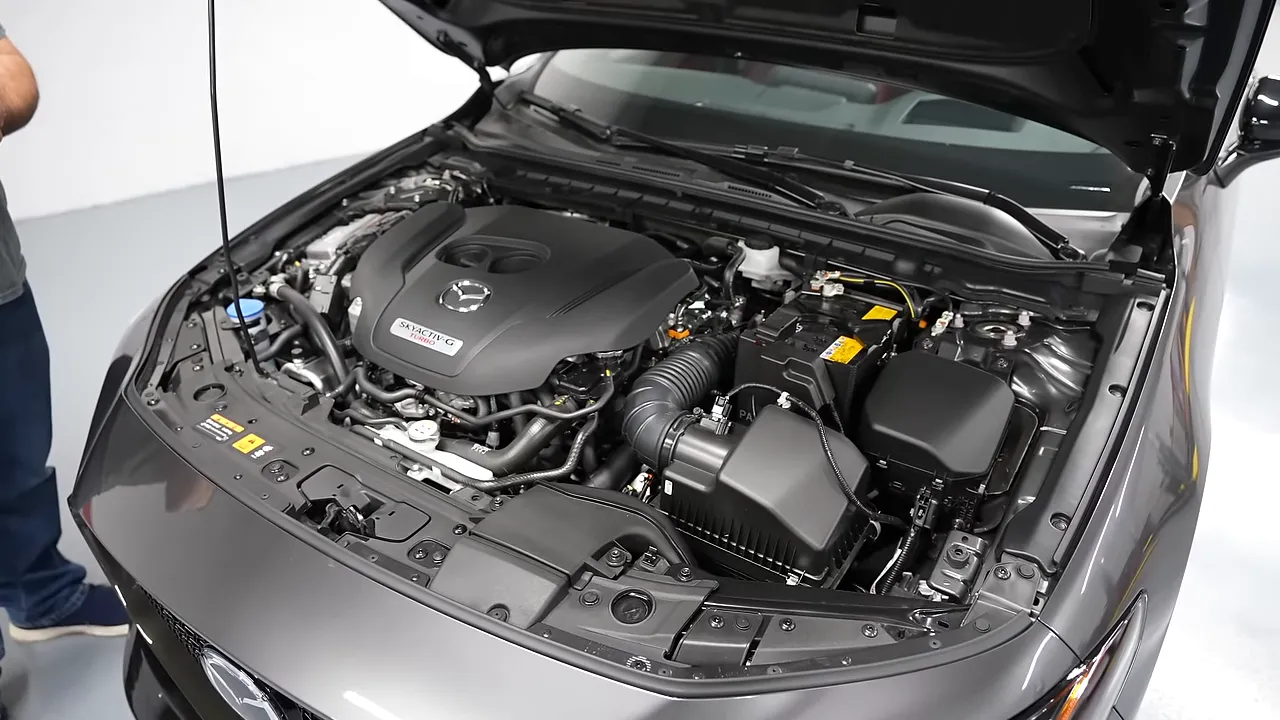
Direct injection makes maintenance important
The turbo engine uses direct injection without supplemental port injection. That is not automatically a deal breaker, but carbon buildup is a consideration, particularly when poor maintenance and unfavorable driving habits enter the picture.
This is a turbocharged, direct-injected engine. Maintenance is not the place to cut corners if you want long service life. For the correct maintenance requirements for a particular car, use the applicable manual available through Mazda’s owner resources.
One interesting technical feature is the electrically controlled intake variable valve timing system. An electric motor changes the intake cam timing by varying its speed relative to the camshaft. Speeding it up advances timing, slowing it down retards timing, and matching camshaft speed holds the timing position. It is a clever piece of engineering in an otherwise familiar engine family.
Tight packaging and a few cooling-system concerns
The engine bay is crowded. There is very little working room at the front, sides, or rear of the engine, and the turbocharger sits toward the back. The same basic engine has far more breathing room in a large SUV.
That matters from a service perspective. A good engine can still be awkward to work on when it occupies nearly every available inch.
I also do not particularly like the plastic coolant housing arrangement. It carries a coolant cap, and the engine cover mounts to it. A plastic component exposed to coolant and repeated handling is something I would keep an eye on as the car ages. That is a design concern, not a declaration that this particular part is guaranteed to fail.
There are also two radiator-style pressure caps close together, including one on the coolant tank. It is an unusual arrangement when you first open the hood.
A conventional six-speed automatic
The automatic transmission in this turbo model is a conventional six-speed. There is no CVT and no dual-clutch transmission here. It uses a torque converter with a lockup clutch to help efficiency, and its operation is very smooth.
The engine and transmission work nicely together. Power delivery is strong, shifts are refined, and I do not see a giant mechanical red flag in the basic layout.
I also appreciate Mazda’s commitment to developing a common engine family rather than constantly introducing completely different powertrains. Concentrating engineering effort gives a manufacturer the opportunity to refine a design over time. That is encouraging, although it is not a substitute for maintenance or a guarantee of trouble-free ownership.
Under the Car: Thoughtful Details and Some Serviceability Tradeoffs
The first thing you notice underneath the Mazda 3 is how thoroughly everything is covered. The front, middle, and sides all have substantial underbody coverage.
Fortunately, Mazda included service access openings. You do not have to treat every routine service as a major disassembly project. There is also a ventilation opening near the turbo area.
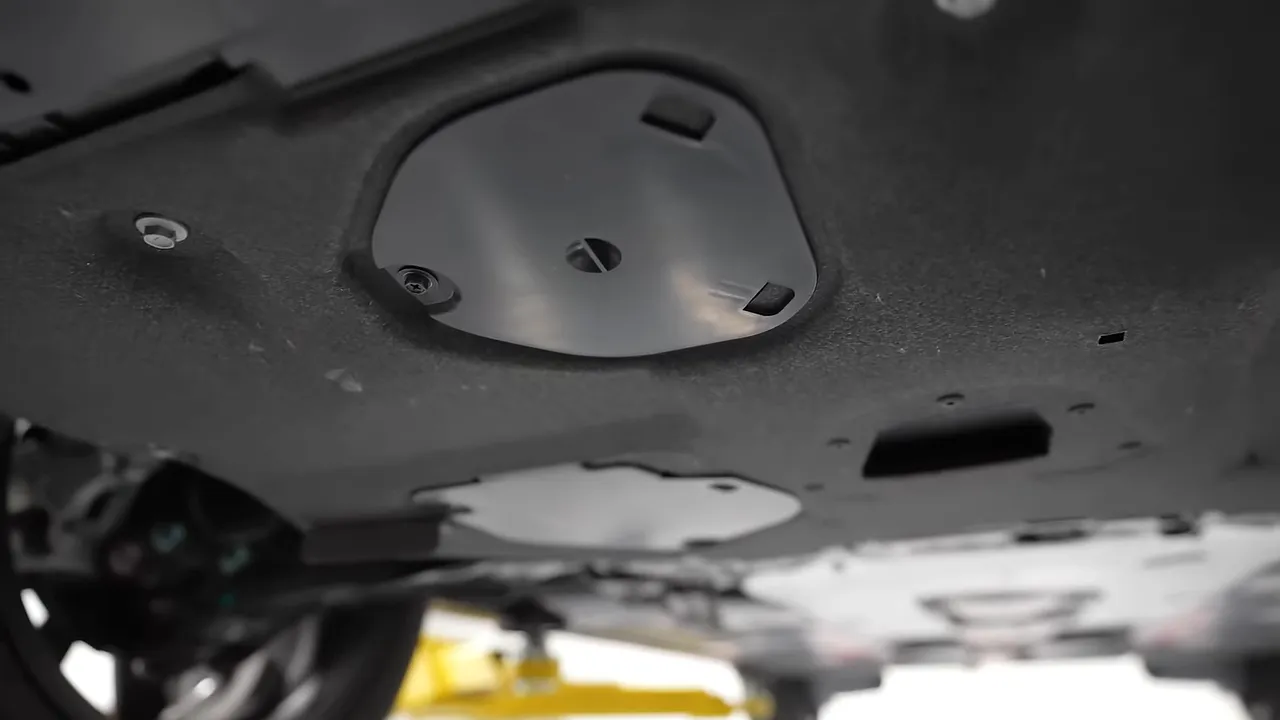
Front suspension: Durable materials, less convenient repairs
The front lower control arms are steel, and the steering knuckles are steel as well. There is no aluminum knuckle here, which is a little surprising in a small car where reducing weight would seem attractive.
The ball joint is integrated into the lower control arm. From a repair standpoint, I would rather have a separately serviceable ball joint. Combining the two means a worn joint involves the larger assembly rather than just the joint itself.
The front strut also fits into a clamping section of the knuckle. It is an interesting arrangement, but separating those components after years of age and corrosion may not be the most enjoyable job.
Insulation, bracing, and a substantial exhaust
Moving rearward reveals extensive shielding and insulation. Some heat shields use the familiar thin material, but other sections are surprisingly substantial pieces of metal. There is also prominent cross-bracing underneath the body.
All that coverage helps explain why this car feels so well isolated for its size. Mazda has put effort into more than the surfaces you can see from the driver’s seat.
The exhaust is large for a small hatchback, but remember what is feeding it: a 2.5-liter turbocharged engine. There is a secondary catalytic converter underneath, while the main converter is located near the turbocharger. At the rear, a sizable muffler feeds two exhaust outlets.
All-wheel drive without unnecessary complication
This car has a compact rear differential and relatively small rear axle shafts. The front power takeoff drives the propeller shaft, while a coupling at the rear controls the delivery of drive to the rear wheels.
The hardware is sized for a small road car, not a vehicle intended for towing or heavy-duty work. Nothing about the compact differential or axle shafts looks out of character for the application.
The surprising part: A torsion-beam rear suspension
Here is something that may surprise you: despite how well the Mazda 3 handles, it uses a torsion-beam rear suspension.
There is no elaborate collection of individual suspension links. You have a substantial steel beam connecting the sides, with separate springs and shocks. It is a simple, rugged layout, but it does not provide the normal alignment adjustability associated with a more complex multi-link arrangement.
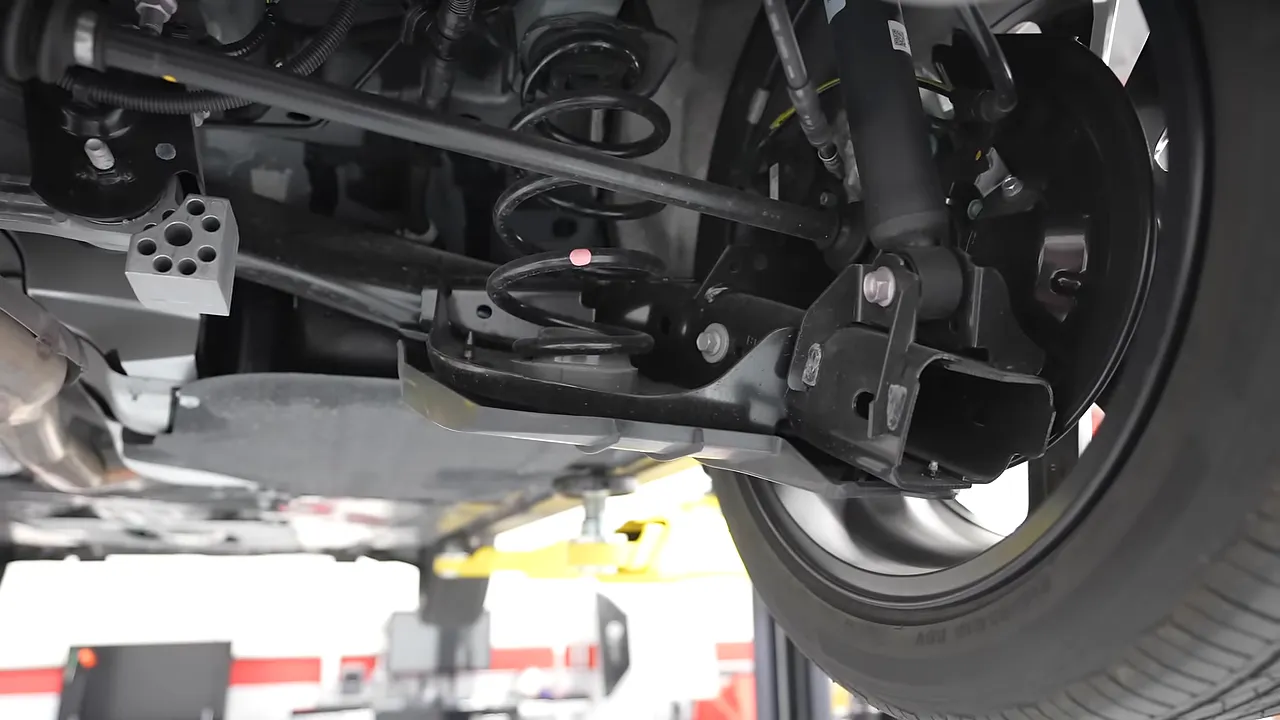
On paper, that might sound like a disappointing cost-saving measure. On the road, the car still handles very well. This is a good reminder that the list of components does not tell you everything about the finished car.
There are rear disc brakes and an electronic parking brake. Some people dislike electronic parking brakes, but I appreciate the straightforward motor-operated arrangement compared with more complicated mechanical parking-brake mechanisms.
Exterior: Sophisticated Rather Than Overdone
Mazda has been doing very good design work, and the Mazda 3 hatchback is a strong example. It looks athletic without needing excessive creases, oversized decorations, or an aggressive shape on every panel.
The front end is classy and sporty at the same time. On this high-trim car, the black grille surround works particularly well, and the gloss-black lower extension adds to the appearance.
There is a practical catch, though: that front extension sits very low. If you regularly scrape the front of your current car on driveway entrances or parking blocks, pay close attention to this trim’s front clearance.
The black wheels suit the car, and the matte-black side extension is subtle rather than outrageous. The body sides are remarkably clean. Their shape does the work instead of a collection of sharp character lines.
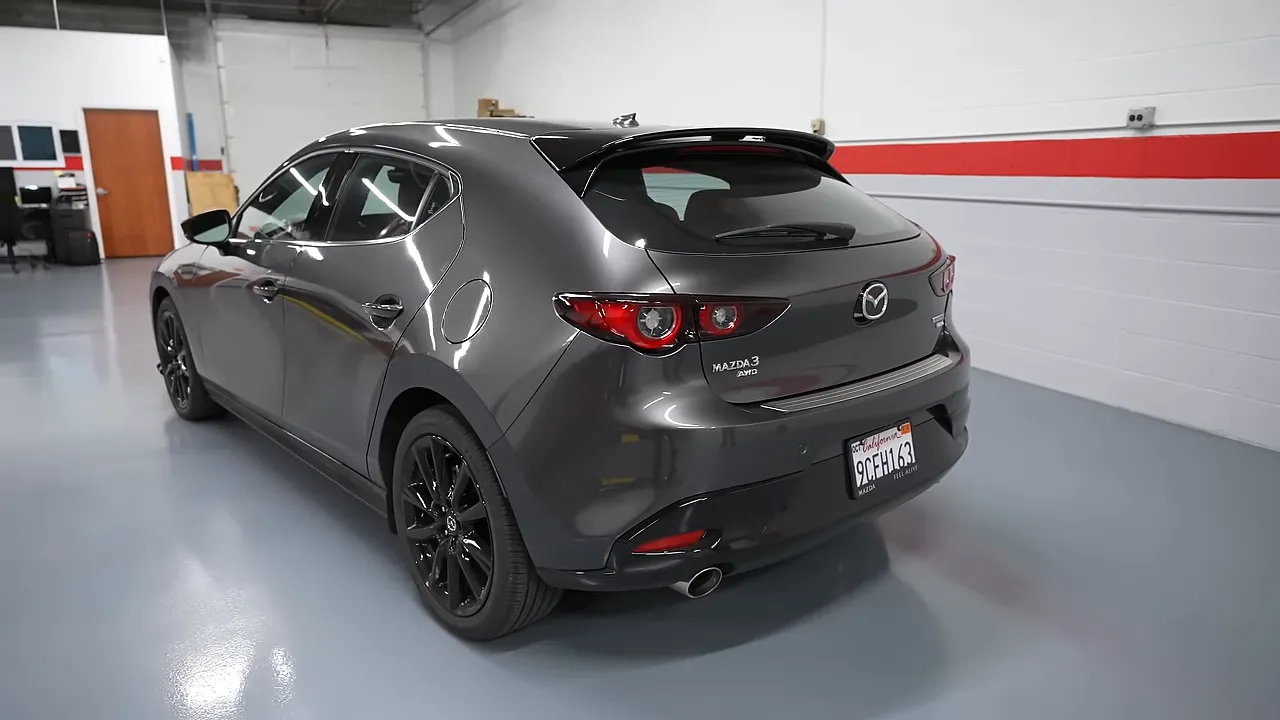
The rear is arguably its best angle. The large taillights still look proportionate, the exhaust outlets fit the turbo model’s character, and the roof spoiler has a small actual opening. There is a rear wiper, too.
My complaint is the number of badges. Mazda 3, AWD, Skyactiv-G, Turbo: that is a lot of lettering on an otherwise clean design. A little less would look better.
Convenience details and small windows
The exterior mirrors fold manually, even on this fully loaded example. That initially seems understandable on a small hatchback, although the price makes it a more noticeable omission.
The front door handles use touch-sensitive keyless entry rather than an exposed push button. Touch the locking area to lock the car, or put your hand behind the handle to unlock it with the key nearby. The rear handles do not have the same functionality.
The rising beltline and the way the bright window trim ends help give the hatchback its distinctive profile. Fit and finish are excellent.
The windows, however, are tiny, particularly toward the rear. They are small even by hatchback standards. I find the proportions more natural here than on the CX-30, and personally, I would choose the Mazda 3 over the CX-30. Still, anyone considering one should make sure the glass area suits them.
Interior: This Is Where the Mazda 3 Feels Special
Climb into this high-trim Mazda 3, and the first impression is not “economy hatchback.” It is much closer to the feeling you expect from Lexus, Acura, or Infiniti.
The dark red upholstery is especially effective. It is closer to a sophisticated maroon than a flashy bright red, and the seats feel soft and inviting. Matching soft-touch trim and stitching continue across the dashboard and doors.
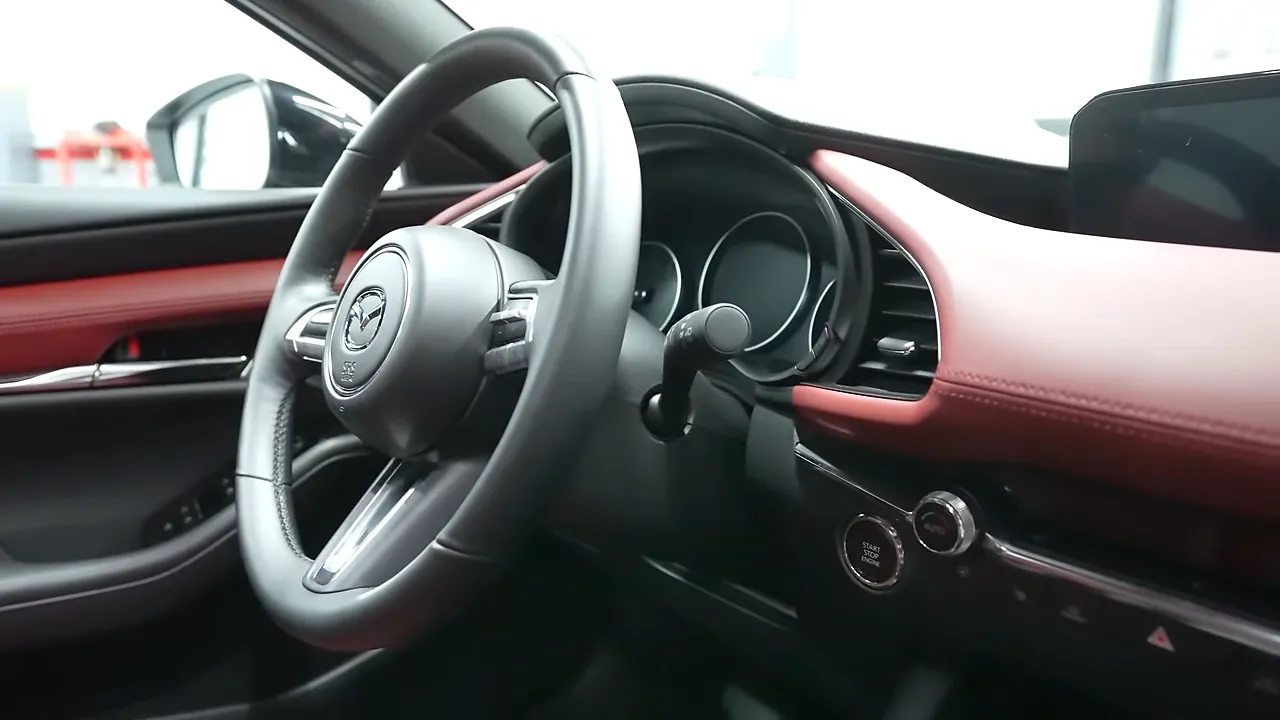
Even the Bose speaker grille has a metal finish that looks more expensive than necessary. The small switches, toggles, rotary controls, and steering-wheel buttons all have a reassuring feel. These are the details you touch every day, and Mazda has paid attention to them.
The conventional mechanical gear selector is another welcome feature. No collection of transmission buttons, no unnecessary reinvention. Just a proper shifter that feels right.
The steering wheel’s slim spokes make it comfortable to hold. Storage is reasonable, and the glove compartment is a useful size rather than a token opening in the dashboard.
Infotainment: Good hardware feel, imperfect interaction
The infotainment system works well. It is responsive, and I did not find it slow or glitchy. But the system in this 2023 example does not have touchscreen operation.
You control it through the center-console rotary dial and associated buttons. The dial itself feels excellent, as does the nearby volume knob.
The limitation becomes more obvious with Apple CarPlay. This car has wired CarPlay, not wireless, and the interface does not feel especially natural when operated entirely through a rotary controller.
I can live with it because the system functions properly and the controls suit the interior’s character. But it is worth trying before buying, especially if touchscreen operation is important to you.
Proper climate controls, with a few omissions
The climate controls are physical and easy to access. You do not need to work through screen menus to make basic adjustments.
This example includes:
- Dual-zone automatic climate control.
- Heated front seats.
- A heated steering wheel.
- A Bose audio system.
There are no ventilated seats. The center vents also sit somewhat low, but that placement preserves the clean dashboard design. Given how well the dashboard looks, I understand the decision.
The closest small vehicle that comes to mind for this kind of cabin impression is the Lexus UX. Yet this Mazda feels quicker and sharper to drive. That is substantial praise for a compact hatchback.
Rear Seats and Cargo: The Small-Car Reality Returns
The premium materials continue into the rear, but the space does not suddenly become generous.
I am 5 feet 7 inches tall. Sitting behind my own driving position, I find the rear seat tight. It is usable, but it is not where I would choose to spend a long journey. Someone younger, more flexible, or smaller may be perfectly happy, particularly for shorter trips.
There are no rear air vents and very little in the way of additional rear-seat amenities. It remains a nicely finished space, but it is still the back seat of a small hatchback.
For my seating position, I still prefer it to the CX-30, but that does not make it a spacious family vehicle.
A useful hatch and an actual spare tire
The cargo area is somewhat narrow, but it is reasonably deep and sits low to the ground. There is a removable cargo cover, which lets you conceal belongings or take it out when you need the opening clear.
Under the floor is something I am always happy to find: a spare tire. It is a temporary spare rather than a full-size wheel, but I would much rather have that than no spare at all.
There is substantial insulation around the underfloor area, and the Bose subwoofer sits within the spare-wheel cavity.
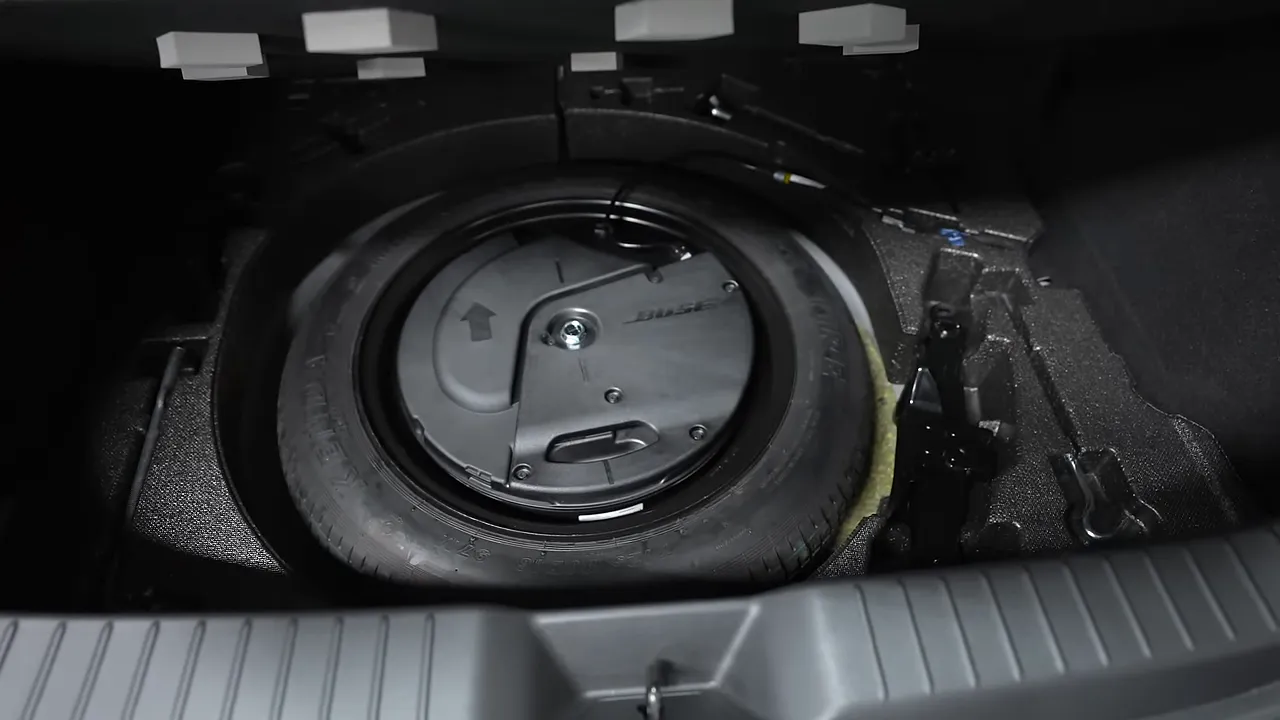
The hatch itself is manual, with no power operation on this fully loaded example. I do not consider that a problem because the door is light.
A more useful little detail is the lock button at the hatch. After loading your belongings, you can lock the car there, close the hatch, and leave without walking back to a front handle or reaching for the key. Small details like that make a difference in everyday use.
Driving Experience: Quick, Refined, and Occasionally Firm
The turbo Mazda 3 is very quick, but speed is not its only attraction. It also feels polished and unusually quiet for this class.
That needs a little qualification. Tire noise is noticeable, and the large wheel-and-tire package can make the ride bumpy and harsh over rough surfaces. This is still a small car, and it cannot absorb every road imperfection like something larger and softer.
Nevertheless, the overall impression is refined. The cabin insulation, smooth powertrain, excellent materials, and good handling work together. The Bose stereo is enjoyable, even if it is not the most impressive Bose installation available.
This is a satisfying everyday driver’s car without becoming an extreme sports car. It is fast enough to feel special, composed enough to enjoy on a good road, and civilized enough to use normally.
For someone starting a career and buying a first new car, the combination sounds nearly perfect: attractive, compact, enjoyable, and beautifully finished. For a family needing generous rear-seat space, it is much harder to recommend.
Unfortunately, the price puts a large obstacle in front of that first buyer.
The Deal Breaker: About $37,000 for the Loaded Turbo
The fully loaded turbocharged, all-wheel-drive example reviewed here carried a price of approximately $37,000.
Folks, that is where I struggle.
I like the styling. I like the way it drives. I like the cabin enough to forgive the lack of a touchscreen. But $37,000 changes the conversation from “What a wonderful small car” to “What else could I buy with this money?”
That is not a small distinction. Buyers often choose compact hatchbacks because they want something manageable in a city, something affordable early in their working lives, or simply something that does not demand a larger-car budget.
This Mazda delivers the compact size, but the loaded turbo’s price moves it into a much broader shopping list.
At this price, compare beyond compact hatchbacks
My first alternative would be another Mazda: the CX-5. At a similar budget in the context of this review, a well-equipped CX-5 offered a very nice cabin, good road manners, and more practical space.
If you want a small car and do not need this particular combination of turbo power and premium equipment, the Honda Civic and Toyota Corolla also deserve consideration.
Then there are larger sedans such as the Toyota Camry and Honda Accord, as well as the Lexus UX as a premium small-vehicle comparison. These are not all direct equipment-for-equipment substitutes. That is precisely the point: at this budget, the alternatives extend well beyond the Mazda 3’s own segment.
Nor is this a special Mazdaspeed model. It has the pace to feel like a hot hatch to me, but it is fundamentally the regular Mazda 3 in its most expensive, best-equipped form.
Does a cheaper Mazda 3 make more sense?
The entry price cited for the Mazda 3 lineup was around $23,000. A lower-priced version makes much more financial sense to me.
The tradeoff is equipment. You do not get the same rich leather interior and full collection of upscale touches that make this loaded example so impressive.
That creates an uncomfortable choice. The more affordable car is easier to justify, but it gives up some of the things that made me fall for this one. The loaded car delivers the full experience, but its price asks too much in my opinion.
Verdict: An Excellent Car With a Difficult Value Proposition
I genuinely like the 2023 Mazda 3 turbo hatchback. It is close to being a car I love. It looks right, drives beautifully, has a smooth and powerful drivetrain, and delivers an interior that exceeds normal expectations for a small hatchback.
Mechanically, I appreciate the familiar engine family and conventional automatic. There are serviceability compromises, tight engine packaging, and maintenance considerations, but the overall design does not leave me with a giant list of objections.
The biggest problem is not the torsion-beam suspension, the rotary infotainment controller, or the manual hatch. It is the price required to get this particular combination of power and luxury.
My recommendation is to consider the lower-priced Mazda 3 models, but explore the alternatives carefully before spending around $37,000 on the loaded turbo. At that level, I would personally look hard at a well-equipped CX-5 and the wider field of cars that budget opens up.
The Mazda 3 proves that a small hatchback can feel special. I just wish getting the best version of it did not require such a large check.


