The 2023 Honda CR-V Hybrid gets something right that a lot of modern cars miss: it makes everyday driving easy. It is quiet, comfortable, spacious, and reassuringly solid. You do not need exotic materials or a dashboard that looks like a spaceship to make a good interior, and Honda understands that.
But a nice cabin only tells part of the story. As a mechanic, I want to know what is under the hood, how difficult it will be to service, and which design choices might become expensive as the vehicle ages.
This review focuses on the 2023 CR-V Hybrid Sport Touring with all-wheel drive, not the non-hybrid model with Honda’s 1.5-liter turbo engine. There is a lot to like here, along with a few mechanical compromises and one significant cargo-space tradeoff.
Quick Summary
- The CR-V Hybrid combines a quiet, spacious cabin with straightforward controls and reassuring build quality.
- Its naturally aspirated engine has thoughtful service access and eliminates several conventional maintenance components.
- Honda’s clutch-equipped hybrid transmission and mechanical all-wheel drive add complexity despite their smooth operation.
- The hybrid battery eliminates conventional underfloor cargo storage and the spare tire.
Table of Contents
- Under the Hood: A Very Honda Approach to Engineering
- The Hybrid eCVT: Do Not Judge It by the Name
- Hybrid Hardware That Removes Maintenance Items
- Underneath the CR-V: Good Construction, Some Odd Choices
- Exterior Design: Recognizably CR-V, Just Much Larger
- Cargo Space: A Big Opening With an Important Compromise
- The Interior Is What Will Win People Over
- Three Features You Might Not Know About
- What I Would Change
- Should You Buy a 2023 Honda CR-V Hybrid?
Under the Hood: A Very Honda Approach to Engineering
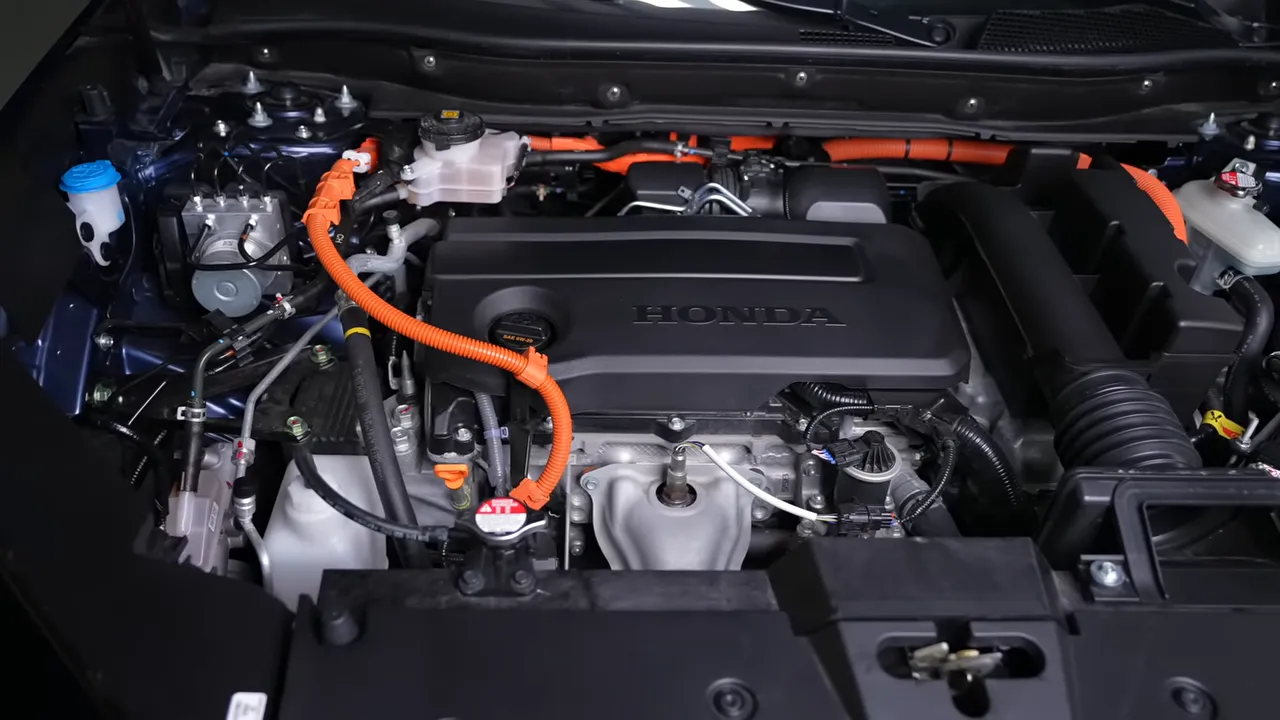
The hybrid uses a 2.0-liter, naturally aspirated, direct-injected four-cylinder engine. No turbocharger. That is a welcome starting point for someone thinking about long-term ownership.
The engine combines some modern technology with some very traditional Honda thinking. It has dual overhead camshafts and a single-piece cylinder head rather than the split cylinder-head construction used by some other manufacturers. Overall, the mechanical layout looks thoughtfully made and reasonably accessible.
Electric Intake Cam Timing, Hydraulic Exhaust Cam Timing
On the intake side, Honda uses an electric motor to adjust camshaft timing. Instead of relying on oil pressure to move the timing mechanism, the motor changes its speed relative to the camshaft to advance or retard timing.
That sounds complicated, but I like this approach. The external motor is accessible, and the adjustment does not depend on an oil-controlled actuator in the same way a conventional hydraulic system does. This type of design is also used by several other manufacturers.
The exhaust side retains hydraulic timing control, along with Honda’s VTEC arrangement. Interestingly, Honda uses a more traditional oil-control-valve location on the side of the cylinder head, with internal oil passages feeding the mechanism. It is an interesting mix of newer and older engineering.
Direct Injection Is Still a Long-Term Consideration
This engine uses multistage direct injection, but it does not combine direct injection with port injection. Honda’s injection strategy is intended to help manage combustion and deposits, but intake-valve carbon buildup remains a concern with a direct-injection-only design.
That is not a reason to dismiss the engine. It is simply something to keep in perspective when comparing it with engines that use both injection systems.
The exhaust manifold is integrated into the cylinder head, something Honda has considerable experience with. Instead of a separate manifold taking up space, the exhaust pipe connects to the integrated outlet. It makes the front of the engine less crowded.
Good Access Where It Matters
The EGR valve brings back memories of older Hondas with clogged EGR passages. A familiar shape does not prove this engine will have the same problems, but it certainly catches my attention.
What I do like is the placement. The valve is at the front, with its cooler underneath and visible connecting pipes. If service becomes necessary, it is not buried behind the engine.
The plastic valve cover also feels well made. I know many people dislike plastic engine components on principle, but looking at the construction here, I do not see an immediate reason for concern.
More importantly, Honda gives the high-pressure fuel pump its own mounting housing. On many direct-injected engines, removing the valve cover means disturbing the pump and fuel lines. Here, the valve cover can come off without turning that job into a fuel-system disassembly. That is the kind of detail a mechanic appreciates.
A Refreshingly Straightforward Cooling System
Hybrid cooling systems can become very busy, with multiple valves and complicated plumbing. The engine side of this Honda is relatively simple:
- A conventional thermostat controls temperature.
- An electric water pump circulates coolant.
- Coolant also serves the heater core and EGR cooler.
There is not a collection of additional control valves complicating the engine circuit. Simple does not automatically mean trouble-free, but it generally makes diagnosis and service easier.
The Hybrid eCVT: Do Not Judge It by the Name
Hear “eCVT,” and you might assume this is either a belt-type CVT or a copy of Toyota’s hybrid transaxle. It is neither.
Honda uses two electric motors with different primary jobs. One is connected to the engine and handles starting and generation. The larger traction motor drives the vehicle and can recover energy during deceleration.
For a general explanation of energy recovery and hybrid operation, the U.S. Department of Energy’s hybrid-electric vehicle guide is useful. The important point here is that Honda has its own way of connecting those components.
How Honda Routes Power
Rather than using Toyota’s planetary power-split arrangement, this Honda system uses gears, shafts, and low- and high-speed engine-drive clutch arrangements. These are multiplate clutches operated through hydraulic controls, with solenoids and a small valve body.
One operating mode allows the traction motor to propel the vehicle while the gasoline engine runs the generator. In that situation, the engine does not need to drive the wheels mechanically.
I would be careful about oversimplifying every possible power-flow combination. I could not independently verify one technical interpretation suggesting that the engine and traction motor could not drive the vehicle together, so I would not use that as an established disadvantage. The useful distinction is the hardware: Honda’s eCVT has clutch and hydraulic-control components that Toyota’s familiar power-split layout does not use in the same way.
How It Feels on the Road
For the most part, this transmission works beautifully. It is smooth and seamless, and its shift-like behavior feels more like a very refined automatic than a conventional CVT.
Some of the perceived shifts are simulated. Others relate to actual changes in the engine-drive clutch arrangements. The result is convincing enough that the typical CVT sensation is much less prominent.
There can be an occasional pause during acceleration. I noticed moments where the system seemed to take a second or two to engage the appropriate drive arrangement before the vehicle responded more strongly. It is not the dominant characteristic, but it is noticeable.
The Tradeoff Is Mechanical Complexity
The downside is not how it drives. The downside is how much hardware is involved.
There are clutch friction elements, solenoids, a valve body, and hydraulic circuits. The transmission fluid is doing more than lubricating and cooling components; it also participates in hydraulic operation.
That makes proper fluid maintenance important. I like the way this system operates, but from a long-term mechanical-simplicity standpoint, I still prefer Toyota’s familiar hybrid arrangement.
Hybrid Hardware That Removes Maintenance Items
The power control unit, or PCU, sits under the hood and manages important electrical functions. It is compact and liquid-cooled, with a separate cooling circuit that has its own radiator, electric pump, and reservoir.
The useful service detail is that it uses the same coolant type as the engine. The circuits are separate, but there is not a different specialty coolant to complicate the situation.
The PCU also incorporates a DC-to-DC converter. This reduces high-voltage battery power to roughly 14 volts to support the vehicle’s low-voltage electrical system and charge its 12-volt battery.
Now count what Honda has eliminated:
- No accessory drive belt: the water pump and air-conditioning compressor are electric.
- No conventional alternator: the DC-to-DC converter handles the low-voltage charging function.
- No conventional starter: an electric motor starts the gasoline engine.
I call this negative maintenance. These are familiar components you simply do not have to replace because the car does not have them. Of course, that does not make the entire hybrid system maintenance-free, but it is a genuine benefit.
Underneath the CR-V: Good Construction, Some Odd Choices
The front underside is largely covered, with several openings around components that need clearance or airflow. Looking past those covers reveals a mixture of sensible service choices and details I would have done differently.
The Oil Pan, Exhaust, and Steering Motor
Honda continues to use an aluminum oil pan. My objection is practical: an overtightened drain plug can damage the threads in the pan. This is not a prediction that every pan will fail. It is a reminder that careless oil-change work can turn a routine service into an expensive repair.
The exhaust also has a flex section. These are useful for accommodating movement, but they can become leak points as a vehicle ages.
Farther back, the electric power-steering motor is substantial and sits close to the exhaust. Honda provides a heat shield, although the coverage around the motor’s metal and plastic portions looks a little uneven to me. It is an observation about the packaging, not evidence of an existing failure.
Front Suspension and Brakes
The front brakes use dual-piston calipers. That is generous hardware for a hybrid that can recover some braking energy electrically, and I am certainly not going to complain about it.
Other useful details include aluminum sway-bar links and a ball joint that is separate from the steel lower control arm. That separate ball joint is a welcome serviceability choice.
The material selection is less consistent. There is a steel steering knuckle, an aluminum tie rod, an aluminum section around the control-arm bushing mount, and a subframe that combines steel and aluminum sections. It almost feels as though different teams had different weight-saving priorities.
Mechanical All-Wheel Drive Adds Hardware
The all-wheel-drive hybrid has a transfer unit, a driveshaft, and a rear differential with a coupler. In other words, Honda still sends power mechanically to the rear wheels.
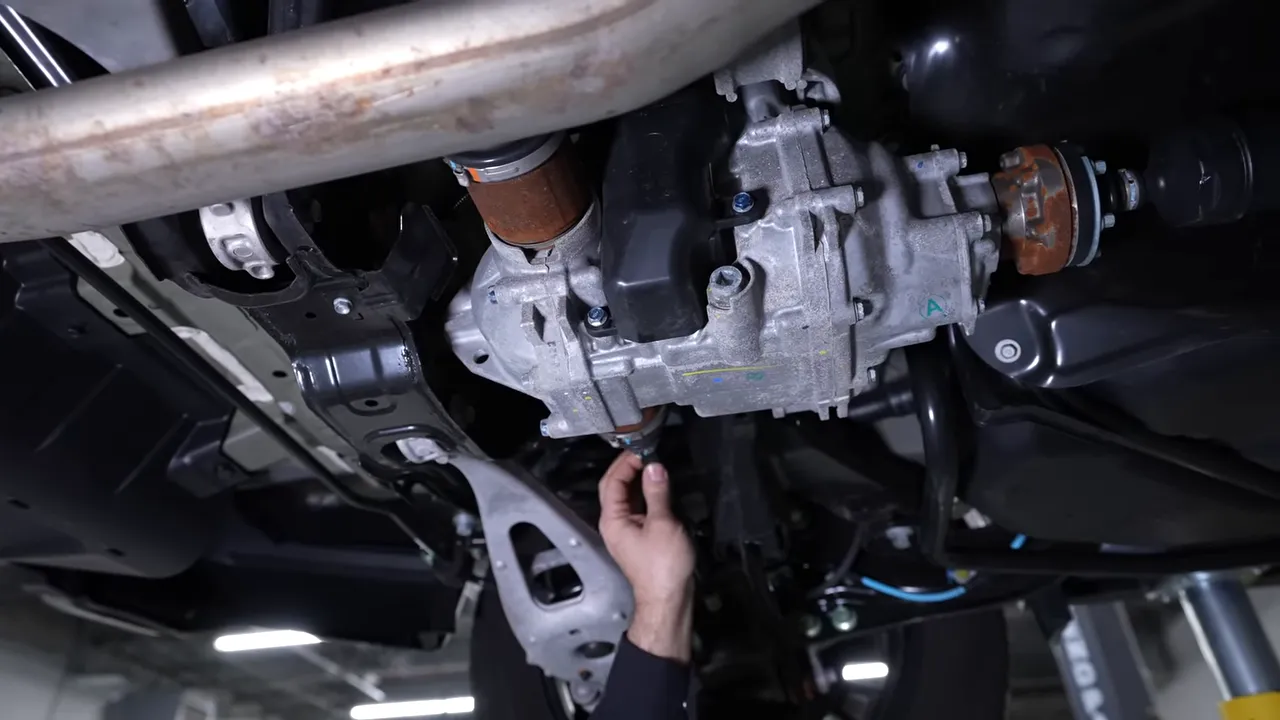
Compared with a hybrid that uses a dedicated rear electric motor, this means more mechanical parts and wear points. It also does not provide regenerative braking through a rear traction motor, because there is no rear traction motor.
The rear coupler is fairly large, while the differential and axle shafts are small. That fits the CR-V’s mission. This is a comfortable commuter with extra traction for conditions such as snow, not a dedicated off-road vehicle.
Rear Suspension, Body Seams, and Protection
At the rear, Honda uses considerably more aluminum, including the lower control arms, knuckles, and sway-bar links. Those are substantial lightweight components, and they stand in contrast to some of the heavier steel pieces at the front.
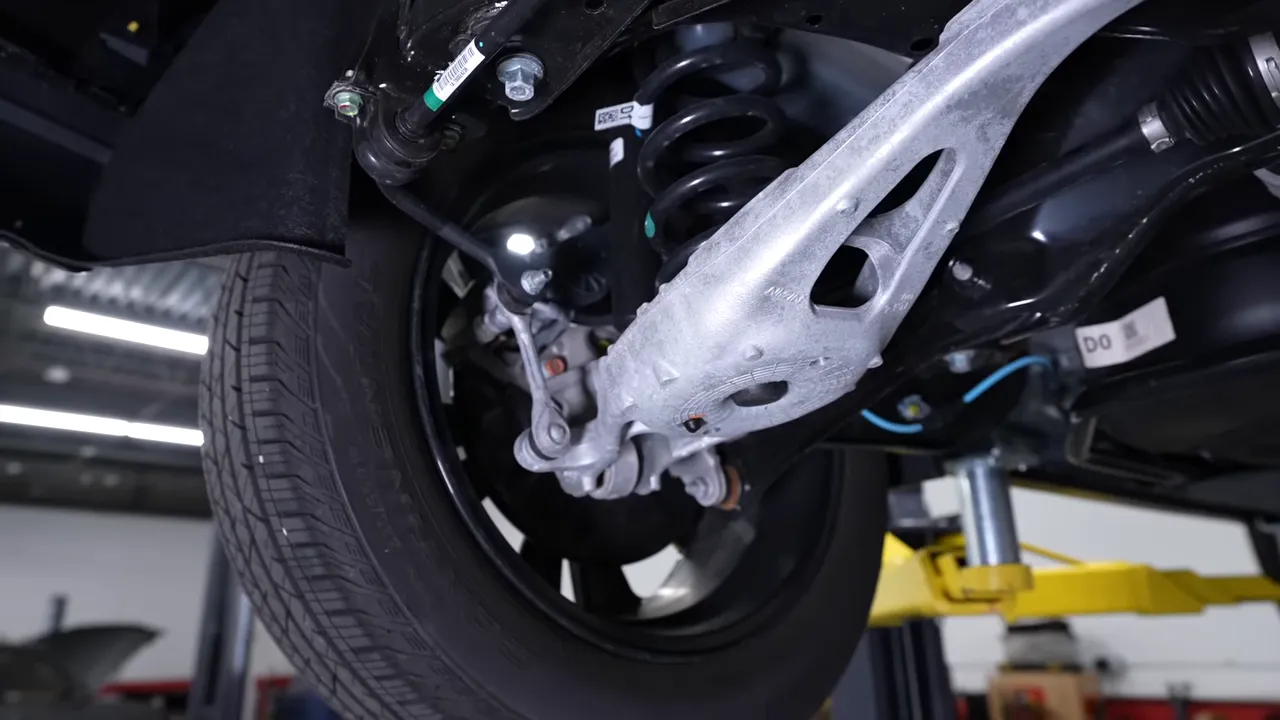
The rear brakes have integrated electronic parking-brake actuators. I prefer this arrangement to older Honda systems with external levers and cables that could seize.
Underbody protection is mixed. There are covers in some areas and exposed floor sections in others. The seam-sealer application generally looks decent, but some open seams would concern me in a road-salt environment. That is a potential long-term corrosion concern, not a claim that a new CR-V is already rusting.
There are also several structural braces and Honda’s familiar protective bar beside one side of the fuel tank. The exhaust routing is straightforward because the hybrid battery is not hanging down into its path. The cost of that battery placement shows up elsewhere, however.
One final detail: the two exhaust-style outlets in the rear bumper do not represent two matching mufflers underneath. This hybrid has a single muffler, with an empty area on the opposite side. The styling tells a slightly different story from the hardware.
Exterior Design: Recognizably CR-V, Just Much Larger
The CR-V has grown considerably from the small SUV it once was. It has the visual presence of a much bigger vehicle, and that extra size becomes useful inside.
I like Honda’s newer front-end design. It is assertive without being overdone, with slim headlights and an LED strip across their upper edge. The large Honda emblem houses the radar sensor behind it.
There are a few less successful details. The openings that resemble fog-light locations do not contain fog lights, and the extensive black lower bumper treatment can look a little basic for a top-trim Sport Touring.
The layered piano-black grille looks attractive, but anyone who has cleaned one of these intricate grilles knows the other side of that decision. Looking good and being easy to keep clean are not always the same thing.
Interesting Body Lines and Some Awkward Additions
The hood has a subtle stepped contour that changes direction near the headlight. Along the side, an indented character line runs through the body and meets an unusually shaped mirror base. These are small details, but they give the CR-V its own identity instead of following every current styling trend.
I am less enthusiastic about the unpainted wheel-arch cladding. The large amber side marker and the small wheel-arch extensions also look somewhat added on. Those extensions serve a compliance purpose related to wheel coverage, but they are not the most elegant part of the design.
The door handles feel substantial without looking excessive, and the doors close with a satisfying sense of quality. The fuel door opens with a push and locks with the vehicle. Behind it is Honda’s capless filler neck, which works well enough even if I question whether eliminating a simple fuel cap was necessary.
The Rear Is the Best Part
Honda has kept the CR-V’s recognizable tall taillights and modernized them successfully. The side character line continues visually through the lamp and across the tailgate, tying the design together.
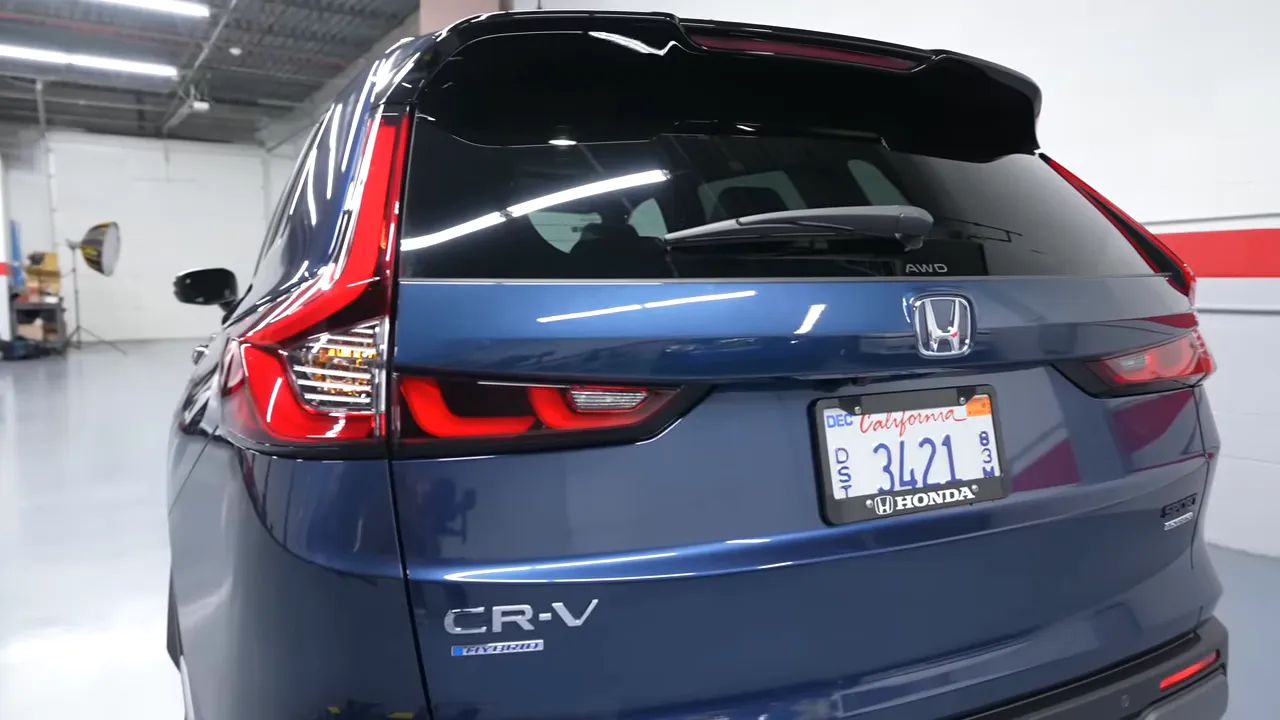
There is no full-width light bar, and I like that. The rear remains recognizably CR-V rather than looking like every other new SUV.
Hybrid identification is restrained. There is a small hybrid badge rather than brightly colored emblems everywhere. The exposed rear wiper is not particularly fashionable, but it is easy to access for service. That is a tradeoff I can live with.
Cargo Space: A Big Opening With an Important Compromise
The power liftgate opens to a generous cargo area. The fairly upright rear shape helps preserve usable space, and Honda has carved out little pockets around the wheel housings instead of covering everything with flat trim and wasting the space behind it.
But there is an important distinction between the main cargo area and storage underneath it:
The hybrid battery occupies the underfloor area, leaving no conventional underfloor storage compartment and no spare tire.
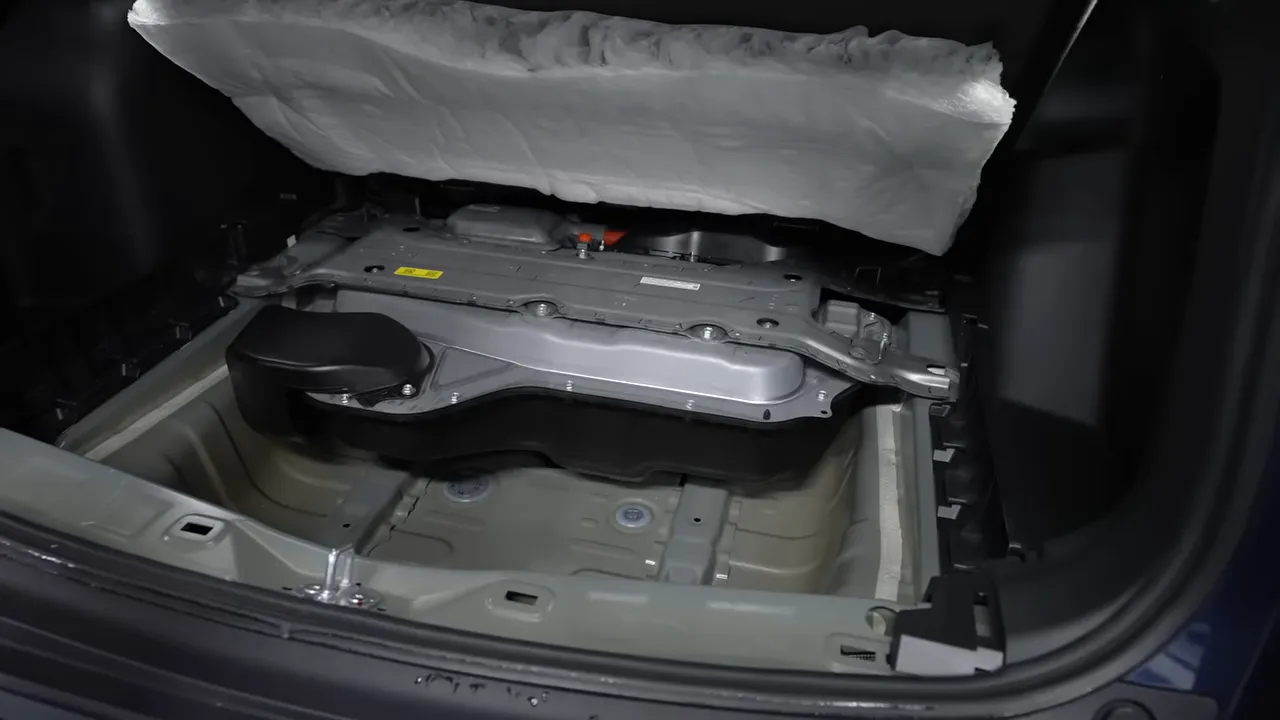
The floor covering looks as though it should lift to reveal a storage well. It does not. On the review vehicle, the covering was already loose and coming apart, apparently after being pulled up. I cannot say that represents normal durability, but the design invites the wrong assumption. Do not force it open expecting a spare-tire compartment.
This is my biggest practical complaint. The main cargo space is still generous, but losing the hidden storage and spare tire is a real ownership compromise.
The powered liftgate uses motorized support struts. They work well, but replacement can be expensive, and a failed unit can make the door difficult to move manually. The exposed washer hose and separate wiring routes near the top of the opening also look busier than necessary. Neither ruins the cargo area, but both are worth noticing.
The Interior Is What Will Win People Over
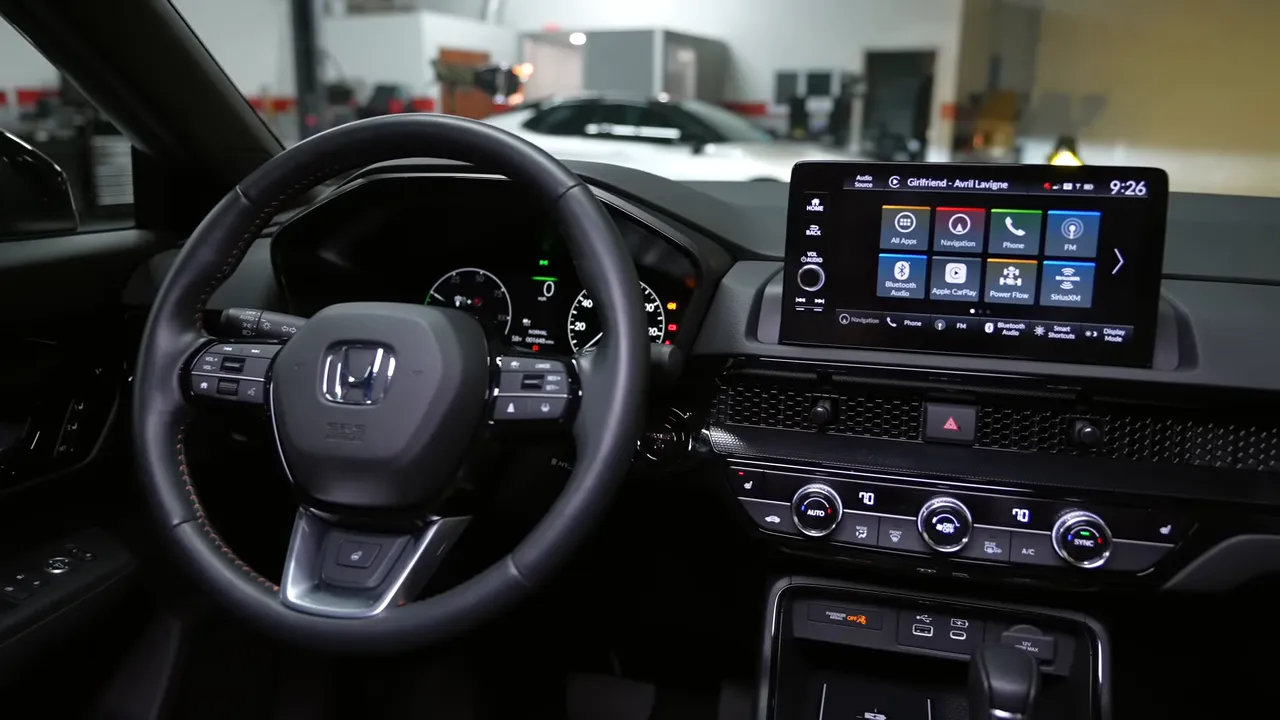
Modern Honda interiors are doing very well, and this one is a good example. Everything feels solid, the cabin is quiet, and the controls make sense almost immediately.
The dashboard’s mesh-style trim integrates the air vents into one continuous horizontal line. Small adjustment knobs operate the vents without breaking up the design. It is simple, attractive, and functional.
Physical Controls Done Properly
Honda has not made basic functions unnecessarily difficult:
- Climate controls: physical buttons and knobs, with a satisfying feel.
- Gear selector: a conventional physical, cable-operated shifter.
- Drive modes: a simple switch beside the shifter.
- Parking brake and brake hold: dedicated controls within easy reach.
- Audio volume: a proper rotary knob.
The brake-hold function is particularly convenient because it remembers the enabled setting after restarting the vehicle. You do not have to turn it back on every trip.
There are plenty of ordinary plastics and conventional trim materials. This is not a cabin built around exotic leather and suede. The quality comes from how everything fits together and how the controls operate. That matters more to me than an impressive materials list.
A Few Control Decisions Are Less Convincing
The infotainment screen is relatively small for a vehicle at this trim level, although I do not need a giant tablet in the middle of the dashboard.
My bigger complaint is the physical Back button. Moving through touchscreen menus and then reaching off the display to go back feels clumsy. An on-screen back arrow would make the interaction more consistent.
The track controls on the display are also positioned toward the driver, who already has steering-wheel controls. Putting them closer to the passenger would have been more useful.
The heated steering-wheel button sits prominently near the middle of the wheel. It is an unusual location, though not a serious problem. The instrument cluster combines a digital section with a physical gauge rather than turning the whole panel into a screen, and the result looks clean and sophisticated.
The overall achievement is that you can sit in this unfamiliar vehicle and understand the important functions within a couple of minutes. A daily driver should not make you study before you can use it.
The Back Seat Benefits From the Bigger Body
Rear passenger space is a major highlight. With the front passenger seat in my normal position, there is generous knee room and headroom behind it. For reference, I am 5 feet 7 inches tall.
The center floor hump is also surprisingly low for a vehicle with a mechanical all-wheel-drive system. Add rear air vents, and this becomes a genuinely comfortable place for adults to spend time.
That is where the CR-V’s growth pays off. It is not just larger on the outside; the cabin makes useful room out of that size.
Three Features You Might Not Know About
1. Sport Touring Wheels Have Internal Noise Reduction
The Sport Touring wheels contain internal noise-reducing components intended to reduce tire noise. I suspect they contribute to the cabin’s impressive quietness.
Normal tire replacement does not require a special procedure simply because these components are present. However, if the internal noise-reducing pieces break, they are not separately serviceable in the arrangement examined here. Replacing the wheel can become necessary.
2. There Is an Alternate Starting Procedure
With a recognized key present, holding the start button for approximately 15 seconds can start the vehicle without pressing the brake pedal.
That is an unusual backup function, not a replacement for the normal starting procedure. For operating conditions and precautions, consult the vehicle’s owner’s manual.
3. It Has an Automatic Shutoff Function
Under the conditions described for this vehicle, it can shut itself off after approximately 20 minutes when all doors are closed and the driver’s seat belt is unbuckled.
The concern this addresses is easy to understand. A hybrid can be ready to drive while its gasoline engine is silent. Someone could mistakenly leave it on, walk away, and have the engine start later to maintain battery charge.
This feature is helpful, but it is not a substitute for shutting the vehicle off yourself, especially in an enclosed garage.
What I Would Change
My complaints are relatively minor because I genuinely like this CR-V. The most important ones are:
- Hybrid battery packaging: losing underfloor storage and a spare tire is the biggest everyday compromise.
- Infotainment operation: the screen is modest in size, and the separate physical Back button interrupts touchscreen navigation.
- Automatic parking-brake behavior: in the operation observed here, it engaged after selecting Park and shutting the vehicle off, rather than immediately upon selecting Park.
That last detail is frustrating because Honda did such a nice job making brake hold remember its setting. I would prefer the parking brake to engage automatically as soon as Park is selected. The manual parking-brake switch remains available, of course.
Mechanically, I would also prefer fewer clutch and hydraulic-control components in the hybrid transmission and an electric rear-drive arrangement instead of a driveshaft and rear coupler. Those are design preferences for long-term simplicity, not reasons to label the CR-V unreliable.
Should You Buy a 2023 Honda CR-V Hybrid?
Yes, it deserves a place near the top of the list if you want a refined, spacious, easy-to-use hybrid SUV.
It drives smoothly, feels comfortable, and has a cabin that gets the fundamentals right. The door feel, control operation, fit, and general quietness create a sense of quality without relying on flashy materials.
From a mechanic’s perspective, there are encouraging details throughout: a naturally aspirated engine, accessible service components, straightforward engine cooling, thoughtful fuel-pump placement, and no conventional starter, alternator, or accessory belt.
I expect good long-term reliability based on the construction and engineering I can inspect. But that is an assessment, not a guarantee or an established long-term record for a newly introduced generation.
I still give Toyota’s familiar hybrid system an advantage in mechanical simplicity and, in my opinion, long-term reliability potential. That does not make the Honda a poor choice. We are comparing two strong approaches, not a good vehicle with a bad one.
The CR-V Hybrid is not the most exciting SUV in the world. It is something more useful for many people: a vehicle that feels well made, makes you comfortable, and does not complicate your day. If you can accept the missing spare tire and underfloor storage, Honda has done a very good job here.


